


PdII -Catalyzed Enantioselective C(sp3 )-H Arylation of Cyclobutyl Ketones Using a Chiral Transient Directing Group
- PMID: 32155313
- PMCID: PMC7269848
- DOI: 10.1002/anie.202000532
PdII -Catalyzed Enantioselective C(sp3 )-H Arylation of Cyclobutyl Ketones Using a Chiral Transient Directing Group
Abstract
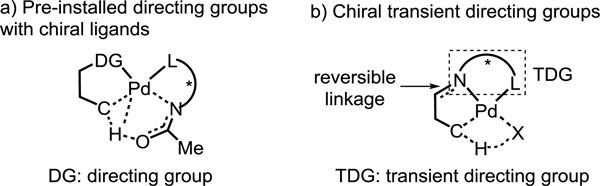
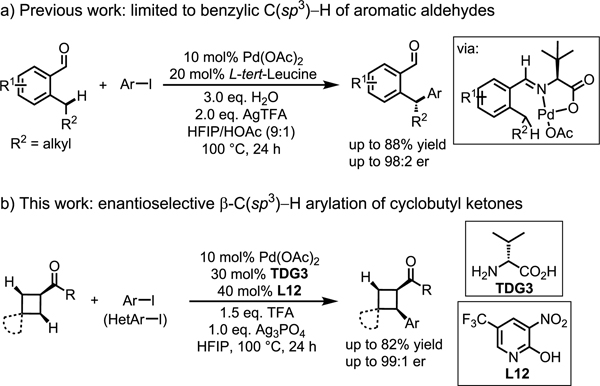
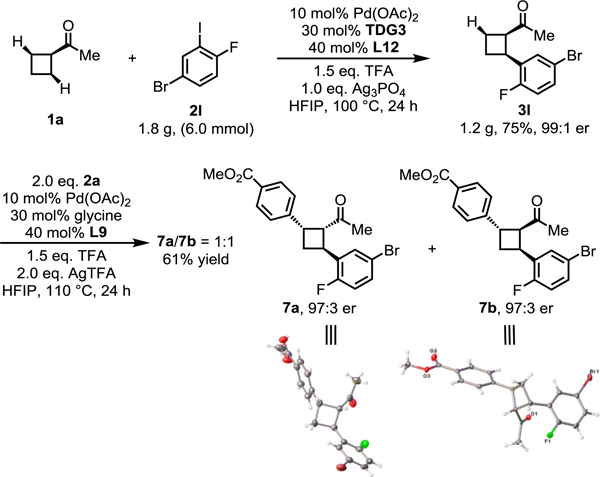
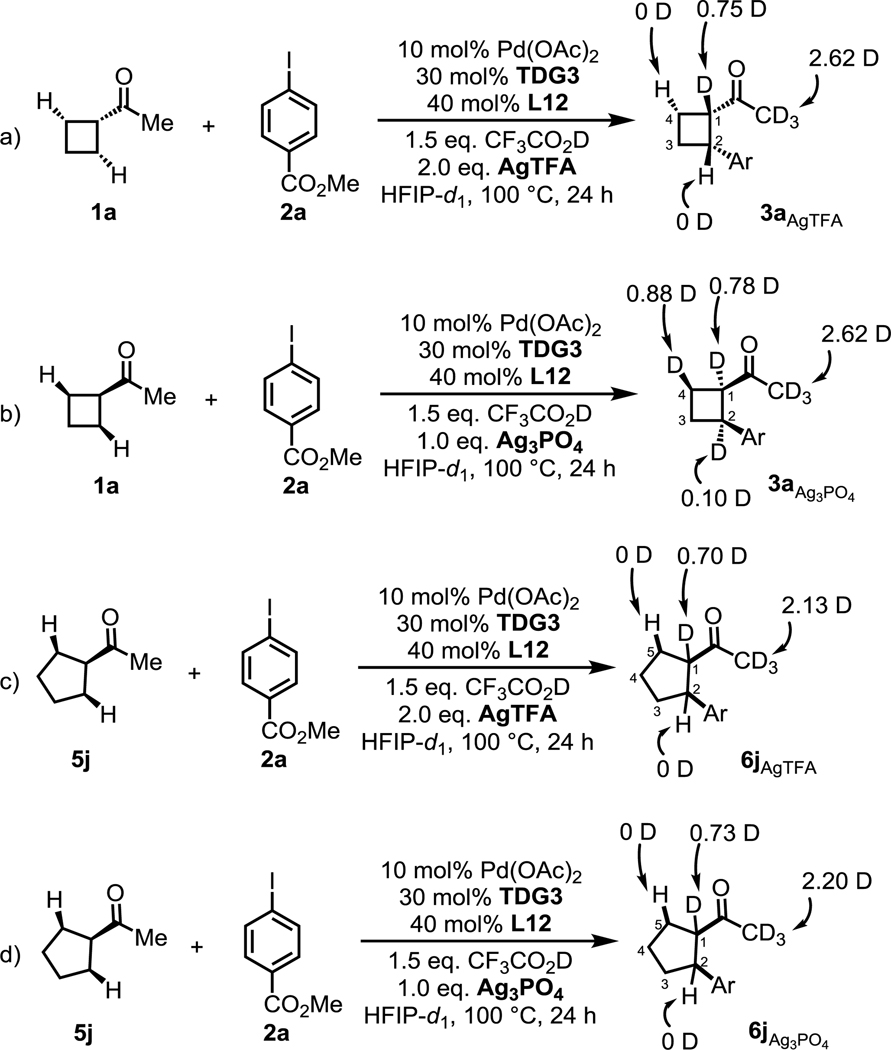
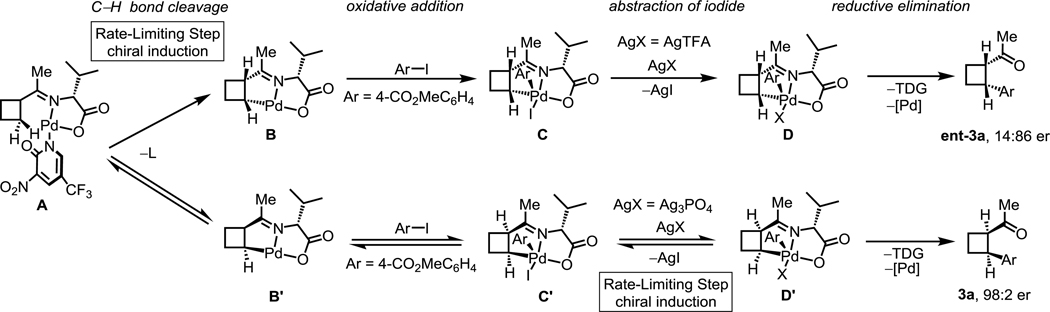
The use of chiral transient directing groups (TDGs) is a promising approach for developing PdII -catalyzed enantioselective C(sp3 )-H activation reactions. However, this strategy is challenging because the stereogenic center on the TDG is often far from the C-H bond, and both TDG covalently attached to the substrate and free TDG are capable of coordinating to PdII centers, which can result in a mixture of reactive complexes. We report a PdII -catalyzed enantioselective β-C(sp3 )-H arylation reaction of aliphatic ketones using a chiral TDG. A chiral trisubstituted cyclobutane was efficiently synthesized from a mono-substituted cyclobutane through sequential C-H arylation reactions, thus demonstrating the utility of this method for accessing structurally complex products from simple starting materials. The use of an electron-deficient pyridone ligand is crucial for the observed enantioselectivity. Interestingly, employing different silver salts can reverse the enantioselectivity.
Keywords: C−H activation; arylation; palladium; pyridone ligands; transient directing groups.
© 2020 Wiley-VCH Verlag GmbH & Co. KGaA, Weinheim.
Figures
References
-
- For selected reviews of enantioselective C−H functionalization, see: Giri R, Shi B-F, Engle KM, Maugel N, Yu J-Q, Chem. Soc. Rev 2009, 38, 3242. - PubMed
- Newton CG, Wang S-G, Oliveira CC, Cramer N, Chem. Rev 2017, 117, 8908. - PubMed
- Saint-Denis TG, Zhu R-Y, Chen G, Wu Q-F, Yu J-Q, Science 2018, 359, eaao4798. - PMC - PubMed
-
- Shi B-F, Maugel N, Zhang Y-H, Yu J-Q, Angew. Chem. Int. Ed 2008, 47, 4882; Angew. Chem. 2018, 120, 4960. - PubMed
- Wasa M, Engle KM, Lin DW, Yoo EJ, Yu J-Q, J. Am. Chem. Soc 2011, 133, 19598. - PMC - PubMed
- Xiao K-J, Lin DW, Miura M, Zhu R-Y, Gong W, Wasa M, Yu J-Q, J. Am. Chem. Soc 2014, 136, 8138. - PMC - PubMed
- Chan KSL, Fu H-Y, Yu J-Q, J. Am. Chem. Soc 2015, 137, 2042. - PMC - PubMed
- Hu L, Shen P-X, Shao Q, Hong K, Qiao JX, Yu J-Q, Angew. Chem. Int. Ed 2019, 11, 2134; Angew. Chem. 2019, 131, 2156. - PMC - PubMed
Publication types
MeSH terms
Substances
Grants and funding
LinkOut - more resources
Full Text Sources
