. 2020 Mar 10;10(1):4408.
doi: 10.1038/s41598-020-61318-2.

Gulls as Sources of Environmental Contamination by Colistin-resistant Bacteria

Affiliations

Gulls as Sources of Environmental Contamination by Colistin-resistant Bacteria

Alan B Franklin et al. Sci Rep. .

Abstract

In 2015, the mcr-1 gene was discovered in Escherichia coli in domestic swine in China that conferred resistance to colistin, an antibiotic of last resort used in treating multi-drug resistant bacterial infections in humans. Since then, mcr-1 was found in other human and animal populations, including wild gulls. Because gulls could disseminate the mcr-1 gene, we conducted an experiment to assess whether gulls are readily colonized with mcr-1 positive E. coli, their shedding patterns, transmission among conspecifics, and environmental deposition. Shedding of mcr-1 E. coli by small gull flocks followed a lognormal curve and gulls shed one strain >101 log10 CFU/g in their feces for 16.4 days, which persisted in the environment for 29.3 days. Because gulls are mobile and can shed antimicrobial-resistant bacteria for extended periods, gulls may facilitate transmission of mcr-1 positive E. coli to humans and livestock through fecal contamination of water, public areas and agricultural operations.


Conflict of interest statement

The authors have no competing interests. The findings and conclusions in this publication are those of the authors and should not be construed to represent any official U. S. Department of Agriculture or U.S. Government determination or policy, but do represent the views of the U. S. Geological Survey. This report was reviewed and approved by U.S. Geological Survey under the Fundamental Science Practices policy (http://www.usgs.gov/fsp/).

Figures

Figure 1
Figure 1
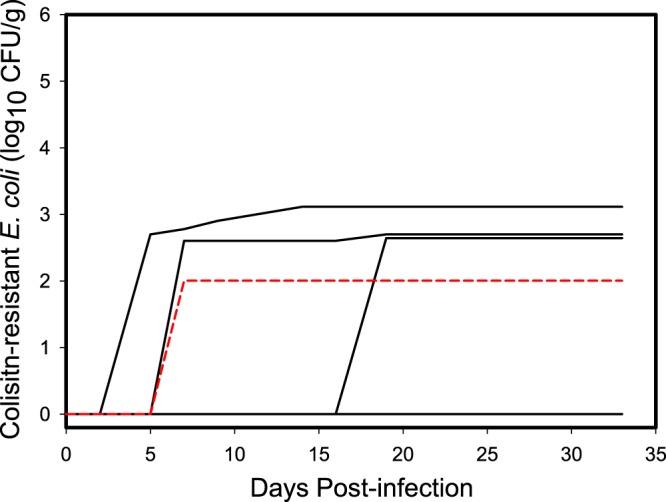
Cumulative shedding curves of E. coli strain M175 containing mcr-1 by individual ring-billed gulls. Half of the six inoculated individuals shed similar cumulative amounts in their feces while the M175 strain was not detected in the feces of the other half. Dashed red line is the curve of the contact control bird that became colonized with mcr-1 positive E. coli while housed with inoculated birds.
Figure 2
Figure 2
Fecal shedding of the M175 strain of mcr-1 positive E. coli by a flock of ring-billed gulls. Data points (red dots) represent total daily amounts shed by individuals (n = 6) in the flock. Solid line represents modeled trend from a 3-parameter lognormal model and the green shaded area represents 95% confidence intervals. Note that detection of the target bacteria was sporadic.
Figure 3
Figure 3
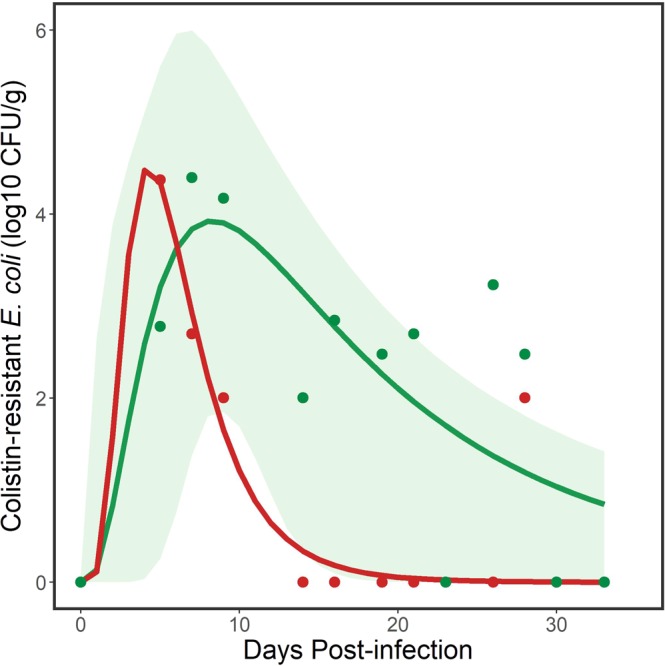
Environmental persistence of the M175 and POR1303 strains of mcr-1 positive E. coli shed by a flock of ring-billed gulls. Data points (green dots for M175 and red dots for POR1303) are samples collected from the floor of the experimental room. Solid lines (green line for M175, red line for POR1303) represent modeled trends from 3-parameter lognormal models. Green shaded area represents 95% confidence intervals for modeled line for M175. Note that detection of the target bacteria was less sporadic than from the flock data (see Fig. 2). There was uncertainty in some of the data points for POR1303 (e.g., DPI 9 and 28), which were only positive following enrichment (see Materials and Methods). For this reason, 95% confidence intervals were not estimated for the modeled line for POR1303.
Figure 4
Figure 4
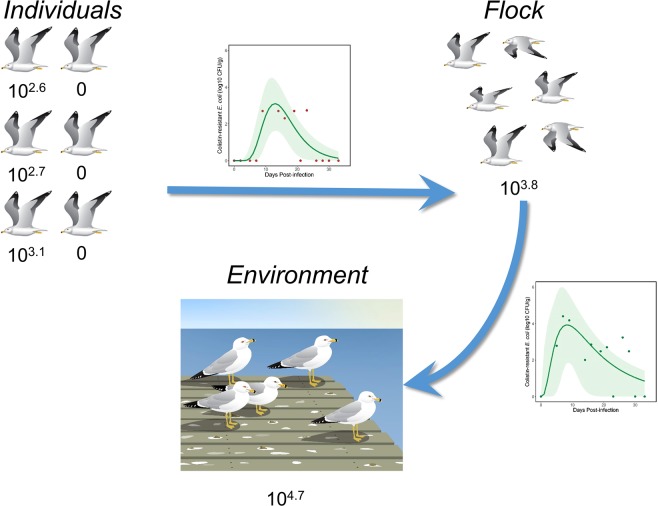
Differential estimates of deposition (in CFU/g) of strain M175 mcr-1 positive E. coli when assessed at different scales. Arrows represent progression from smaller (individuals) to larger scales (flocks and the environment). Estimates represent total accumulations within the flock and environment categories based on the area under the modeled growth curves (see Figs. 2 and 3). Individual estimates are shown for comparison but represent amounts measured every 2–3 days and do not accurately represent total amounts shed by individuals. Images were drawn by Vanessa Sorensen of Sorensen Designs.
Figure 5
Figure 5
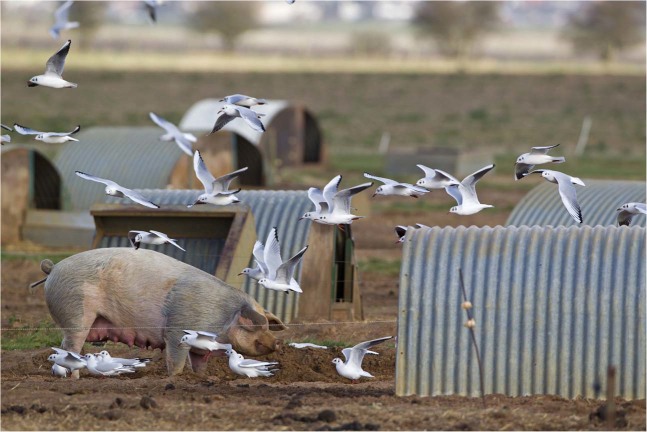
Example of gulls interacting with agricultural livestock operations. Photograph is of a flock of black-headed gulls (Larus ridibundus) feeding at an outdoor pig unit in January, Suffolk, England, which illustrates one mechanism by which mcr-1 positive E. coli could be disseminated between gulls and domestic animals consumed by the humans. Photograph is ©age footstock America Inc.

References

    1. Liu Y-Y, et al. Emergence of plasmid-mediated colistin resistance mechanism MCR-1 in animals and human beings in China: a microbiological and molecular biological study. Lancet Infec. Dis. 2016;16:161–168. doi: 10.1016/S1473-3099(15)00424-7. - DOI - PubMed
    1. Lim LM, et al. Resurgence of colistin: a review of resistance, toxicity, pharmacodynamics, and dosing. Pharmacotherapy. 2010;30:1279–1291. doi: 10.1592/phco.30.12.1279. - DOI - PMC - PubMed
    1. Du H, Chen L, Tang Y-W, Kreiswirth BN. Emergence of the mcr-1 colistin resistance gene in carbapenem-resistant Enterobacteriaceae. Lancet Infec. Dis. 2016;16:287–288. doi: 10.1016/S1473-3099(16)00056-6. - DOI - PubMed
    1. Gao R, et al. Dissemination and mechanism for the MCR-1 colistin resistance. PLOS Pathog. 2016;12:e1005957. doi: 10.1371/journal.ppat.1005957. - DOI - PMC - PubMed
    1. Wang R, et al. The global distribution and spread of the mobilized colistin resistance gene mcr-1. Nat. Commun. 2018;9:1179. doi: 10.1038/s41467-018-03205-z. - DOI - PMC - PubMed

Publication types

Substances