


Harnessing the immune system via FcγR function in immune therapy: a pathway to next-gen mAbs
- PMID: 32157732
- PMCID: PMC7228307
- DOI: 10.1111/imcb.12326
Harnessing the immune system via FcγR function in immune therapy: a pathway to next-gen mAbs
Abstract
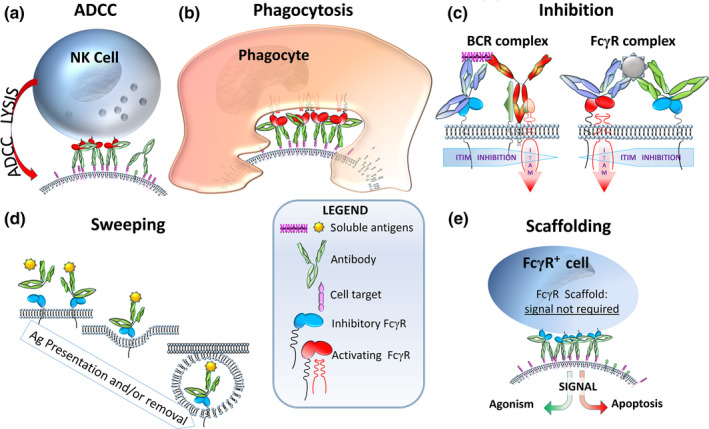
The human fragment crystallizable (Fc)γ receptor (R) interacts with antigen-complexed immunoglobulin (Ig)G ligands to both activate and modulate a powerful network of inflammatory host-protective effector functions that are key to the normal physiology of immune resistance to pathogens. More than 100 therapeutic monoclonal antibodies (mAbs) are approved or in late stage clinical trials, many of which harness the potent FcγR-mediated effector systems to varying degrees. This is most evident for antibodies targeting cancer cells inducing antibody-dependent killing or phagocytosis but is also true to some degree for the mAbs that neutralize or remove small macromolecules such as cytokines or other Igs. The use of mAb therapeutics has also revealed a "scaffolding" role for FcγR which, in different contexts, may either underpin the therapeutic mAb action such as immune agonism or trigger catastrophic adverse effects. The still unmet therapeutic need in many cancers, inflammatory diseases or emerging infections such as severe acute respiratory syndrome coronavirus 2 (SARS-CoV-2) requires increased effort on the development of improved and novel mAbs. A more mature appreciation of the immunobiology of individual FcγR function and the complexity of the relationships between FcγRs and antibodies is fueling efforts to develop more potent "next-gen" therapeutic antibodies. Such development strategies now include focused glycan or protein engineering of the Fc to increase affinity and/or tailor specificity for selective engagement of individual activating FcγRs or the inhibitory FcγRIIb or alternatively, for the ablation of FcγR interaction altogether. This review touches on recent aspects of FcγR and IgG immunobiology and its relationship with the present and future actions of therapeutic mAbs.
Keywords: ADCC; Fc receptors; SARS-CoV-2; immune therapy; monoclonal antibodies; phagocytosis.
© 2020 The Authors. Immunology & Cell Biology published by John Wiley & Sons Australia, Ltd on behalf of Australian and New Zealand Society for Immunology, Inc.
Conflict of interest statement
None.
Figures
References
Publication types
MeSH terms
Substances
Grants and funding
LinkOut - more resources
Full Text Sources
Other Literature Sources
Miscellaneous
