. 2020 Mar;72(1):104-111.
doi: 10.1007/s12070-019-01774-z. Epub 2019 Dec 5.

Rhino-Orbital-Cerebral Mucormycosis: Battle with the Deadly Enemy

Affiliations

Rhino-Orbital-Cerebral Mucormycosis: Battle with the Deadly Enemy

Saroj Gupta et al. Indian J Otolaryngol Head Neck Surg. 2020 Mar.

Abstract

To study the clinical presentation and management outcomes in a series of patients with invasive rhino-orbital-cerebral mucormycosis presenting to a tertiary care center in central India. Medical records of eleven consecutive cases of invasive rhino-orbital-cerebral mucormycosis were reviewed. All clinically diagnosed cases, confirmed on microbiological examination were included. Their demographic data, clinical manifestations, underlying systemic conditions, microbiological and radiological reports, medical treatments, and surgical interventions were recorded and analyzed. There were nine male and two female patients with mean age of 46.8 years. Uncontrolled diabetes mellitus was noted in all patients. One patient had history of renal transplantation. The common presenting features were-ophthalmoplegia (73%), diminution of vision, (64%) proptosis (36%) and periorbital swelling (27%). CT scan/MRI revealed sino-orbital involvement in eight cases and rhino-orbital-cerebral involvement in three cases. Ethmoid sinus (100%) was the commonest paranasal sinus involved. KOH preparation and histopathology revealed broad aseptate filamentous fungi branching at right angles with tissue invasion. Culture on sabouraud's dextrose agar showed growth of mucor species. All patients received intravenous amphotericin B and had undergone radical debridement of involved sinuses. The mean duration of follow up was 13 months. All survived except three, who developed cerebral mucormycosis. Rhino-orbital-cerebral mucormycosis is a fetal fungal infection requiring multidisciplinary approach. Uncontrolled diabetes mellitus is the main predisposing factor. Early diagnosis, reversal of predisposing co-morbidities, aggressive medical and surgical management are vital in managing this highly aggressive disease.

Keywords: Diabetes mellitus; Mucormycosis; Ophthalmoplegia; Orbital apex syndrome; Orbital cellulitis.


Conflict of interest statement

Conflicts of interestAll authors have declare that they have no conflict of interest.

Figures
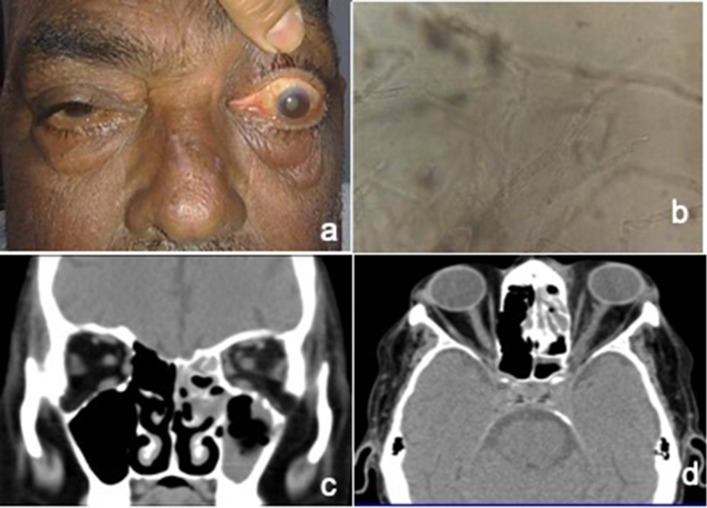
Fig. 1
Fig. 1
a Photograph of patient with left eye proptosis and ophthalmoplegia. b KOH mount showing broad aseptate fungal hyphae with right angled branching. c CT Scan coronal image showing opacification of ethmoid and maxillary sinus on left side. d CT axial image showing proptosis left eye with orbital fat stranding and opacification of ethmoid sinus. There is evidence of ill defined soft tissue density at the orbital apex with bulky left cavernous sinus
Fig. 2
Fig. 2
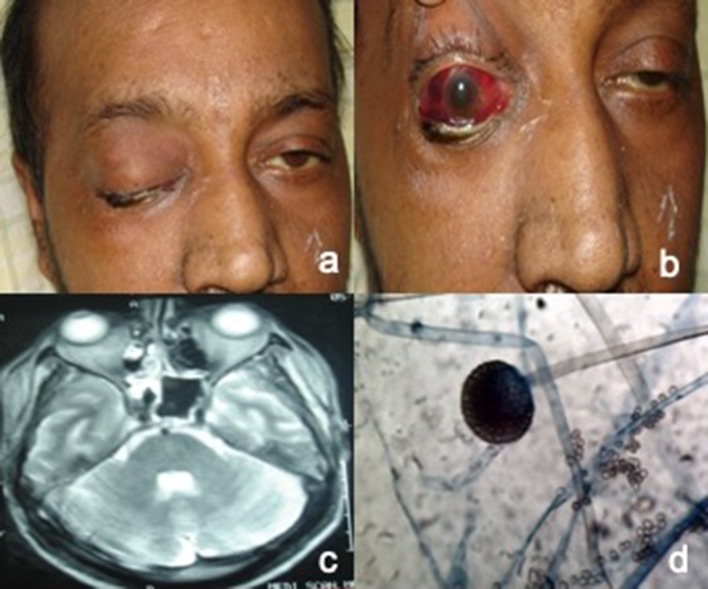
a, b Photograph of patient with right eye total ophthalmoplegia with subconjunctival hemorrhage and ecchymosis. c Axial MRI T2W image showing signs of ethmoid and sphenoid sinusitis with involvement of orbital apex. d Lactophenol cotton blue mount with rhizoids and sporangia
Fig. 3
Fig. 3
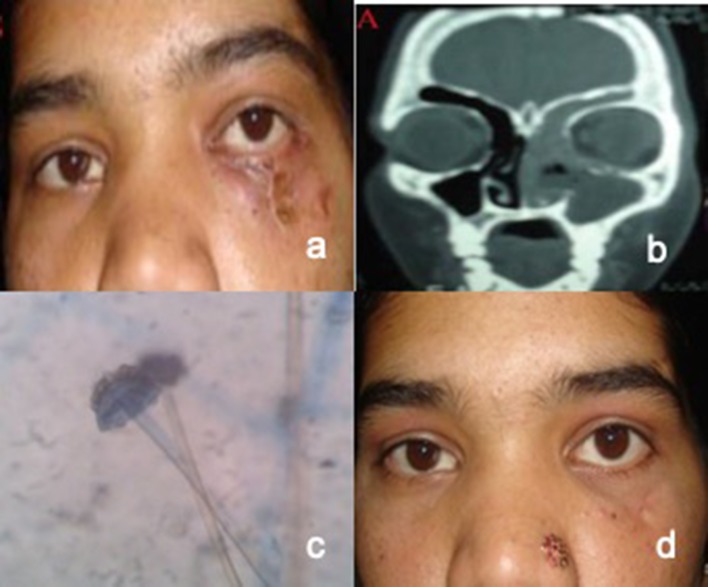
a Photograph of patient showing facial cellulitis with discharging sinus along inferior orbital margin and globe displacement on left side. b CT Coronal image showing opacification of frontal, ethmoid and maxillary sinus with erosion of floor and medial orbital wall on left side. c Lactophenol cotton blue mount with broad aseptate hyphae and sporangium d Photograph of the patient after treatment
Fig. 4
Fig. 4
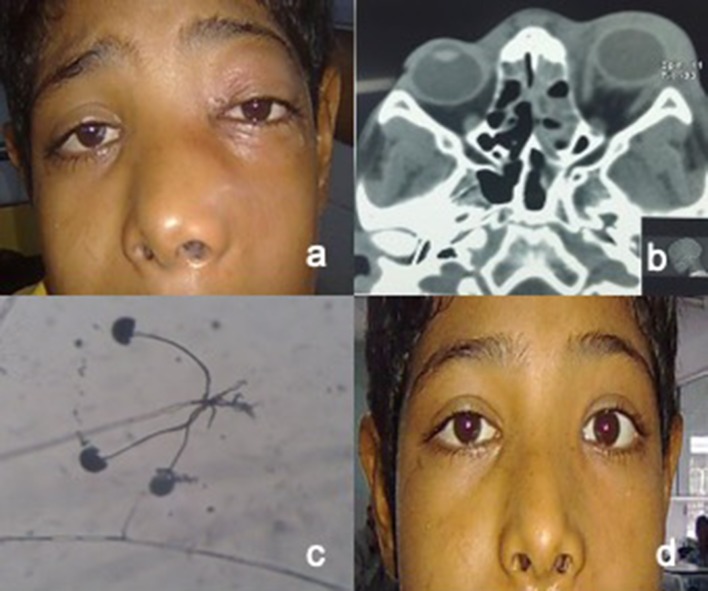
a Photograph showing proptosis with periorbital swelling in left eye. b Axial CT scan showing left sided periorbital and orbital cellulitis with opacification of ethmoid sinus. c Lactophenol cotton blue mount showing rhizoids and sporangia. d Photograph of the patient after recovery

References

    1. Yohai RA, Bullock JD, Aziz AA, Markert RJ. Survival factors in rhino-orbital-cerebral mucormycosis. Surv Ophthalmol. 1994;39:3–22. doi: 10.1016/S0039-6257(05)80041-4. - DOI - PubMed
    1. Uğurlu KS, Selim S, Kopar A, Songu M. Rhino-orbital mucormycosis: clinical findings and treatment outcomes of four cases. TJO. 2015;45(4):169–174. doi: 10.4274/tjo.82474. - DOI - PMC - PubMed
    1. Kohn R, Hepler R. Management of limited rhino-orbital mucormycosis without exenteration. Ophthalmology. 1985;92:1440–1443. doi: 10.1016/S0161-6420(85)33844-7. - DOI - PubMed
    1. Bala K, Chander J, Handa U, Singh R, Kumar A. A prospective study of mucormycosis in north India: experience from a tertiary care hospital. Med Mycol. 2015;53:248–257. doi: 10.1093/mmy/myu086. - DOI - PubMed
    1. Ferry AP, Abedi S. Diagnosis and management of rhino-orbito-cerebral mucormycosis (phycomycosis): A report of 16 personally observed cases. Ophthalmology. 1983;90:1096–1104. doi: 10.1016/S0161-6420(83)80052-9. - DOI - PubMed

LinkOut - more resources