


Historical Expansion of Kyasanur Forest Disease in India From 1957 to 2017: A Retrospective Analysis
- PMID: 32159030
- PMCID: PMC7007137
- DOI: 10.1029/2018GH000164
Historical Expansion of Kyasanur Forest Disease in India From 1957 to 2017: A Retrospective Analysis
Abstract
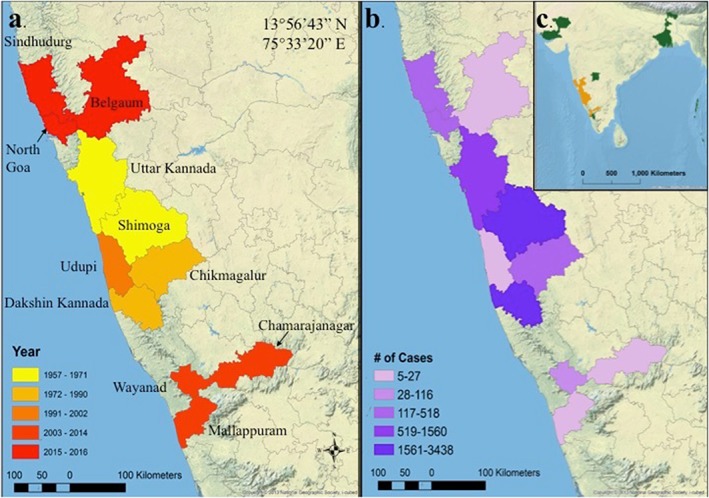
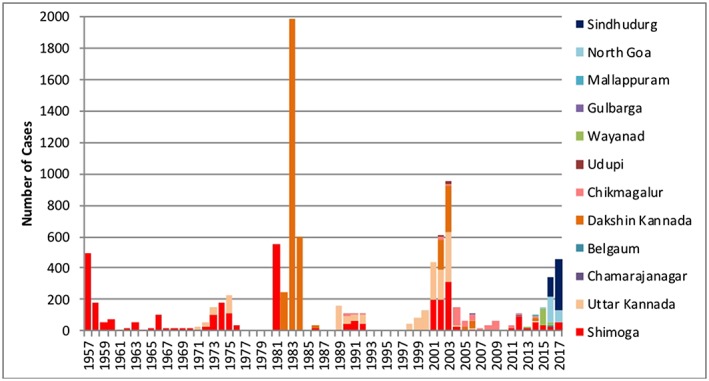
A highly infectious tick-borne virus causes Kyasanur Forest disease (KFD), which has been expanding in recent decades in India. Current studies do not provide an updated understanding of the disease trends and its expansion in India. We address this gap in the literature through a detailed review to reveal the annual historic expansion of KFD cases across the span of years from 1957 to 2017. In addition, we explore the factors that may have led to the geographic expansion of KFD. The annual numbers of cases of KFD among humans are estimated using peer-reviewed journal articles, Pro-MED database, historical and archived newspapers, and government reports, technical reports, publications, and medical websites. From 1957 to 2017, there were an estimated 9,594 cases of KFD within 16 districts in India. The most significant human outbreaks of the disease were in the years 1957-1958 (681 cases), 1983-1984 (2,589 cases), 2002-2003 (1,562 cases), and 2016-2017 (809 cases). In 2015, KFD appeared in Goa. In 2016, new cases emerged in Belgaum, a district in Karnataka state, and in the Sindhudurg district in Maharashtra state. The processes by which KFD persists and spreads are not clear, but demographic, socioeconomic, political, and environmental factors seem to play a role.
Keywords: Kyasanur Forest disease; retrospective analysis.
©2019. The Authors.
Conflict of interest statement
The authors declare no conflicts of interest relevant to this study.
Figures
References
-
- Agricultural Census of India (2018). Agricultural census database. Retrieved May 21, from http://agcensus.dacnet.nic.in/DistCharacteristic.aspx
-
- Anderson, C. R. , & Singh, K. R. P. (1971). The reaction of cattle to Kyasanur Forest disease virus. Indian Journal of Medical Research, 59(2), 195–198. - PubMed
-
- Awate, P. , Yadav, P. , Patil, D. , Shete, A. , Kumar, V. , Kore, P. , Dolare, J. , Deshpande, M. , Bagde, S. , Sapkal, G. , Gurav, Y. , & Mourya, D. T. (2016). Outbreak of Kyasanur Forest disease (monkey fever) in Sindhudurg, Maharashtra State, India, 2016. The Indian Journal of Medical Research, 62(4), 497–510. - PubMed
Publication types
LinkOut - more resources
Full Text Sources
Miscellaneous