


Estimating the Health-Related Costs of 10 Climate-Sensitive U.S. Events During 2012
- PMID: 32159045
- PMCID: PMC7007172
- DOI: 10.1029/2019GH000202
Estimating the Health-Related Costs of 10 Climate-Sensitive U.S. Events During 2012
Abstract
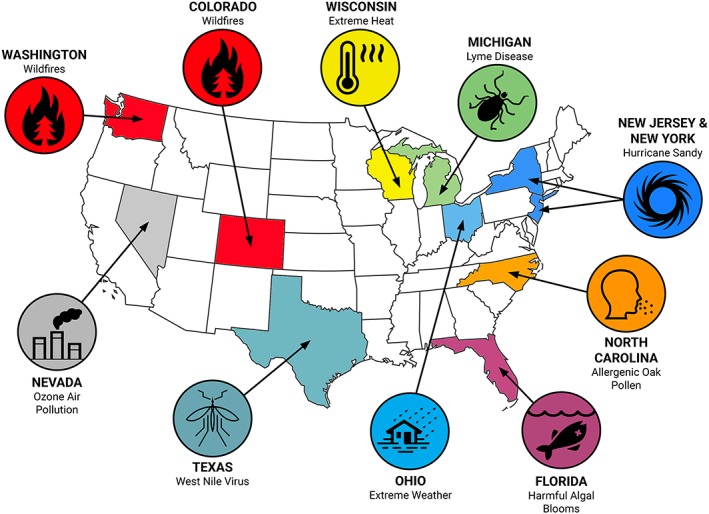
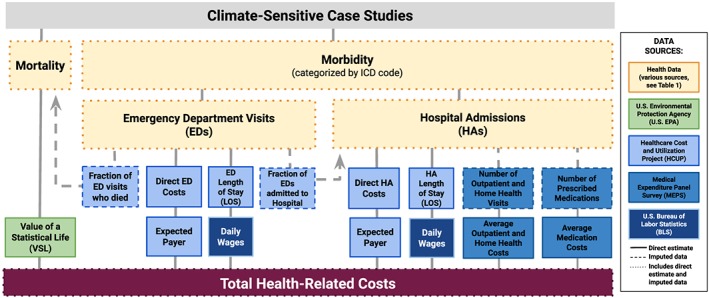
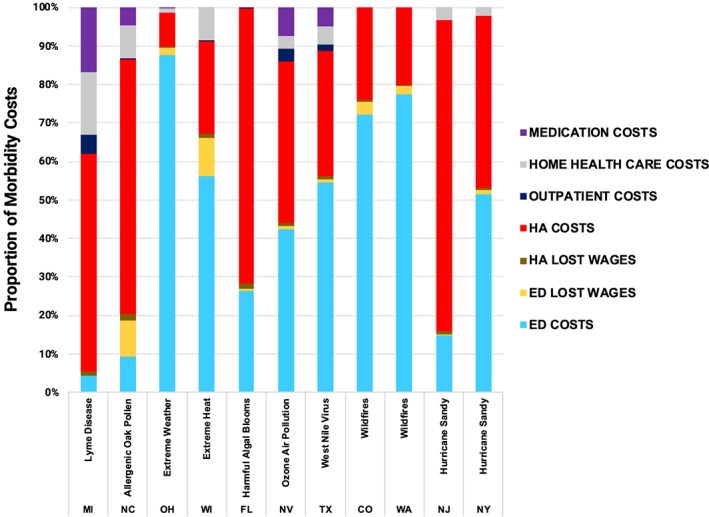
Climate change threatens human health, but there remains a lack of evidence on the economic toll of climate-sensitive public health impacts. We characterize human mortality and morbidity costs associated with 10 climate-sensitive case study events spanning 11 US states in 2012: wildfires in Colorado and Washington, ozone air pollution in Nevada, extreme heat in Wisconsin, infectious disease outbreaks of tick-borne Lyme disease in Michigan and mosquito-borne West Nile virus in Texas, extreme weather in Ohio, impacts of Hurricane Sandy in New Jersey and New York, allergenic oak pollen in North Carolina, and harmful algal blooms on the Florida coast. Applying a consistent economic valuation approach to published studies and state estimates, we estimate total health-related costs from 917 deaths, 20,568 hospitalizations, and 17,857 emergency department visits of $10.0 billion in 2018 dollars, with a sensitivity range of $2.7-24.6 billion. Our estimates indicate that the financial burden of deaths, hospitalizations, emergency department visits, and associated medical care is a key dimension of the overall economic impact of climate-sensitive events. We found that mortality costs (i.e., the value of a statistical life) of $8.4 billion exceeded morbidity costs and lost wages ($1.6 billion combined). By better characterizing health damages in economic terms, this work helps to shed light on the burden climate-sensitive events already place on U.S. public health each year. In doing so, we provide a conceptual framework for broader estimation of climate-sensitive health-related costs. The high health-related costs associated with climate-sensitive events highlight the importance of actions to mitigate climate change and adapt to its unavoidable impacts.
Keywords: climate change; extreme events; health; morbidity; mortality; valuation.
©2019. The Authors.
Conflict of interest statement
The authors declare no conflicts of interest relevant to this study.
Figures
References
-
- Abel, D. W. , Holloway, T. , Harkey, M. , Meier, P. , Ahl, D. , Limaye, V. S. , & Patz, J. A. (2018). Air‐quality‐related health impacts from climate change and from adaptation of cooling demand for buildings in the eastern United States: An interdisciplinary modeling study. PLoS Medicine, 15(7), e1002599 10.1371/journal.pmed.1002599 - DOI - PMC - PubMed
-
- Achakulwisut, P. , Anenberg, S. C. , Neumann, J. E. , Penn, S. L. , Weiss, N. , Crimmins, A. , Fann, N. , Martinich, J. , Roman, H. , & Mickley, L. J. (2019). Effects of increasing aridity on ambient dust and public health in the U.S. Southwest under climate change. GeoHealth, 3, 127–144. 10.1029/2019GH000187 - DOI - PMC - PubMed