Cardiovascular Health Trajectories From Childhood Through Middle Age and Their Association With Subclinical Atherosclerosis
- PMID: 32159727
- PMCID: PMC7066520
- DOI: 10.1001/jamacardio.2020.0140
Cardiovascular Health Trajectories From Childhood Through Middle Age and Their Association With Subclinical Atherosclerosis
Abstract
Importance: Cross-sectional measures of cardiovascular health (CVH) have been associated with cardiovascular disease in older age, but little is known about longitudinal trajectories in CVH and their association with subclinical atherosclerosis in middle age.
Objectives: To model long-term patterns in CVH starting in childhood and to assess their association with subclinical atherosclerosis in middle age.
Design, setting, and participants: This cohort study used data from 5 prospective cardiovascular cohort studies from the United States and Finland from 1973 to 2015. A total of 9388 participants aged 8 to 55 years had at least 3 examinations and were eligible for this study. Statistical analysis was performed from December 1, 2015, to June 1, 2019.
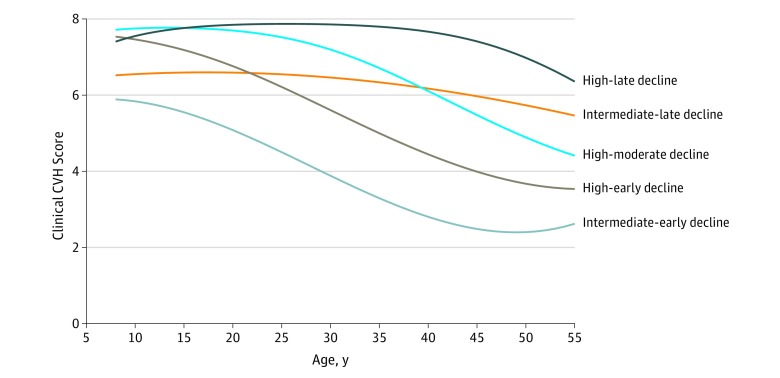
Exposures: Clinical CVH factors (body mass index, total cholesterol level, blood pressure, and glucose level) were classified as ideal, intermediate, or poor, and were summed as a clinical CVH score. Group-based latent class modeling identified trajectories in this score over time.
Main outcomes and measures: Carotid intima-media thickness (cIMT) was measured for participants in 3 cohorts, and high cIMT was defined as a value at or above the 90th percentile. The association between CVH trajectory and cIMT was modeled using both linear and logistic regression adjusted for demographics, baseline health behaviors, and baseline (or proximal) CVH score.
Results: Among 9388 participants (5146 [55%] female; 6228 [66%] white; baseline mean [SD] age, 17.5 [7.5] years), 5 distinct trajectory groups were identified: high-late decline (1518 participants [16%]), high-moderate decline (2403 [26%]), high-early decline (3066 [32%]), intermediate-late decline (1475 [16%]), and intermediate-early decline (926 [10%]). The high-late decline group had significantly lower adjusted cIMT vs other trajectory groups (high-late decline: 0.64 mm [95% CI, 0.63-0.65 mm] vs intermediate-early decline: 0.72 mm [95% CI, 0.69-0.75 mm] when adjusted for demographics and baseline smoking, diet, and physical activity; P < .01). The intermediate-early declining group had higher odds of high cIMT (odds ratio, 2.4; 95% CI, 1.3-4.5) compared with the high-late decline group, even after adjustment for baseline or proximal CVH score.
Conclusions and relevance: In this study, CVH declined from childhood into adulthood. Promoting and preserving ideal CVH from early life onward may be associated with reduced CVD risk later in life.
Conflict of interest statement
Figures
Comment in
-
American Heart Association Goals Through a 20/20 Lens.JAMA Cardiol. 2020 May 1;5(5):504-506. doi: 10.1001/jamacardio.2020.0256. JAMA Cardiol. 2020. PMID: 32159734 No abstract available.
References
-
- Lloyd-Jones DM, Hong Y, Labarthe D, et al. ; American Heart Association Strategic Planning Task Force and Statistics Committee . Defining and setting national goals for cardiovascular health promotion and disease reduction: the American Heart Association’s strategic Impact Goal through 2020 and beyond. Circulation. 2010;121(4):586-613. doi: 10.1161/CIRCULATIONAHA.109.192703 - DOI - PubMed
-
- Mozaffarian D, Benjamin EJ, Go AS, et al. ; Writing Group Members; American Heart Association Statistics Committee; Stroke Statistics Subcommittee . Heart disease and stroke statistics–2016 update: a report from the American Heart Association. Circulation. 2016;133(4):e38-e360. doi: 10.1161/CIR.0000000000000350 - DOI - PubMed
-
- Steinberger J, Daniels SR, Hagberg N, et al. ; American Heart Association Atherosclerosis, Hypertension, and Obesity in the Young Committee of the Council on Cardiovascular Disease in the Young; Council on Cardiovascular and Stroke Nursing; Council on Epidemiology and Prevention; Council on Functional Genomics and Translational Biology; and Stroke Council . Cardiovascular health promotion in children: challenges and opportunities for 2020 and beyond: a scientific statement from the American Heart Association. Circulation. 2016;134(12):e236-e255. doi: 10.1161/CIR.0000000000000441 - DOI - PMC - PubMed
-
- Shay CM, Ning H, Daniels SR, Rooks CR, Gidding SS, Lloyd-Jones DM. Status of cardiovascular health in US adolescents: prevalence estimates from the National Health and Nutrition Examination Surveys (NHANES) 2005-2010. Circulation. 2013;127(13):1369-1376. doi: 10.1161/CIRCULATIONAHA.113.001559 - DOI - PubMed