


Genetic characterization of the spike gene of porcine epidemic diarrhea viruses (PEDVs) circulating in Vietnam from 2015 to 2016
- PMID: 32159913
- PMCID: PMC7397879
- DOI: 10.1002/vms3.256
Genetic characterization of the spike gene of porcine epidemic diarrhea viruses (PEDVs) circulating in Vietnam from 2015 to 2016
Abstract
Background: Porcine epidemic diarrhea (PED) is a highly contagious swine disease caused by the PED virus (PEDV), which is a member of the family Coronaviridae. Since the first outbreaks in Belgium and the United Kingdom were reported in 1971, PED has spread throughout many countries around the world and causing significant economic loss. This study was conducted to investigate the recent distribution of PEDV strains in Vietnam during the 2015-2016 seasons.
Methods: A total of 30 PED-specific PCR-positive intestinal and faecal samples were collected from unvaccinated piglets in Vietnam during the 2015-2016 seasons. The full length of the spike (S) gene of these PEDV strains were analysed to determine their phylogeny and genetic relationship with other available PEDV strains globally.
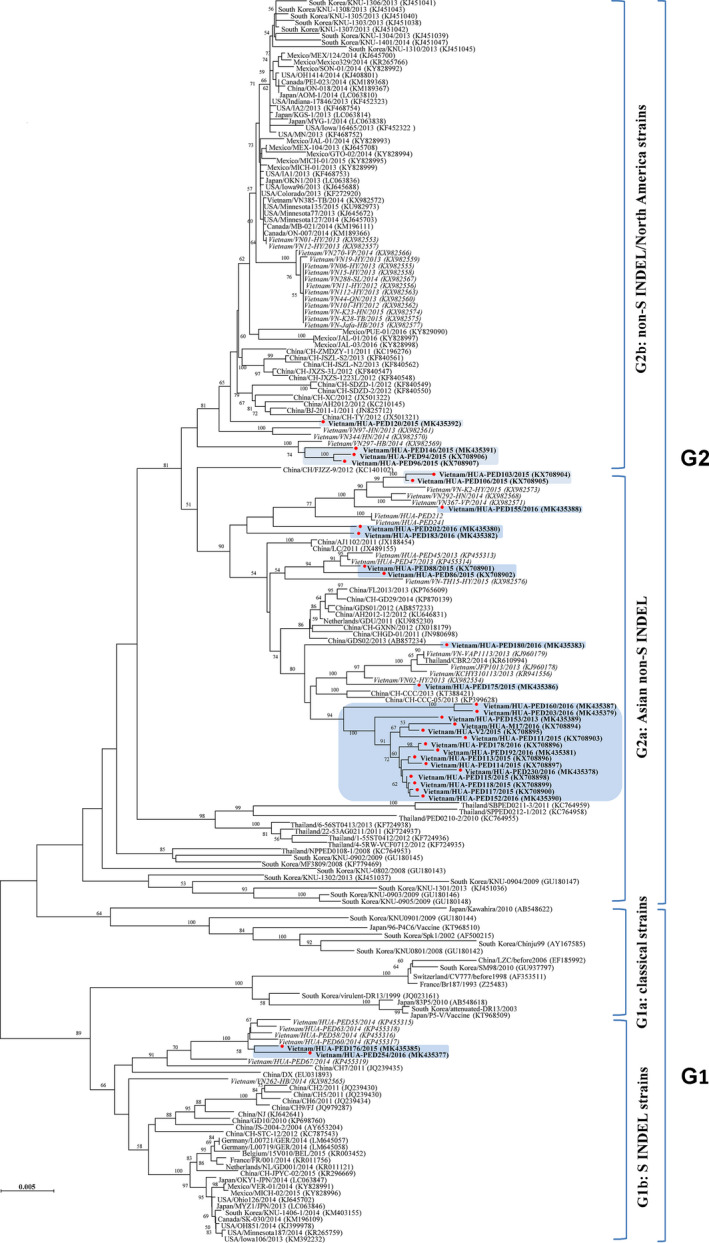
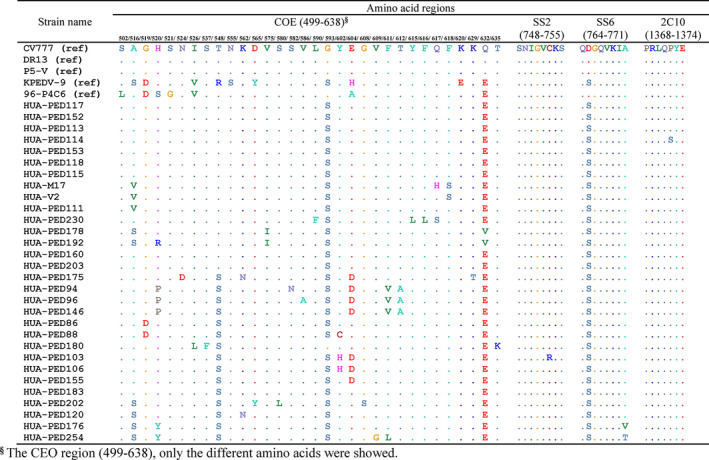
Results: Phylogenetic analysis of the complete S gene sequences revealed that the 28 Vietnamese PEDV strains collected in the northern and central regions clustered in the G2 group (both G2a and G2b sub-groups), while the other 2 PEDV strains (HUA-PED176 and HUA-PED254) collected in the southern region were clustered in the G1/G1b group/sub-group. The nucleotide (nt) and deduced amino acid (aa) analyses based on the complete S gene sequences showed that the Vietnamese PEDV strains were closely related to each other, sharing nt and aa homology of 93.2%-99.9% and 92.6%-99.9%, respectively. The N-glycosylation patterns and mutations in the antigenic region were observed in Vietnamese PEDV strains.
Conclusions: This study provides, for the first time, up-to-date information on viral circulation and genetic distribution, as well as evidence to assist in the development of effective PEDV vaccines in Vietnam.
Keywords: molecular characterization; phylogenetic analysis; porcine epidemic diarrhea virus (PEDV); spike glycoprotein gene.
© 2020 The Authors. Veterinary Medicine and Science Published by John Wiley & Sons Ltd.
Conflict of interest statement
The authors declared no potential conflicts of interest with respect to the research, authorship and/or publication of this article.
Figures
References
-
- Bosch, B. J. , van der Zee, R. , de Haan, C. A. , & Rottier, P. J. (2003). The coronavirus spike protein is a class I virus fusion protein: Structural and functional characterization of the fusion core complex. Journal of Virology, 77, 8801–8811. 10.1128/JVI.77.16.8801-8811.2003 - DOI - PMC - PubMed
-
- Bridgen, A. , Duarte, M. , Tobler, K. , Laude, H. , & Ackermann, M. (1993). Sequence determination of the nucleocapsid protein gene of the porcine epidemic diarrhoea virus confirms that this virus is a coronavirus related to human coronavirus 229E and porcine transmissible gastroenteritis virus. Journal of General Virology, 74(Pt 9), 1795–1804. 10.1099/0022-1317-74-9-1795 - DOI - PubMed
Publication types
MeSH terms
Substances
LinkOut - more resources
Full Text Sources
Research Materials
