Review
. 2020 Jul 30;14(7):995-1009.
doi: 10.1093/ecco-jcc/jjaa009.

Stromal Cells in the Pathogenesis of Inflammatory Bowel Disease

Affiliations
Review

Stromal Cells in the Pathogenesis of Inflammatory Bowel Disease

M C Barnhoorn et al. J Crohns Colitis. .

Abstract

Up till now, research on inflammatory bowel disease [IBD] has mainly been focused on the immune cells present in the gastrointestinal tract. However, recent insights indicate that stromal cells also play an important and significant role in IBD pathogenesis. Stromal cells in the intestines regulate both intestinal epithelial and immune cell homeostasis. Different subsets of stromal cells have been found to play a role in other inflammatory diseases [e.g. rheumatoid arthritis], and these various stromal subsets now appear to carry out also specific functions in the inflamed gut in IBD. Novel potential therapies for IBD utilize, as well as target, these pathogenic stromal cells. Injection of mesenchymal stromal cells [MSCs] into fistula tracts of Crohn's disease patients is already approved and used in clinical settings. In this review we discuss the current knowledge of the role of stromal cells in IBD pathogenesis. We further outline recent attempts to modify the stromal compartment in IBD with agents that target or replace the pathogenic stroma.

Keywords: MSCs; Stromal cells; fibroblasts; inflammatory bowel disease; stroma.


Figures

Figure 1.
Figure 1.
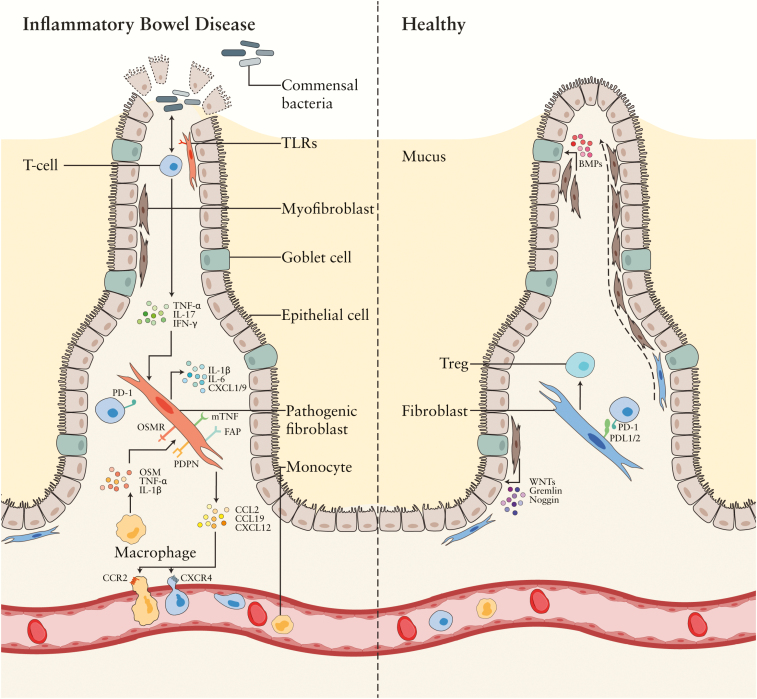
Stromal cells in the intestine of IBD patients versus healthy individuals. Different stromal subsets are present in the inflamed bowel. Diminished migration capacity in fibroblasts and less stromal cells [green] supporting epithelial cells are found in IBD. Stromal cells directly [via TLRs] and indirectly [via microbiota-reactive memory T cells] respond to microbiota by the production of several pro-inflammatory factors. Pathogenic fibroblasts [pink] show expression of PDPN, OSMR, mTNF, and FAP, while they produce among others IL-6, IL-13, TNFSF14, and IL-1β. Through for example CCL2 and CXCL12, they recruit, respectively, monocytes and T cells towards the inflamed tissue. Treg – regulatory T cell, PD-L – programmed death-ligand, PDPN – podoplanin, OSMR – oncostatin M receptor, FAP – fibroblast activation protein, IFN-y – interferon gamma, CXCL – C-X-C motif chemokine, IL-– interleukin, TNFSF-14 – tumor necrosis factor superfamily 14, mTNF – membrane-bound tumor necrosis factor, CCL – chemokine ligand, BMP – bone morphogenetic protein. Some of the figure components are derived from the Servier Medical Art library.
Figure 2.
Figure 2.
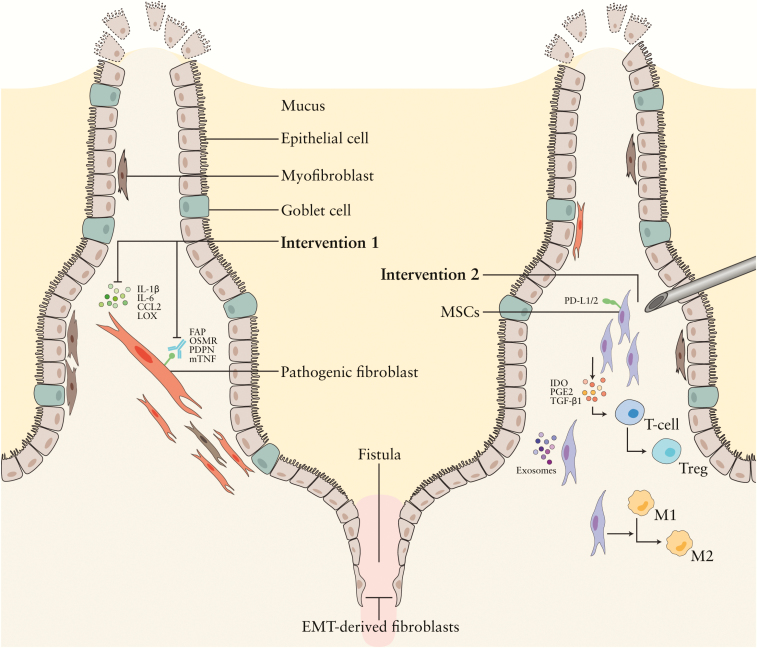
Targeting stromal subsets in luminal IBD- and CD-associated perianal fistulas. 1: Targeting stromal subsets in IBD. Pathogenic stromal cells could be directly targeted via surface markers like OSMR, mTNF, PDPN, and FAP, or indirectly by blocking the soluble factors pathogenic stromal cells produce, like LOX. 2: Local MSC therapy. MSCs modulate immune cell responses, thereby reducing the number of proliferating T cells and stimulating the conversion of T cells into regulatory T cells and immunosuppressive ‘M2’ macrophages. Furthermore, they support epithelial regeneration. In these processes, soluble factors like IDO, VEGF, HGF, PGE2, and surface markers like PD-L1, ICAM, and MSC-derived exosomes are involved. Treg – regulatory T cell, IL- interleukin, LOX – lysyl oxidase, CCL2 – chemokine ligand 2, PDPN – podoplanin, OSMR – oncostatin M receptor, mTNF – membrane-bound tumor necrosis factor, FAP – fibroblast activation protein, PGE2 – prostaglandin E2, IDO – indoleamine, PD-L1 – programmed death-ligand 1, TGF-β – transforming growth factor β. Some of the figure components are derived from the Servier Medical Art library.

References

    1. Ng SC, Shi HY, Hamidi N, et al. . Worldwide incidence and prevalence of inflammatory bowel disease in the 21st century: a systematic review of population-based studies. Lancet 2018;390:2769–78. - PubMed
    1. Reinisch W, Hommes DW, Van Assche G, et al. . A dose escalating, placebo controlled, double blind, single dose and multidose, safety and tolerability study of fontolizumab, a humanised anti-interferon gamma antibody, in patients with moderate to severe Crohn’s disease. Gut 2006;55:1138–44. - PMC - PubMed
    1. Hueber W, Sands BE, Lewitzky S, et al. . Secukinumab, a human anti-il-17a monoclonal antibody, for moderate to severe Crohn’s disease: unexpected results of a randomised, double-blind placebo-controlled trial. Gut 2012;61:1693–700. - PMC - PubMed
    1. Schnitzler F, Fidder H, Ferrante M, et al. . Mucosal healing predicts long-term outcome of maintenance therapy with infliximab in Crohn’s disease. Inflamm Bowel Dis 2009;15:1295–301. - PubMed
    1. Rutgeerts P, Van Assche G, Sandborn WJ, et al. . Adalimumab induces and maintains mucosal healing in patients with Crohn’s disease: data from the EXTEND trial. Gastroenterology 2012;142:1102–11.e2. - PubMed

MeSH terms