. 2020 Apr 9;63(7):3701-3712.
doi: 10.1021/acs.jmedchem.0c00012. Epub 2020 Mar 20.

Garcinoic Acid Is a Natural and Selective Agonist of Pregnane X Receptor

Affiliations

Garcinoic Acid Is a Natural and Selective Agonist of Pregnane X Receptor

Desirée Bartolini et al. J Med Chem. .

Abstract

Pregnane X receptor (PXR) is a master xenobiotic-sensing transcription factor and a validated target for immune and inflammatory diseases. The identification of chemical probes to investigate the therapeutic relevance of the receptor is still highly desired. In fact, currently available PXR ligands are not highly selective and can exhibit toxicity and/or potential off-target effects. In this study, we have identified garcinoic acid as a selective and efficient PXR agonist. The properties of this natural molecule as a specific PXR agonist were demonstrated by the screening on a panel of nuclear receptors, the assessment of the physical and thermodynamic binding affinity, and the determination of the PXR-garcinoic acid complex crystal structure. Cytotoxicity, transcriptional, and functional properties were investigated in human liver cells, and compound activity and target engagement were confirmed in vivo in mouse liver and gut tissue. In conclusion, garcinoic acid is a selective natural agonist of PXR and a promising lead compound toward the development of new PXR-regulating modulators.


Conflict of interest statement

The authors declare the following competing financial interest(s): A.G. and R.P. are cofounders of TES Pharma.

Figures
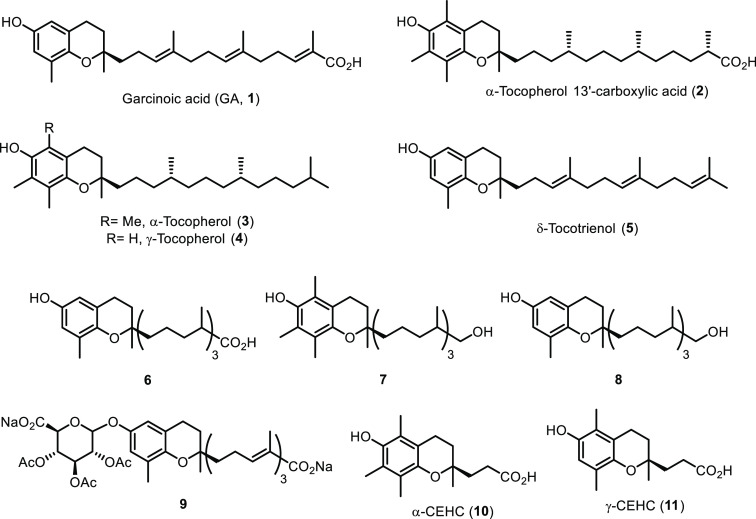
Chart 1
Chart 1. Chemical Structures of Garcinoic Acid (GA, 1), α- and γ-Tocopherol (3, 4), δ-Tocotrienol (5), Long-Chain Metabolites (2, 69), and Short-Chain Carboxyethylhydroxychroman (CEHC) Metabolites (10, 11)
Scheme 1
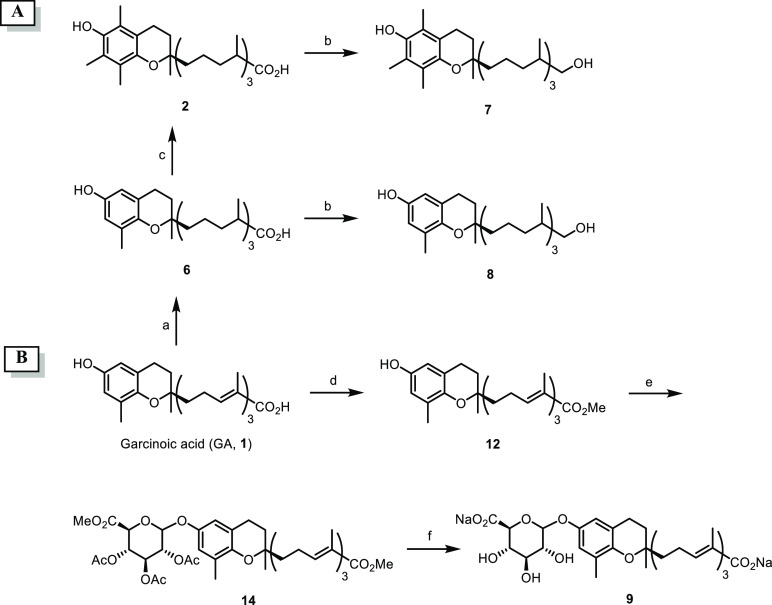
Scheme 1. Synthesis of Metabolites 2, 69
Reagents and conditions: (a) 10% Pd/C cartridge (s-cart, 30 × 4 mm i.d.), 1 bar (full H2 mode), 25 °C, 1 mL min–1; (b) LiAlH4, THF, 0 °C → rt; (c) SnCl2, HCl 12 M, Et2O, (CH2O)n, 70 °C; (d) CH2N2, Et2O, 0 °C → rt; (e) methyl-1-bromo-2,3,4-tri-O-acetyl-α-d-glucuronate (13), Fetizon reagent, molecular sieves, toluene; (f) Na2CO3, MeOH, rt.
Figure 1
Figure 1
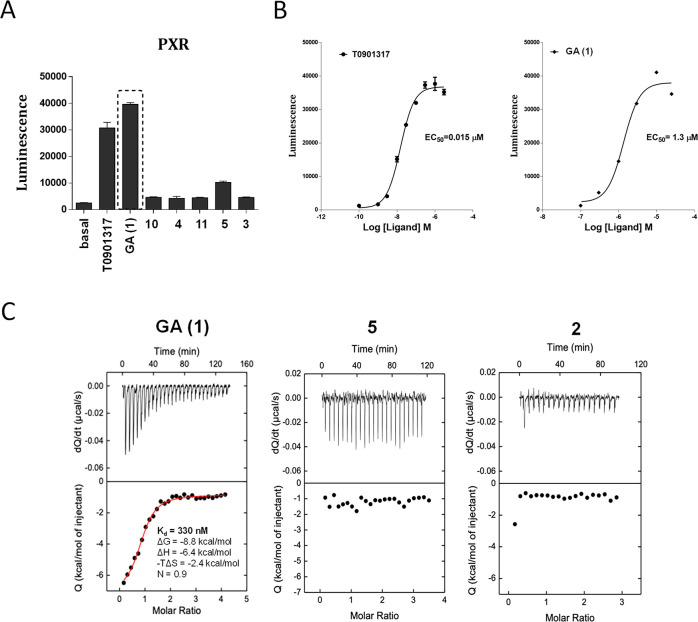
PXR agonist activity and binding properties of GA. Binding activity of GA (1) was assessed by the AlphaScreen test at 10 μM compound concentration (A) and during a dose-dependent experiment (B). Comparisons were made with a series of vitamin E compounds and the PXR agonist 0.05 μM T0901317 (see Table S1). Calorimetric titrations of GA binding to PXR-LBD (C) were investigated in comparison with compounds 2 and 5 dissolved in DMSO and then further diluted to 60 μM final concentration in 25 mM Hepes buffer, pH 7.5, containing 150 mM NaCl. The final concentration of PXR-LBD in the reaction mixture was 3 μM, and DMSO was 8% v/v.
Figure 2
Figure 2
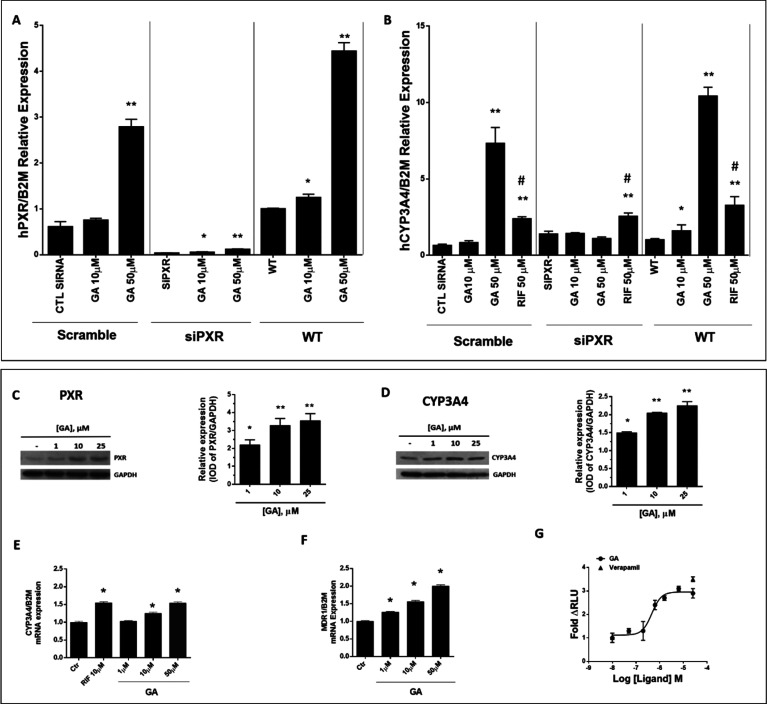
PXR and CYP3A4 expression in HepG2 cells treated with garcinoic acid (1). siRNA technique was used to transiently inhibit PXR (A) or CYP3A4 (B) gene expression [*p < 0.05; **p < 0.01 vs WT or Ctr test; #p < 0.01 vs Rifampicin (RIF)]. PXR (C) and CYP3A4 (D) protein and mRNA (E) expression were also assessed in cells treated for 24 h with 1 and 25 μM GA (1). MDR1 mRNA expression (F) was evaluated at concentrations between 1 and 50 μM GA. The P-glycoprotein activity (G) was measured in the presence of GA between 50 nM and 25 μM (●), and Verapamil (▲) was used as a control. t test: control versus treatments, *p < 0.05; **p < 0.01.
Figure 3
Figure 3
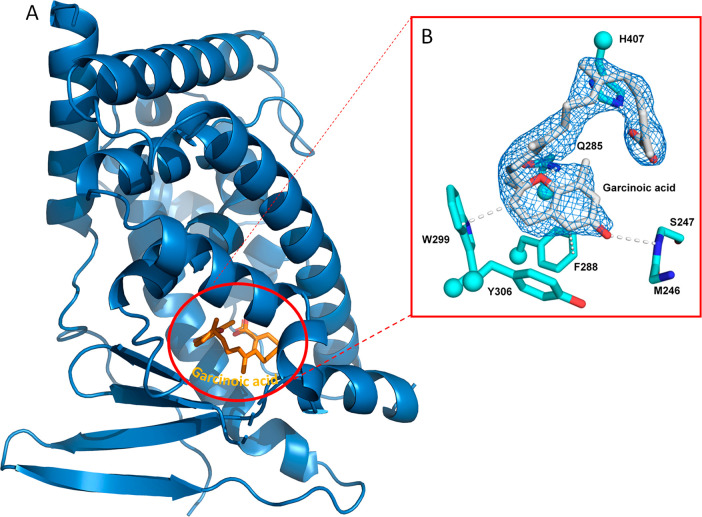
Crystal structure of hPXR–garcinoic acid complex. (A) Overview of hPXR LBD–garcinoic acid complex. (B) 2.3 Å resolution X-ray diffraction data of crystals demonstrated that GA (gray) binds in a single orientation within the ligand binding pocket of hPXR, contacted by four amino acid side chains (cyan) and one main-chain region (M246–S247; cyan). Distances noted are in angstroms.
Figure 4
Figure 4
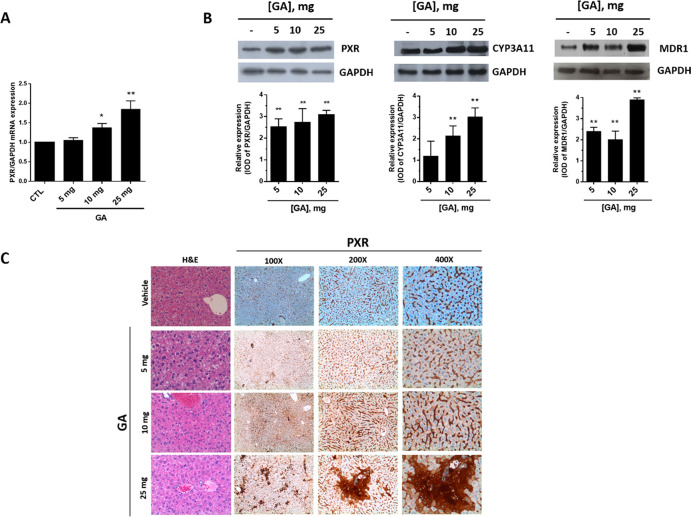
PXR, CYP3A4, and MDR1 expression in the liver of mice treated with garcinoic acid (1). Mice were treated with increasing doses of GA from 5 to 25 mg administered as a single bolus, and PXR mRNA (A) and protein expression (B, left panel) were measured in liver samples 24 h post-treatment. CYP3A4 (CYP3A11 in mice) and MDR1 protein expression were also investigated (B, middle and right panels); *p < 0.05; **p < 0.01. Liver histology was examined by hematoxylin and eosin (H&E) staining and IHC for PXR antigen (C).
Figure 5
Figure 5
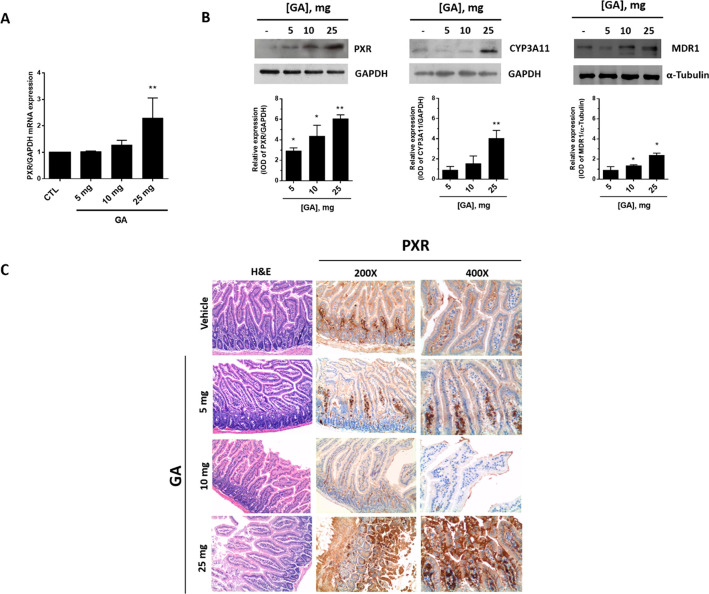
PXR, CYP3A4, and MDR1 expression in the intestine of mice treated with garcinoic acid (1). Mice were treated with increasing doses of GA from 5 to 25 mg administered as a single bolus, and PXR mRNA (A) and protein expression (B, left panel) were measured in liver samples 24 h post-treatment. CYP3A4 (CYP3A11 in mice) and MDR1 protein expression were also investigated (B, middle and right panels); *p < 0.05; **p < 0.01. Liver histology was examined by hematoxylin and eosin (H&E) staining and IHC for PXR antigen (C).

References

    1. Kandel B. A.; Thomas M.; Winter S.; Seehofer D.; Burk O.; Schwab M.; Zanger U. M. Genomewide comparison of the inducible transcriptomes of nuclear receptors CAR, PXR and PPARalpha in primary human hepatocytes. Biochim. Biophys. Acta, Gene Regul. Mech. 2016, 1859, 1218–1227. 10.1016/j.bbagrm.2016.03.007. - DOI - PubMed
    1. Kliewer S. A.; Goodwin B.; Willson T. M. The nuclear pregnane X receptor: a key regulator of xenobiotic metabolism. Endocr. Rev. 2002, 23, 687–70. 10.1210/er.2001-0038. - DOI - PubMed
    1. Chen Y.; Tang Y.; Guo C.; Wang J.; Boral D.; Nie D. Nuclear receptors in the multidrug resistance through the regulation of drug-metabolizing enzymes and drug transporters. Biochem. Pharmacol. 2012, 83, 1112–1126. 10.1016/j.bcp.2012.01.030. - DOI - PMC - PubMed
    1. Banerjee M.; Chen T. Differential regulation of CYP3A4 promoter activity by a new class of natural product derivatives binding to pregnane X receptor. Biochem. Pharmacol. 2013, 86, 824–835. 10.1016/j.bcp.2013.07.023. - DOI - PMC - PubMed
    1. Kliewer S. A.; Moore J. T.; Wade L.; Staudinger J. L.; Watson M. A.; Jones S. A.; McKee D. D.; Oliver B. B.; Willson T. M.; Zetterström R. H.; Perlmann T.; Lehmann J. M. An orphan nuclear receptor activated by pregnanes defines a novel steroid signaling pathway. Cell 1998, 92, 73–82. 10.1016/S0092-8674(00)80900-9. - DOI - PubMed

Publication types

LinkOut - more resources