


Timing of complementary feeding is associated with gut microbiota diversity and composition and short chain fatty acid concentrations over the first year of life
- PMID: 32160858
- PMCID: PMC7065329
- DOI: 10.1186/s12866-020-01723-9
Timing of complementary feeding is associated with gut microbiota diversity and composition and short chain fatty acid concentrations over the first year of life
Abstract
Background: Early introduction of complementary foods has been associated with various immune disorders, oxidative stress, and obesity in childhood. The gut microbiota and the short chain fatty acids (SCFAs) they produce are postulated to be on the causal pathway. The objective of this study was to determine if early complementary feeding (i.e. consumption of solids or non-water/formula liquids at or before 3 months) is prospectively associated with infant gut microbiota composition, diversity and SCFAs at 3 and 12 months of age in the Nurture birth cohort.
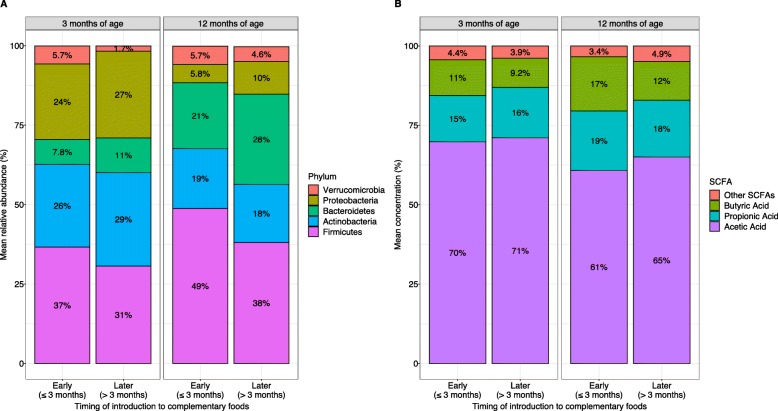
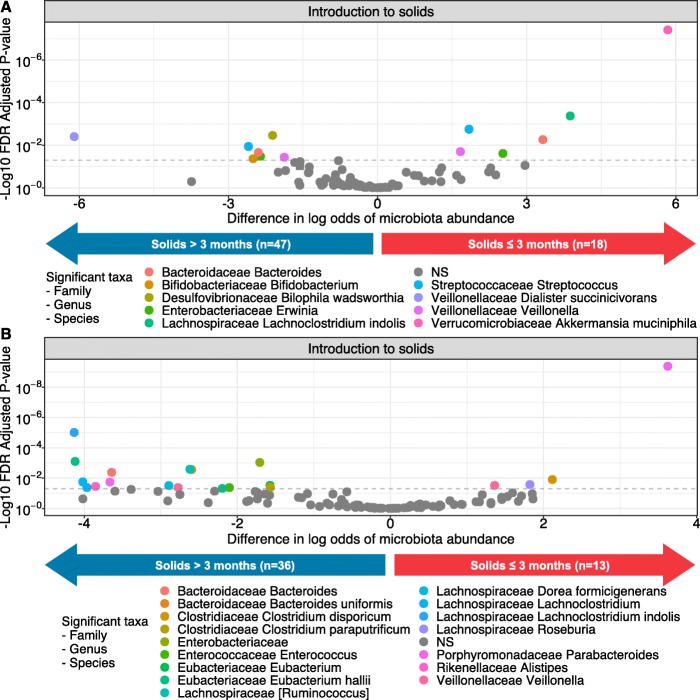
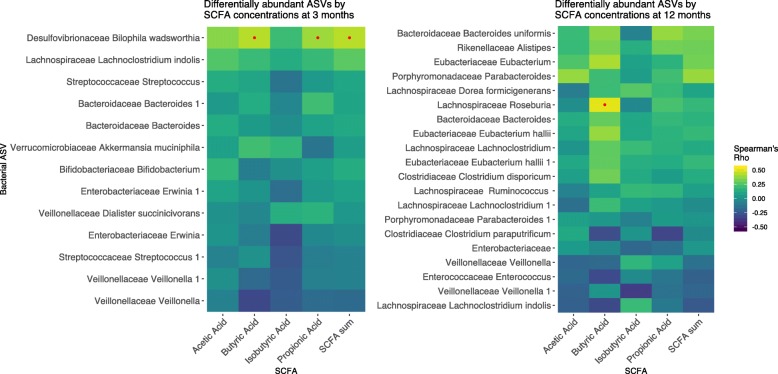
Results: Mother-infant dyads in the early complementary feeding group (n = 18) had similar baseline characteristics to those in the later feeding group (n = 49). We assessed differential abundance of microbial taxa (measured by 16S rRNA gene sequencing of the V4 region) by timing of complementary feeding using beta-binomial regression models (considering a two-sided FDR corrected p-value of < 0.05 as significant), and we fittted linear regression models to assess the association between early complementary feeding and SCFA concentrations (quantified using gas chromatography). After multivariable adjustment for breastfeeding, delivery method, birth weight, and gestational age, there were 13 differentially abundant microbial amplicon sequence variants (ASVs) by timing of introduction to complementary foods at 3 months and 20 ASVs at 12 months. Infants introduced to complementary foods early (vs. later) had higher concentrations of the SCFA butyric acid (mean difference = 0.65, 95% CI: 0.27, 1.04, p < 0.01) and total SCFAs (mean difference = 38.8, 95% CI: 7.83, 69.7) at 12 months. Bilophila wadsworthia and Lachnospiraceae Roseburia were associated with early (vs. later) complementary feeding and with higher butyric acid concentrations at 3 and 12 months, respectively.
Conclusions: Our findings are consistent with the hypothesis that early (vs. later) introduction to complementary foods is associated with altered gut microbiota composition and butyric acid concentrations measured in stool until at least 1 year of age. Further research is needed to determine if these changes mediate future development of metabolic and immune conditions.
Keywords: Butyrate; Complementary feeding; Metabolites; Microbiome; Pediatrics; Weaning.
Conflict of interest statement
The authors declare that they have no competing interests.
Figures
References
-
- Pluymen Linda P. M., Wijga Alet H., Gehring Ulrike, Koppelman Gerard H., Smit Henriëtte A., van Rossem L. Early introduction of complementary foods and childhood overweight in breastfed and formula-fed infants in the Netherlands: the PIAMA birth cohort study. European Journal of Nutrition. 2018;57(5):1985–1993. doi: 10.1007/s00394-018-1639-8. - DOI - PMC - PubMed
-
- Wang J, Wu YJ, Xiong GP, Chao TT, Jin Q, Liu R, Hao LP, Wei S, Yang NH, Yang XF. Introduction of complementary feeding before 4 months of age increases the risk of childhood overweight or obesity: a meta-analysis of prospective cohort studies. Nutr Res. 2016;36:759–770. doi: 10.1016/j.nutres.2016.03.003. - DOI - PubMed
Publication types
MeSH terms
Substances
Grants and funding
LinkOut - more resources
Full Text Sources
Medical
