


Seeing ophthalmologic problems in Parkinson disease: Results of a visual impairment questionnaire
- PMID: 32161030
- PMCID: PMC7251522
- DOI: 10.1212/WNL.0000000000009214
Seeing ophthalmologic problems in Parkinson disease: Results of a visual impairment questionnaire
Abstract
Objective: To determine the prevalence and clinical effect of ophthalmologic symptoms in patients with Parkinson disease (PD), compared with controls, using a standardized questionnaire.
Methods: In this observational, cross-sectional, multicenter study, 848 patients with PD and 250 healthy controls completed the Visual Impairment in Parkinson's Disease Questionnaire (VIPD-Q). The VIPD-Q addressed 4 domains according to structures: (1) ocular surface; (2) intraocular; (3) oculomotor; and (4) optic nerve. The questionnaire also assessed the effect of ophthalmologic symptoms on daily activities.
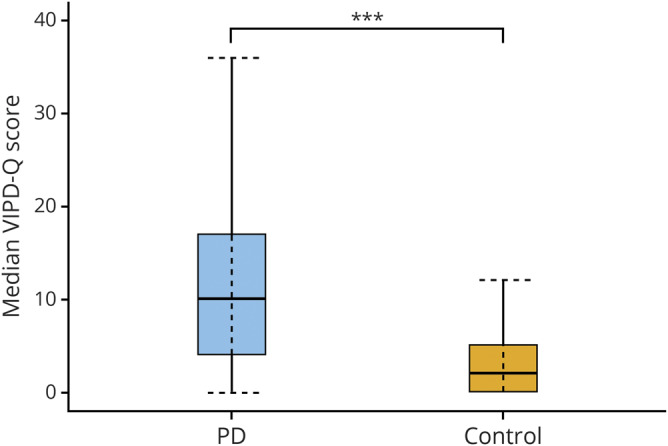
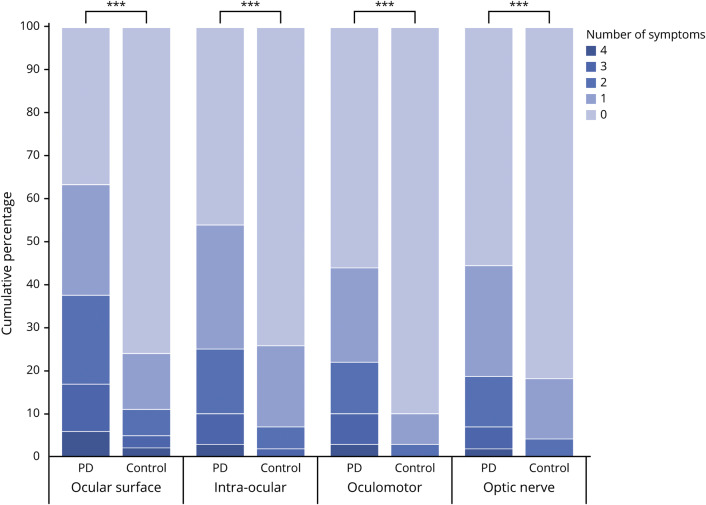
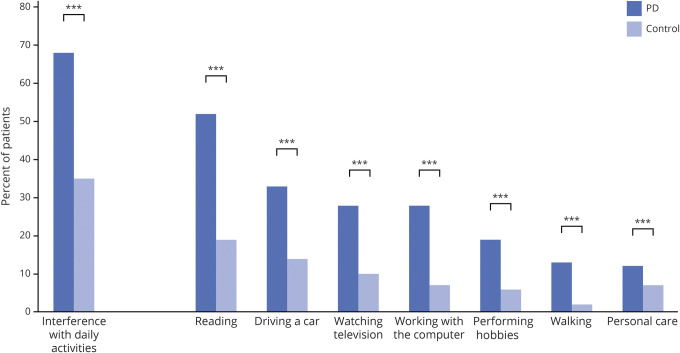
Results: One or more ophthalmologic symptoms were reported by 82% (95% confidence interval [CI], 80-85) of patients, compared with 48% (95% CI, 42-54) of controls (p < 0.001). Patients with PD experienced more ophthalmologic symptoms across all domains than controls (p < 0.001), as reflected by a higher VIPD-Q total score among patients (median 10 [interquartile range (IQR) 13]) than controls (median 2 [IQR 5]; p < 0.001). Ophthalmologic symptoms interfered with daily activities in 68% (95% CI, 65-71) of patients, compared with 35% (95% CI, 29-41) of controls (p < 0.001).
Conclusion: Patients with PD have a higher prevalence of ophthalmologic symptoms than controls. Moreover, these frequently interfere with daily activities. A screening questionnaire such as the VIPD-Q may help with identifying ophthalmologic symptoms in PD, thereby enabling more timely treatment.
Copyright © 2020 The Author(s). Published by Wolters Kluwer Health, Inc. on behalf of the American Academy of Neurology.
Figures
References
-
- Ekker MS, Janssen S, Seppi K, et al. . Ocular and visual disorders in Parkinson's disease: common but frequently overlooked. Parkinsonism Relat Disord 2017;40:1–10. - PubMed
-
- Archibald NK, Clarke MP, Mosimann UP, Burn DJ. The retina in Parkinson's disease. Brain 2009;132:1128–1145. - PubMed
-
- Biousse V, Skibell BC, Watts RL, Loupe DN, Drews-Botsch C, Newman NJ. Ophthalmologic features of Parkinson's disease. Neurology 2004;62:177–180. - PubMed
-
- Pascolini D, Mariotti SP. Global estimates of visual impairment: 2010. Br J Ophthalmol 2012;96:614–618. - PubMed
