Review
. 2020 Feb 26:13:659-672.
doi: 10.2147/IDR.S232982. eCollection 2020.

The Battle of Probiotics and Their Derivatives Against Biofilms

Affiliations
Review

The Battle of Probiotics and Their Derivatives Against Biofilms

Abolfazl Barzegari et al. Infect Drug Resist. .

Abstract

Biofilm-related infections have been a major clinical problem and include chronic infections, device-related infections and malfunction of medical devices. Since biofilms are not fully available for the human immune system and antibiotics, they are difficult to eradicate and control; therefore, imposing a global threat to human health. There have been avenues to tackle biofilms largely based on the disruption of their adhesion and maturation. Nowadays, the use of probiotics and their derivatives has gained a growing interest in battling against pathogenic biofilms. In the present review, we have a close look at probiotics with the ultimate objective of inhibiting biofilm formation and maturation. Overall, insights into the mechanisms by which probiotics and their derivatives can be used in the management of biofilm infections would be warranted.

Keywords: antibiotic resistance; biofilm; infection; lactobacillus; probiotics; sepsis.


Conflict of interest statement

All of the authors declare that there are no personal, commercial, political, and any other potential conflicting interests related to the published paper.

Figures
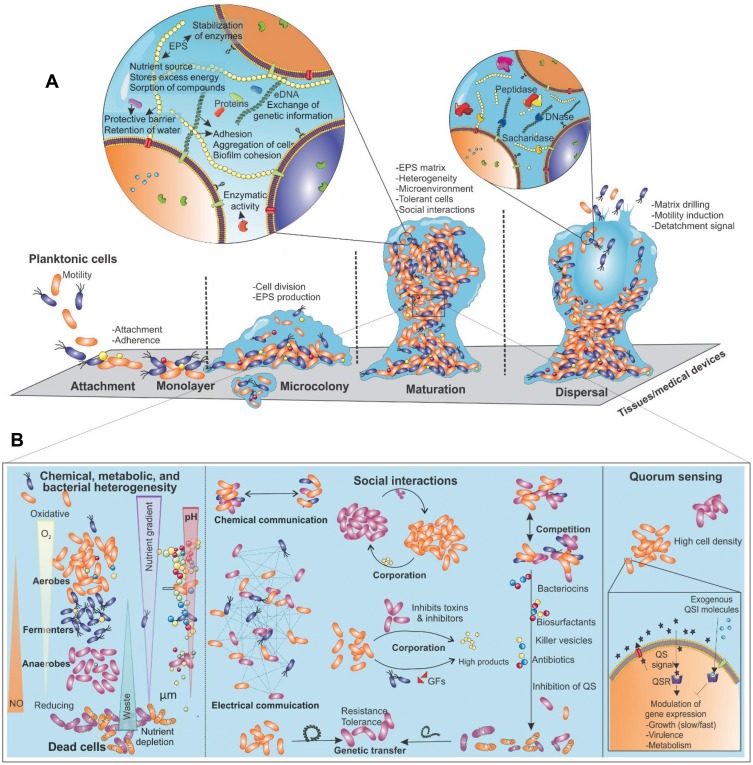
Figure 1
Figure 1
The stages and complex structure of bacterial biofilms. (A) Different stages are involved in biofilm formation, during which a series of changes happen. These stages include initial attachment, microcolony formation, maturation and dispersion. Detachment allows bacteria to colonize in new niches. (B) The formation of the EPS matrix leads to the establishment of stable gradients of nutrition, pH, waste products and oxygen that make different localized habitats at a small scale. Social connections in biofilms include positive (competition or cooperation) and negative (competition) interactions between bacterial cells that result in remodeling of the biofilm community. Cooperation is mediated by electrical and chemical communications between cells in biofilms while competition is mediated by different killing strategies such as producing bacteriocins, antibiotics, enzymes and growth inhibition mechanisms like preventing QS and depletion of nutrient. Abbreviations: EPS, extracellular polymeric substance; GFs, growth factors; NO, nitric oxide; QS, quorum sensing.
Figure 2
Figure 2
Targeting microbial biofilms by probiotics. Probiotics employ different mechanisms by which interfere with the activity of pathogenic bacteria. They produce antagonistic substances such as, surfactants, bacteriocins, EPS, organic acids, lactic acid, fatty acids, enzymes (lipase, amylase) and hydrogen peroxide that can hinder the activity of pathogenic bacteria and their adhesion to surfaces. Moreover, they prevent QS, biofilm formation and the survival of pathogens as well as interfere with biofilm integrity/quality, finally, lead to biofilm eradication. Furthermore, probiotics generate unfavorable environmental conditions for pathogens (e.g., pH alteration as well as competition for surface and nutrients). Their competitive adhesion to human tissues or medical devices (catheters, prostheses, or other medical devices), prevent the colonization of harmful bacteria. Additionally, by modulating host immune responses and formation of non-pathogenic biofilms, they target pathogenic biofilms that prevent the biofilms formation by certain pathogenic bacteria. Abbreviations: CF, cystic fibrosis; COPD, chronic obstructive pulmonary disease; EPS, extracellular polymeric substance; QS, quorum sensing; UTI, urinary tract infection.

References

    1. Bjarnsholt T, Buhlin K, Dufrêne YF, et al. Biofilm formation – what we can learn from recent developments. J Intern Med. 2018;284(4):332–345. doi: 10.1111/joim.12782 - DOI - PMC - PubMed
    1. Sharahi JY, Azimi T, Shariati A, Safari H, Tehrani MK, Hashemi A. Advanced strategies for combating bacterial biofilms. J Cell Physiol. 2019;234:14689–14708. doi: 10.1002/jcp.28225 - DOI - PubMed
    1. Mathur H, Field D, Rea MC, Cotter PD, Hill C, Ross RP. Fighting biofilms with lantibiotics and other groups of bacteriocins. NPJ Biofilms Microbiomes. 2018;4:9. doi: 10.1038/s41522-018-0053-6 - DOI - PMC - PubMed
    1. Iannitti T, Palmieri B. Therapeutical use of probiotic formulations in clinical practice. Clin Nutr. 2010;29(6):701–725. doi: 10.1016/j.clnu.2010.05.004 - DOI - PMC - PubMed
    1. Sanchez B, Delgado S, Blanco-Miguez A, Lourenco A, Gueimonde M, Margolles A. Probiotics, gut microbiota, and their influence on host health and disease. Mol Nutr Food Res. 2017;61(1):1600240. doi: 10.1002/mnfr.201600240 - DOI - PubMed

LinkOut - more resources
