Review
. 2020 Feb 25:11:311.
doi: 10.3389/fimmu.2020.00311. eCollection 2020.

NK Cell Function Regulation by TGF-β-Induced Epigenetic Mechanisms

Affiliations
Review

NK Cell Function Regulation by TGF-β-Induced Epigenetic Mechanisms

Stefano Regis et al. Front Immunol. .

Abstract

TGF-β is a potent immunosuppressive cytokine that severely affects the function of NK cells. Tumor cells can take advantage of this ability, enriching their surrounding microenvironment with TGF-β. TGF-β can alter the expression of effector molecules and of activating and chemokine receptors, influence metabolism, induce the NK cell conversion toward the less cytolytic ILC1s. These and other changes possibly occur by the induction of complex gene expression programs, involving epigenetic mechanisms. While most of these programs are at present unexplored, the role of certain transcription factors, microRNAs and chromatin changes determined by TGF-β in NK cells start to be elucidated in human and/or mouse NK cells. The deep understanding of these mechanisms will be useful to design therapies contributing to restore the full NK function.

Keywords: NK cells; TGF-β; epigenetic; microRNAs; transcription factors.


Figures

Figure 1
Figure 1
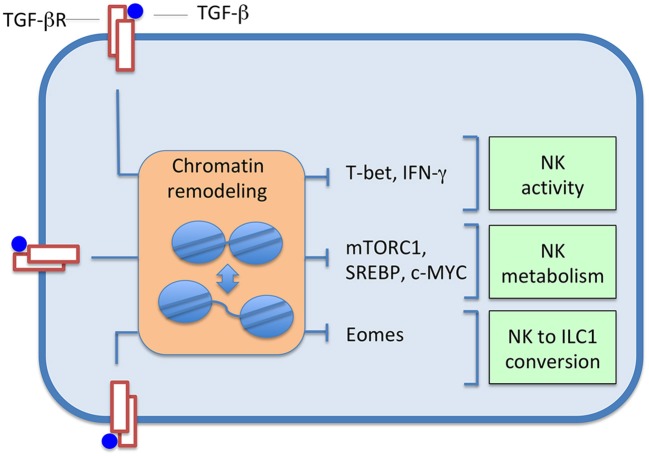
TGF-β induces changes in the expression of several transcription factors, and, consequently, in sets of controlled genes. Effects, often accompanied by chromatin alterations, range from inhibition of NK cell activity, to depression of cell metabolism, up to the induced conversion of NK cells to ILC1s.
Figure 2
Figure 2
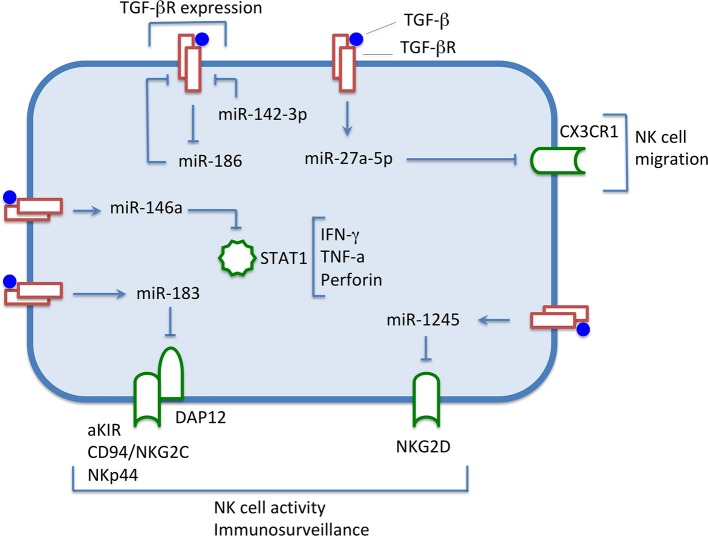
Under the influence of TGF-β, levels of expression of some miRNAs are increased, down-regulating the expression of surface molecules and transcription factors involved in NK cell activity. Conversely, miRNA-186 level decreases, thus preventing the down-regulation of the TGF-β receptor expression, and maintaining the NK cells responsiveness to the immunomodulatory cytokine. miR-142-3p down-regulates TGFBR1, thus modulating the TGF-β signaling.

References

    1. Björkström NK, Ljunggren H-G, Michaëlsson J. Emerging insights into natural killer cells in human peripheral tissues. Nat Rev Immunol. (2016) 16:310–20. 10.1038/nri.2016.34 - DOI - PubMed
    1. Freud AG, Mundy-Bosse BL, Yu J, Caligiuri MA. The broad spectrum of human natural killer cell diversity. Immunity. (2017) 47:820–33. 10.1016/j.immuni.2017.10.008 - DOI - PMC - PubMed
    1. Crinier A, Milpied P, Escalière B, Piperoglou C, Galluso J, Balsamo A, et al. . High-dimensional single-cell analysis identifies organ-specific signatures and conserved NK cell subsets in humans and mice. Immunity. (2018) 49:971–86.e5. 10.1016/j.immuni.2018.09.009 - DOI - PMC - PubMed
    1. Harmon C, Jameson G, Almuaili D, Houlihan DD, Hoti E, Geoghegan J, et al. . Liver-derived TGF-β maintains the EomeshiTbetlo phenotype of liver resident natural killer cells. Front Immunol. (2019) 10:1502. 10.3389/fimmu.2019.01502 - DOI - PMC - PubMed
    1. Spits H, Bernink JH, Lanier L. NK cells and type 1 innate lymphoid cells: partners in host defense. Nat Immunol. (2016) 17:758–64. 10.1038/ni.3482 - DOI - PubMed

Publication types

LinkOut - more resources