Review
. 2020 Mar 5:25:15.
doi: 10.1186/s11658-020-00211-2. eCollection 2020.

Metabolic host response and therapeutic approaches to influenza infection

Affiliations
Review

Metabolic host response and therapeutic approaches to influenza infection

Mohsen Keshavarz et al. Cell Mol Biol Lett. .

Abstract

Based on available metabolomic studies, influenza infection affects a variety of cellular metabolic pathways to ensure an optimal environment for its replication and production of viral particles. Following infection, glucose uptake and aerobic glycolysis increase in infected cells continually, which results in higher glucose consumption. The pentose phosphate shunt, as another glucose-consuming pathway, is enhanced by influenza infection to help produce more nucleotides, especially ATP. Regarding lipid species, following infection, levels of triglycerides, phospholipids, and several lipid derivatives undergo perturbations, some of which are associated with inflammatory responses. Also, mitochondrial fatty acid β-oxidation decreases significantly simultaneously with an increase in biosynthesis of fatty acids and membrane lipids. Moreover, essential amino acids are demonstrated to decline in infected tissues due to the production of large amounts of viral and cellular proteins. Immune responses against influenza infection, on the other hand, could significantly affect metabolic pathways. Mainly, interferon (IFN) production following viral infection affects cell function via alteration in amino acid synthesis, membrane composition, and lipid metabolism. Understanding metabolic alterations required for influenza virus replication has revealed novel therapeutic methods based on targeted inhibition of these cellular metabolic pathways.

Keywords: Fatty acid synthesis; Glycolysis; Indoleamine-2,3-dioxygenase; Influenza; Metabolism.


Conflict of interest statement

Competing interestsThe authors declare that they have no competing interests.

Figures

Fig. 1
Fig. 1
Metabolic changes caused by influenza infection and related mechanisms. Several anabolic and catabolic processes can be affected: higher glucose uptake and metabolism in glycolysis and pentose phosphate pathways, higher nucleotide catabolism, increase in biosynthesis of fatty acids including arachidonic acid, the precursor of proinflammatory lipids, and also enhanced glutaminolysis and protein synthesis. Activation of mTORC1&2 signaling and downstream factors by influenza infection may have an essential role in the upregulation of these metabolic processes. In addition, high ATP consumption and reduced β-oxidation, as well as glucose oxidation by influenza infection, contribute to the ATP crisis and hence influenza-related multi-organ failure
Fig. 2
Fig. 2
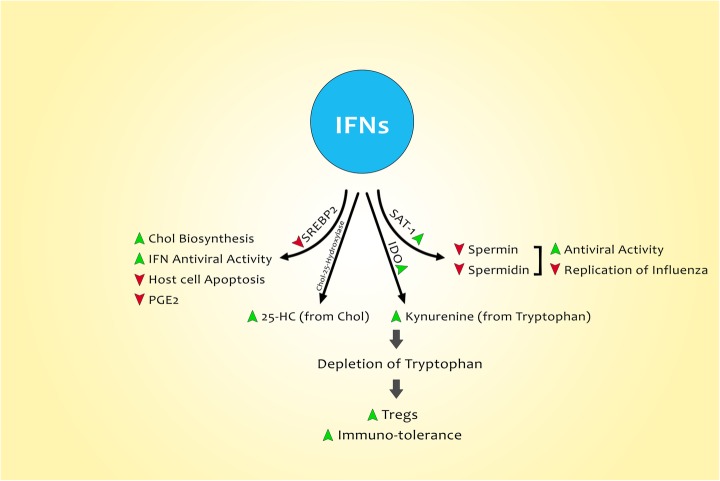
Role of IFNs in host cell metabolic changes following infection with influenza. IFNs affect the lipid metabolism through downregulation of SREBP-2, leading to higher cholesterol biosynthesis, and suppressed host cell apoptosis and PGE-2 production. They can also enhance the level of 25-HC arisen from cholesterol (via activation of Chol-25 hydroxylase) and IDO. SAT-1 can be upregulated by IFNs, lowering the levels of spermidine and spermine and thereby dampening influenza replication
Fig. 3
Fig. 3
Role of IFN in IDO activation. IFNs also induce activity of IDO, an enzyme that mediates the production of kynurenine from tryptophan. This event results in tryptophan depletion, which in turn develops the immune tolerance and generates Tregs

References

    1. Keshavarz M, Namdari H, Arjeini Y, Mirzaei H, Salimi V, Sadeghi A, Mokhtari-Azad T, Rezaei F. Induction of protective immune response to intranasal administration of influenza virus-like particles in a mouse model. J Cell Physiol. 2019;234:16643–16652. doi: 10.1002/jcp.28339. - DOI - PubMed
    1. Keshavarz M, Namdari H, Farahmand M, Mehrbod P, Mokhtari-Azad T, Rezaei F. Association of polymorphisms in inflammatory cytokines encoding genes with severe cases of influenza a/H1N1 and B in an Iranian population. Virol J. 2019;16:79. doi: 10.1186/s12985-019-1187-8. - DOI - PMC - PubMed
    1. Mizuguchi M, Yamanouchi H, Ichiyama T, Shiomi M. Acute encephalopathy associated with influenza and other viral infections. Acta Neurol Scand. 2007;115:45–56. doi: 10.1111/j.1600-0404.2007.00809.x. - DOI - PubMed
    1. Sanei F, Wilkinson T. Influenza vaccination for patients with chronic obstructive pulmonary disease: understanding immunogenicity, efficacy and effectiveness. Ther Adv Respir Dis. 2016;10:349–367. doi: 10.1177/1753465816646050. - DOI - PMC - PubMed
    1. Vasileiou E, Sheikh A, Butler C, El Ferkh K, Von Wissmann B, McMenamin J, Ritchie L, Schwarze J, Papadopoulos NG, Johnston SL. Effectiveness of influenza vaccines in asthma: a systematic review and meta-analysis. Clin Infect Dis. 2017;65:1388–1395. doi: 10.1093/cid/cix524. - DOI - PMC - PubMed

MeSH terms