


Changing youth behaviour in South Africa
- PMID: 32161669
- PMCID: PMC7059634
- DOI: 10.4102/hsag.v25i0.1031
Changing youth behaviour in South Africa
Abstract
Background: Youth behaviour in South Africa continues to be a public health concern. Primary prevention interventions remain a pre-requisite for promotion of improved social and health outcomes.
Aim: The aim of the study was to assess the impact of a behavioural youth risk reduction intervention among grade 10 learners.
Setting: The Study was conducted in KwaZulu-Natal high schools, at UMgungundlovu District Municipality.
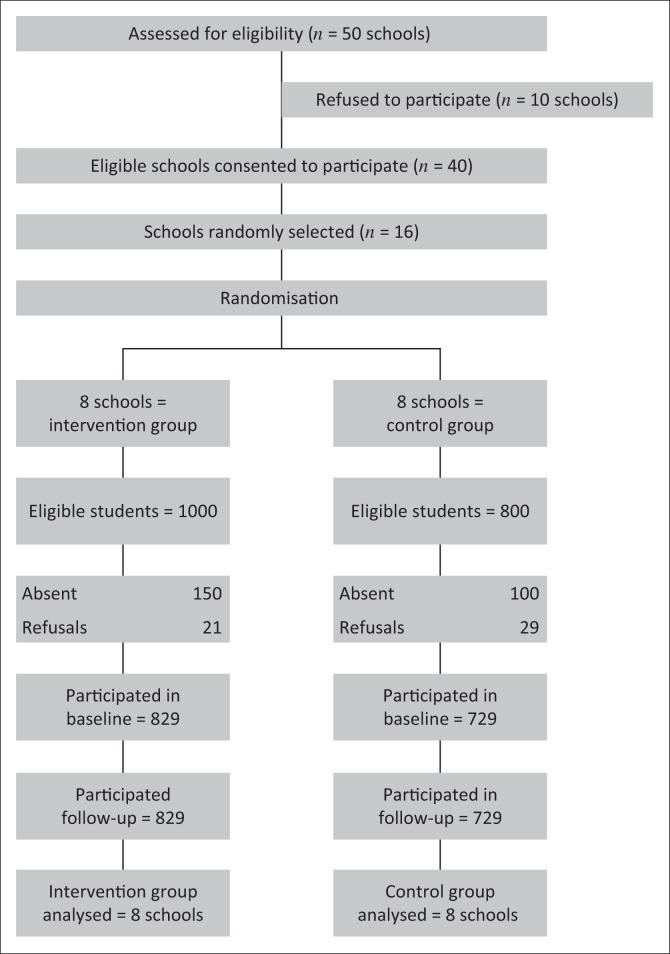
Methods: We conducted a cluster randomised controlled trial at 16 KwaZulu-Natal high schools where learners completed a self- administered questionnaire assessing youth risk behaviours. Schools were divided into two arms, intervention and a control arms.
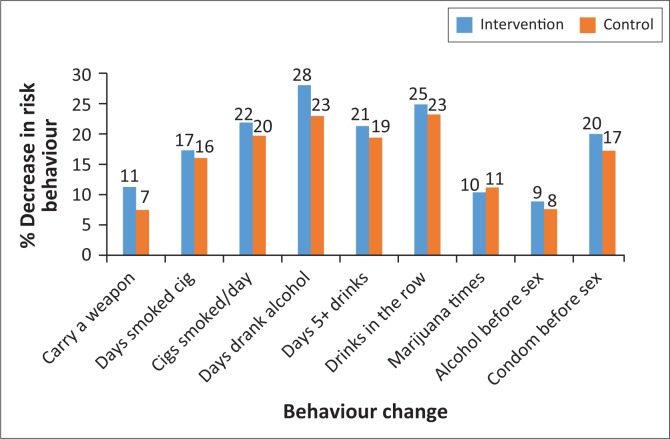
Results: The intervention reduced learners' reports of carrying of a weapon to school in the past 30 days, but did not significantly reduce other assessed risk behaviours. Although the intervention appeared more likely to reduce learners' risk behaviours when compared to the control group, such as carrying weapons, risky sexual behaviour and alcohol and drug abuse.
Conclusion: This study was unable to show statistical significance for these outcomes.
Keywords: alcohol abuse; carried weapons; sexual behaviours; students; youth behaviour.
© 2020. The Authors.
Conflict of interest statement
The authors have declared that no conflicts of interest exist.
Figures
References
-
- Bosch A., Rossouw J., Claassens T. & Du Plessis B., 2010, ‘A second look at measuring inequality in South Africa: A modified Gini coefficient’, School of Development Studies Working Paper 58, University of KwaZulu-Natal, Durban.
-
- Burton P. & Leoschut L., 2013a, ‘School violence in South Africa: Results of the 2012 national school violence study’, Centre for Justice and Crime Prevention Monograph Series 12, Centre for Justice and Crime Prevention, Mombray, Cape Town.
-
- Burton P. & Leoschut L., 2013b, School violence in South Africa: Results of the 2012 national school violence study, Centre for Justice and Crime Prevention, Mowbray, Cape Town.
LinkOut - more resources
Full Text Sources
Miscellaneous