


The prevalence of fear avoidance and pain catastrophising amongst patients with chronic neck pain
- PMID: 32161823
- PMCID: PMC7059507
- DOI: 10.4102/sajp.v76i1.1326
The prevalence of fear avoidance and pain catastrophising amongst patients with chronic neck pain
Abstract
Background: Cognitive factors impact chronic pain, but the prevalence of fear avoidance (FA) and pain catastrophising (PC) in individuals suffering from chronic neck pain (CNP) has not been investigated in South Africa.
Objectives: To determine the prevalence of FA and PC in patients with CNP at private physiotherapy practices in Johannesburg.
Method: The Tampa Scale for Kinesiophobia-11 (TSK-11) (α = 0.80) and Pain Catastrophising Scale (α = 0.87) self-report questionnaires were used in a cross-sectional study to determine the prevalence of FA and PC, respectively. Descriptive statistics and correlations using Pearson's or Spearman's coefficient were conducted between demographic variables and FA and PC. Non-parametric data were tested using the Wilcoxon rank-sum or Kruskal-Wallis test. Cohen's d-value or r-value measured strength of associations.
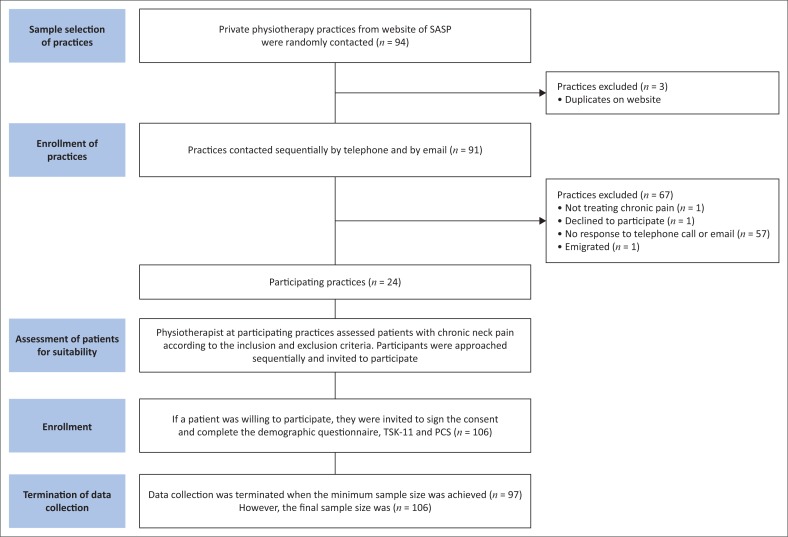
Results: A sample of 106 CNP patients with a mean age of 48.7 years (± 14.8) from 25 randomly selected private practices participated in the study. Of the participants, 81% were women (n = 86). Fear avoidance and PC had a prevalence of 25.5% (n = 27) and 15.1% (n = 16), respectively. A positive correlation was found between FA-11-Total and PC-Total (r = 0.684; p = 0.0001) and between FA (TSK-11-Total and TSK-SF (somatic focus)) and PC and its subscales (r ≥ 0.602; p = 0.0001). Participants with a secondary education (26.0 ± 3.4) showed a higher FA than those with tertiary education (21.9 ± 1.5). Effect size was moderate (Cohen's d = 0.60). Pain intensity correlated positively with both FA (Pearson's correlation: r = 0.33; p = 0.001) and PC (Spearman's correlation; r = 0.39; p = 0.0001).
Conclusion: FA and PC affect a number of patients with CNP. A lower level of education was associated with FA and a higher pain intensity was associated with higher FA and PC.
Clinical implications: Identifying FA and PC in patients with CNP is important to facilitate holistic management.
Keywords: South Africa; chronic neck pain; fear avoidance; pain catastrophising; prevalence.
© 2020. The Authors.
Conflict of interest statement
The authors declare that they have no financial or personal relationships that may have inappropriately influenced them in writing this article.
Figures
References
-
- Andersen T.E., 2016, ‘Pain-catastrophizing and fear-avoidance beliefs as mediators between posttraumatic stress symptoms and pain following whiplash injury – A prospective cohort study’, European Journal of Pain 20(8), 1241–1252. - PubMed
-
- Boonstra A.M., Preuper H.R.S., Reneman M.F., Posthumus J.B. & Stewart R.E.. 2008, ‘Reliability and validity of the visual analogue scale for disability in patients with chronic musculoskeletal pain’, International Journal of Rehabilitation Research 31(2), 165–169. 10.1097/MRR.0b013e3282fc0f93 - DOI - PubMed
-
- Carroll L.J., Hogg-Johnson S., Van Der Velde G., Haldeman S., Holm L.W., Carragee E.J. et al. , 2008, ‘Course and prognostic factors for neck pain in the general population: Results of the bone and joint decade 2000–2010 task force on neck pain and its associated disorders’, Spine 33(4S), S75–S82. 10.1097/BRS.0b013e31816445be - DOI - PubMed
LinkOut - more resources
Full Text Sources