Root Resorption Classifications: A Narrative Review and a Clinical Aid Proposal for Routine Assessment
- PMID: 32161869
- PMCID: PMC7006572
- DOI: 10.14744/eej.2018.33043
Root Resorption Classifications: A Narrative Review and a Clinical Aid Proposal for Routine Assessment
Abstract
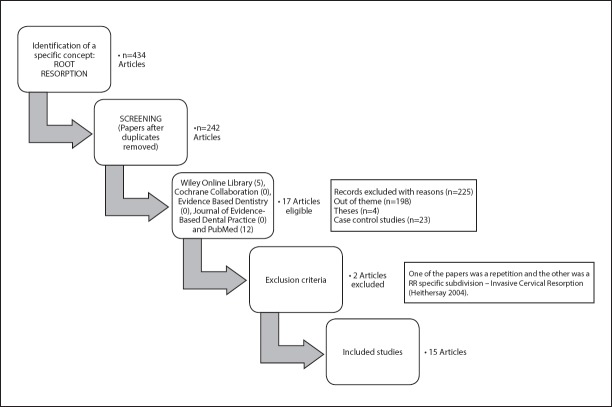
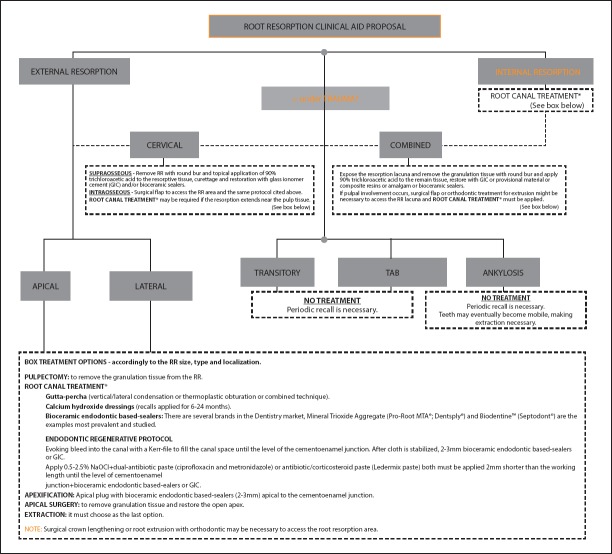
Root resorption (RR) refers to noninfectious damage related to the loss of hard and soft dental tissue that results from clastic cell activity. It is observed as a pathologic process that is predominantly asymptomatic in the permanent dentition and physiological during the shedding of primary teeth. Roots are protected by unmineralized organic cementoid and predentine. RR occurs because of the inability of the clastic cells to adhere to unmineralized surfaces. Since the first RR classification was described by Andreasen in the 1970s, several classifications have been proposed with diverse terminology. A narrative literature review was undertaken on the current classification, diagnosis, pathophysiology, and treatment of RR. A bibliographic search resulted in 434 titles and abstracts, and from those, 17 articles were obtained that alluded to 15 RR classifications. A total of 28 articles that met the inclusion criteria were included. Results showed that Andreasen's classification is the most widely used for classifying RR. In terms of epidemiologic data, studies are scarce, although RR pathophysiology is well described in the literature. Overall clinical guidelines are summarized in a new RR classification diagram. The choice of RR treatment application should be in line with the RR type and the dentist's experience. However, an earlier and correct diagnosis will significantly improve final outcomes and long-term prognosis, especially with the current evolution of advanced imaging techniques, such as cone-beam computed tomography and bioceramic-based endodontic sealers.
Keywords: RR diagnosis; RR pathophysiology and RR treatment; Root resorption classification; root resorption clinical aid proposal.
Copyright: © 2018 European Endodontic Journal.
Conflict of interest statement
Disclosures Conflict of interest: No conflict of interest was declared by the authors.
Figures
References
-
- Andreasen JO. Luxation of permanent teeth due to trauma A clinical and radiographic follow-up study of 189 injured teeth. Scand J Dent Res. 1970;78(3):273–86. - PubMed
-
- Trope M. Root resorption of dental and traumatic origin:classification based on etiology. Pract Periodontics Aesthet Dent. 1998;10(4):515–22. - PubMed
-
- Sak M, Radecka M, Karpiński T, Wędrychowicz-Welman A, Szkaradkiewicz A. Tooth root resorption:etiopathogenesis and classification. MicroMedicine. 2016;4(1):21–31.
-
- Trope M. Root Resorption due to dental trauma. Endodontic Topics. 2002;1(1):79–100.
-
- Patel S, Saberi N. The ins and outs of root resorption. Br Dent J. 2018;224(9):691–699. - PubMed
Publication types
LinkOut - more resources
Full Text Sources
Miscellaneous