Fracture Resistance of Endodontically Treated Anterior Teeth Restored with Different Post Systems: An In Vitro Study
- PMID: 32161874
- PMCID: PMC7006576
- DOI: 10.14744/eej.2018.70299
Fracture Resistance of Endodontically Treated Anterior Teeth Restored with Different Post Systems: An In Vitro Study
Abstract
Objective: This in vitro study aimed to evaluate the fracture resistance of endodontically treated maxillary central incisors with different post systems.
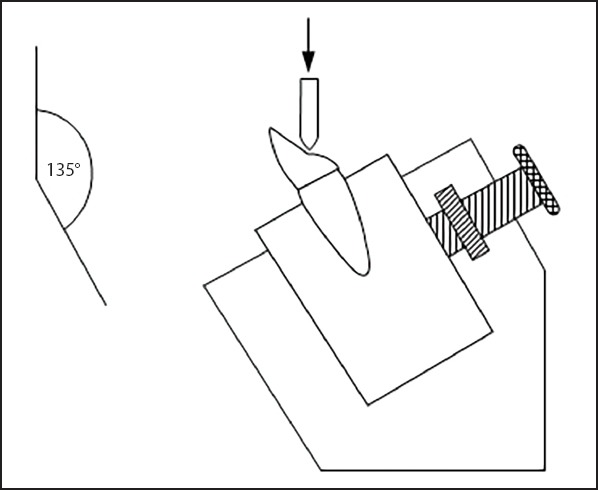
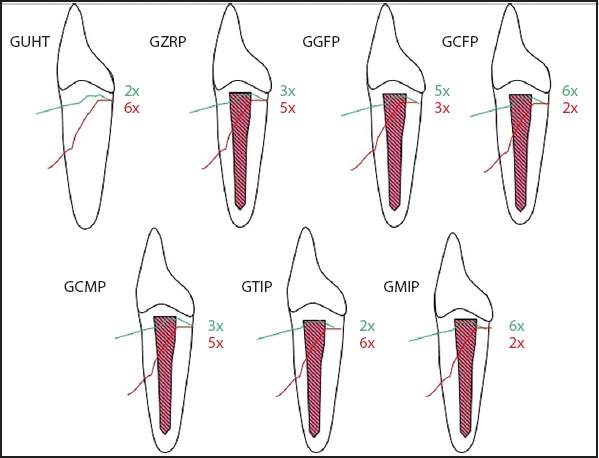
Methods: Fifty-six extracted intact maxillary permanent central incisors were used, treated endodontically (except for the control group), and distributed into the following seven test groups (n=8) depending on the post type: UHT (control group: root-filled teeth without endodontic post), ZRP (prefabricated zirconia post), GFP (prefabricated glass fiber post), CFP (prefabricated carbon fiber post), CPC (custom-made cast post and core), TIP (prefabricated titanium post), and MIP (prefabricated mixed post). The specimens were loaded in a universal testing machine until fracture occurrence. Failure loads were then analyzed with one-way analysis of variance (ANOVA), followed by multiple comparisons by using Tukey's honest significant difference test (α=0.05).
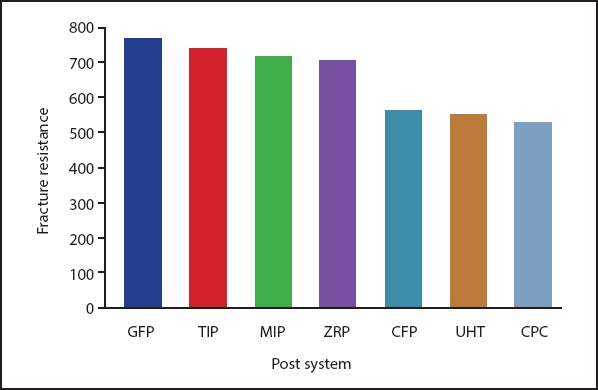
Results: Mean (SD) failure loads for groups ranged from 524±73.2 N for CPC to 764.1±156 N for GFP. One-way ANOVA showed significant differences in terms of fracture resistances among groups (P<0.001). Tukey's honest significant difference test showed significant differences in fracture resistance within groups (P≤0.05), whereas no difference was observed between the UHT (control group) and CFP and CPC groups (P≥0.05).
Conclusion: Endodontically treated teeth restored with zirconia post, glass fiber post, titanium post, or mixed post were more resistant to fracture loads compared with those that were not restored (control group) or restored with either carbon fiber post or cast post and core.
Keywords: Cast posts; fiber posts; fracture resistance; titanium posts; zirconia posts.
Copyright: © 2018 European Endodontic Journal.
Conflict of interest statement
Disclosures Conflict of interest: No conflict of interest was declared by the authors.
Figures
References
-
- Samran A, El Bahra S, Kern M. The influence of substance loss and ferrule height on the fracture resistance of endodontically treated premolars. An in vitro study. Dent Mater. 2013;29(12):1280–6. - PubMed
-
- Abduljawad M, Samran A, Kadour J, Al-Afandi M1, Ghazal M, Kern M. Effect of fiber posts on the fracture resistance of endodontically treated anterior teeth with cervical cavities:An in vitro study. J Prosthet Dent. 2016;116(1):80–4. - PubMed
-
- Samran A, Al-Afandi M, Kadour JA, Kern M. Effect of ferrule location on the fracture resistance of crowned mandibular premolars:An in vitro study. J Prosthet Dent. 2015;114(1):86–91. - PubMed
-
- Karzoun W, Abdulkarim A, Samran A, Kern M. Fracture strength of endodontically treated maxillary premolars supported by a horizontal glass fiber post:an in vitro study. J Endod. 2015;41(6):907–12. - PubMed
LinkOut - more resources
Full Text Sources
Miscellaneous