


Infant emotion regulation and cortisol response during the first 2 years of life: Association with maternal parenting profiles
- PMID: 32162302
- PMCID: PMC10264087
- DOI: 10.1002/dev.21965
Infant emotion regulation and cortisol response during the first 2 years of life: Association with maternal parenting profiles
Abstract
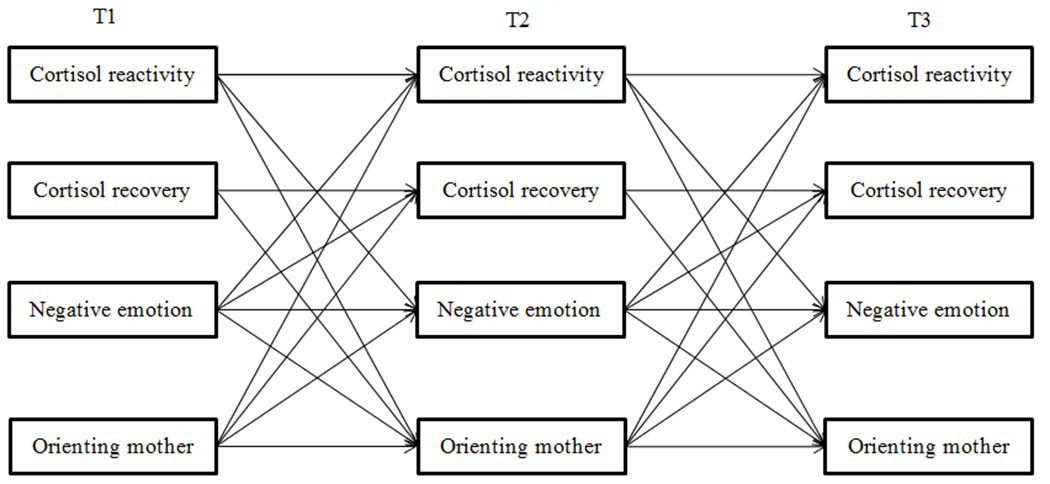
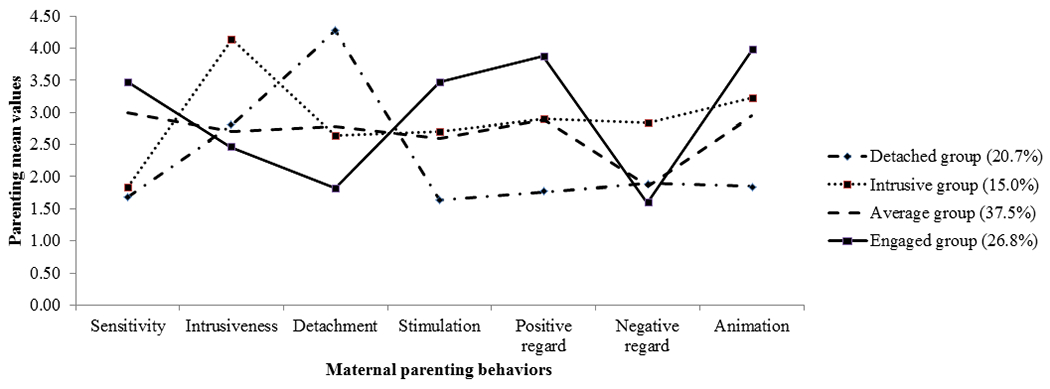
This study investigated the prospective associations among emotion expression, behavioral regulation, and cortisol responses in relation to different maternal parenting behaviors during the first 2 years of the infant's life, among a sample of low-income families. Participants included 1,141 mother-child pairs, assessed when the infants were 6, 15, and 24 months old. Maternal parenting behaviors were observed at the 6-month assessment, whereas infant emotion expression, orienting toward mothers, and cortisol responses were measured using a series of emotion-eliciting tasks at all time points. A latent profile analysis revealed four maternal parenting profiles: Detached, Intrusive, Average, and Engaged. Furthermore, a multiple-group path model revealed distinct patterns of emotion development for infants within different maternal parenting groups. Among children with Engaged and Average mothers, orienting behaviors tended to predict less negative emotion and cortisol responses, which was associated with more future orienting behaviors. Conversely, among children with Intrusive and Detached mothers, orienting behaviors tended to predict more negative emotion and cortisol responses, which predicted less future orienting behaviors. Findings of this study enhance current understanding of how different profiles of maternal parenting behaviors impact infant emotional development in poverty, with significant implications for intervention programs targeting early mother-infant interactions.
Keywords: cortisol responses; emotion expression; emotion regulation; maternal parenting.
© 2020 Wiley Periodicals, Inc.
Conflict of interest statement
No conflict of interest was disclosed by the authors.
Figures
References
-
- Ainsworth MDS, Blehar MC, Waters E, & Wall S (1978). Patterns of attachment. A psychological study of the strange situation. Hilsdale. NJ: Lawrence Erlbaurn.
-
- Asparouhouv T, & Muthén B (2013). Appendices for auxiliary variables in mixture modeling: 3-step approaches using Mplus. Mplus user’s guide. Achieved from: http://www.statmodel.com/download/AppendicesOct28.pdf
-
- Bakermans-Kranenburg MJ, van IJzendoorn MH, & Kroonenberg PM (2004). Differences in attachment security between African-American and white children: Ethnicity or socio-economic status?. Infant Behavior and Development, 27, 417–433. doi: 10.1016/j.infbeh.2004.02.002 - DOI
