Review
. 2020 Aug;127(2):102-110.
doi: 10.1111/bcpt.13403. Epub 2020 Mar 23.

Implicating endothelial cell senescence to dysfunction in the ageing and diseased brain

Affiliations
Review

Implicating endothelial cell senescence to dysfunction in the ageing and diseased brain

Sara I Graves et al. Basic Clin Pharmacol Toxicol. 2020 Aug.

Abstract

Cerebrovascular endothelial cells (CECs) are integral components of both the blood-brain barrier (BBB) and the neurovascular unit (NVU). As the primary cell type of the BBB, CECs are responsible for the tight regulation of molecular transport between the brain parenchyma and the periphery. Additionally, CECs are essential in neurovascular coupling where they help regulate cerebral blood flow in response to regional increases in cellular demand in the NVU. CEC dysfunction occurs during both normative ageing and in cerebrovascular disease, which leads to increased BBB permeability and neurovascular uncoupling. This MiniReview compiles what is known about the molecular changes underlying CEC dysfunction, many of which are reminiscent of cells that have become senescent. In general, cellular senescence is defined as an irreversible growth arrest characterized by the acquisition of a pro-inflammatory secretory phenotype in response to DNA damage or other cellular stresses. We discuss evidence for endothelial cell senescence in ageing and cardiovascular disease, and how CEC senescence may contribute to age-related cerebrovascular dysfunction.

Keywords: Alzheimer's disease; cellular senescence; endothelial cells; neurodegenerative disorders; neuropharmacology.


Figures

FIGURE 1
FIGURE 1
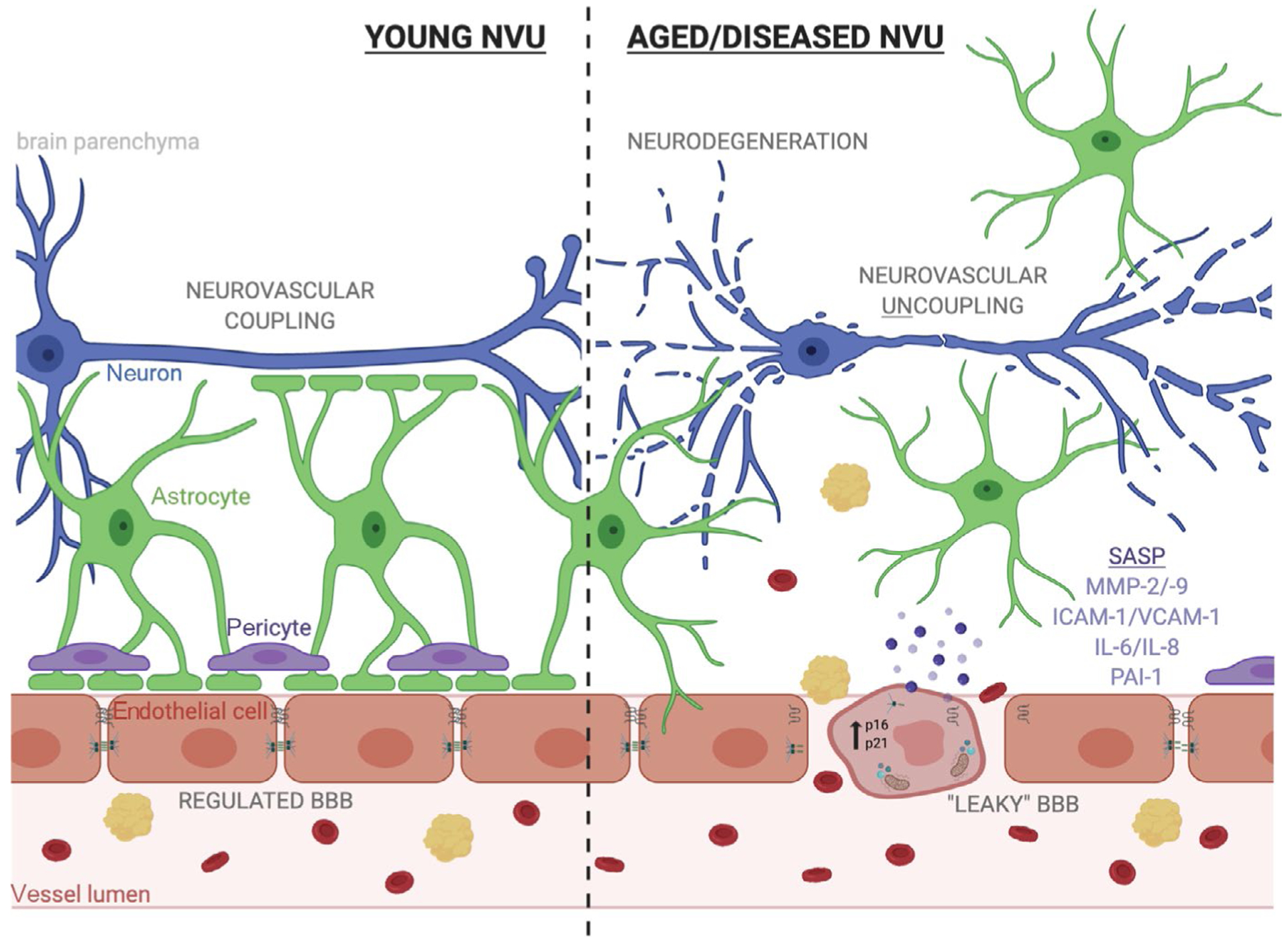
Endothelial cell senescence could drive blood-brain barrier (BBB) disruption, neurovascular uncoupling and neurodegeneration in ageing and disease. The neurovascular unit (NVU) is composed of endothelial cells, astrocytes, pericytes, and neurons which function cooperatively to regulate molecular transport from the periphery to the brain in order to maintain neuronal homeostasis and respond to changes in neuronal energy demands. Aging can induce changes in endothelial cells that disrupt the NVU’s role in the BBB and neurovascular coupling. These changes to endothelial cells are reminiscent of cellular senescence and include upregulation of cyclin-dependent kinase inhibitors, acquisition of a pro-inflammatory and degradative senescence-associated secretory phenotype (SASP), increased oxidative stress, and deregulated tight junctions. In this way, endothelial cell senescence along with age-related loss of pericytic coverage of vessels can lead to increased extravasation of red blood cells and other neurotoxic proteins. This BBB disruption causes an imbalance in the local microenvironment and can drive neuronal dysfunction. Additionally, age-related increases in astrocytic reactivity result in loss of astrocytic endfoot coverage and break the communication between neurons and the endothelium, termed “neurovascular uncoupling”, and also drives neurodegeneration
FIGURE 2
FIGURE 2
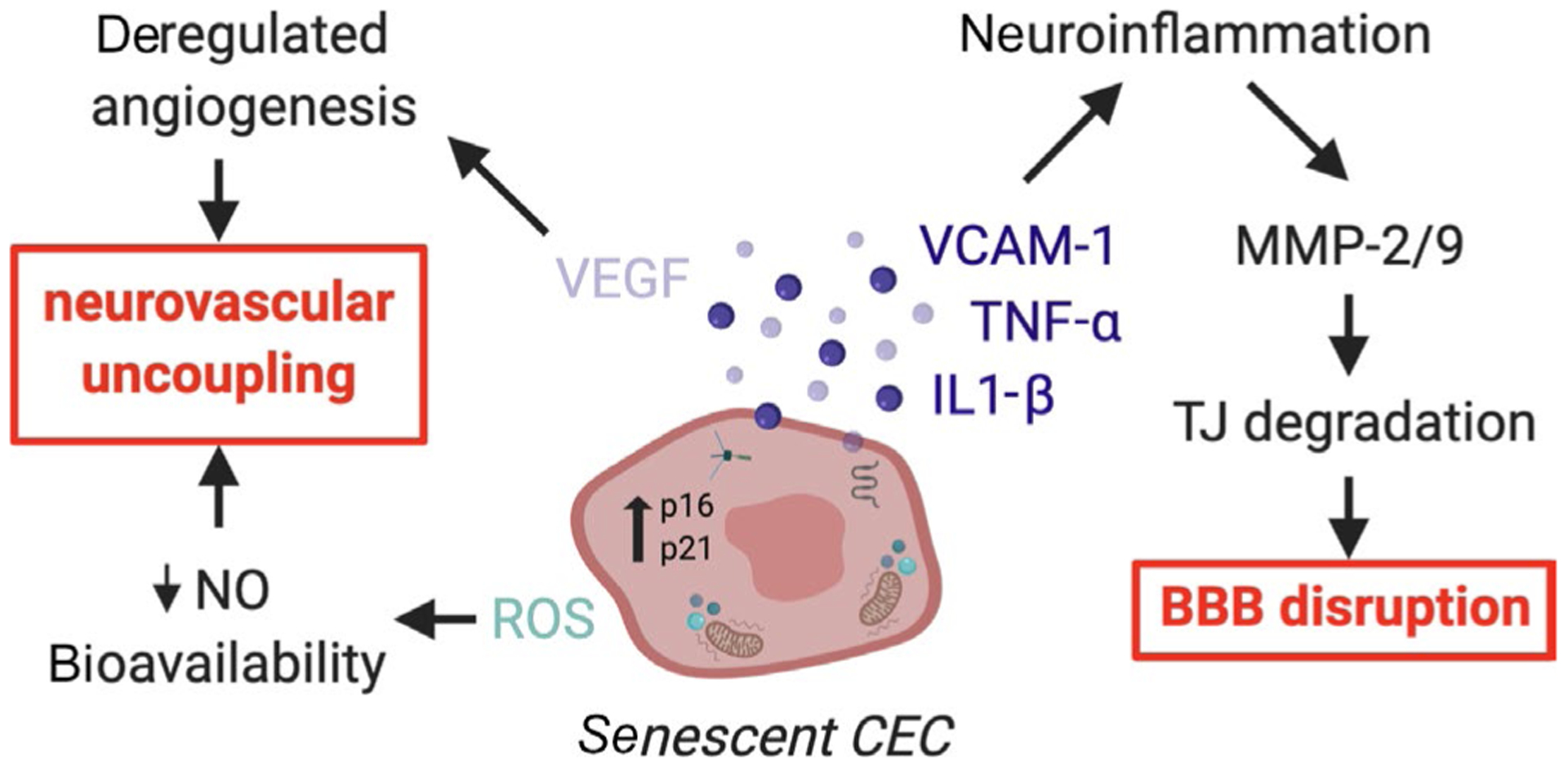
Proposed mechanisms for how senescent CECs affect the BBB and NVU. Senescent cerebrovascular endothelial cells (CECs) are hypothesized to accumulate with aging and cerebrovascular diseases like dementia by affecting neurovascular coupling and the blood-brain barrier (BBB). In general, senescent cells secrete pro-inflammatory molecules like VCAM-1, TNFα, and IL-1β, which stimulate greater neuroinflammation. Thus, one mechanism by which senescent CECs may induce BBB disruption is by stimulating chronic states of neuroinflammation and activating cytokine-inducible matrix metalloproteases (MMPs) that directly degrade tight junction (TJ) proteins. Senescent CECs may also promote neurovascular uncoupling via de-regulated VEGF/angiogenesis and/or increased reactive oxygen species (ROS)/decreased nitric oxide (NO) axes

References

    1. Arvanitakis Z, Capuano AW, Leurgans SE, Bennett DA, Schneider JA. Relation of cerebral vessel disease to Alzheimer’s disease dementia and cognitive function in elderly people: a cross-sectional study. Lancet Neurol. 2016;15(9):934–943. - PMC - PubMed
    1. Farrall AJ, Wardlaw JM. Blood–brain barrier: ageing and microvascular disease – systematic review and meta-analysis. Neurobiol Aging. 2009;30(3):337–352. - PubMed
    1. Iturria-Medina Y, Sotero RC, Toussaint PJ, Mateos-Pérez JM, Evans AC. Early role of vascular dysregulation on late-onset Alzheimer’s disease based on multifactorial data-driven analysis. Nat Commun. 2016;7(1):11934. - PMC - PubMed
    1. Montagne A, Samuel M, Matthew A, et al. Blood-brain barrier breakdown in the aging human hippocampus. Neuron. 2015;85(2):296–302. - PMC - PubMed
    1. Nation DA, Sweeney MD, Montagne A, et al. Blood–brain barrier breakdown is an early biomarker of human cognitive dysfunction. Nat Med. 2019;25(2):270–276. - PMC - PubMed

MeSH terms