


Association Between Skin Reaction and Clinical Benefit in Patients Treated with Anti-Programmed Cell Death 1 Monotherapy for Advanced Non-Small Cell Lung Cancer
- PMID: 32162801
- PMCID: PMC7066688
- DOI: 10.1634/theoncologist.2019-0550
Association Between Skin Reaction and Clinical Benefit in Patients Treated with Anti-Programmed Cell Death 1 Monotherapy for Advanced Non-Small Cell Lung Cancer
Abstract
Background: Anti-programmed cell death 1 antibody is a standard therapy for advanced non-small cell lung cancer (NSCLC). However, immune-related adverse events (irAEs), such as skin reactions, are frequently observed. Although skin reactions are associated with clinical efficacy in melanoma, this association in advanced NSCLC and predictors of irAEs remain unclear. Accordingly, this study identified potential correlations of skin reactions with clinical efficacy and clinical predictors of development of skin reactions.
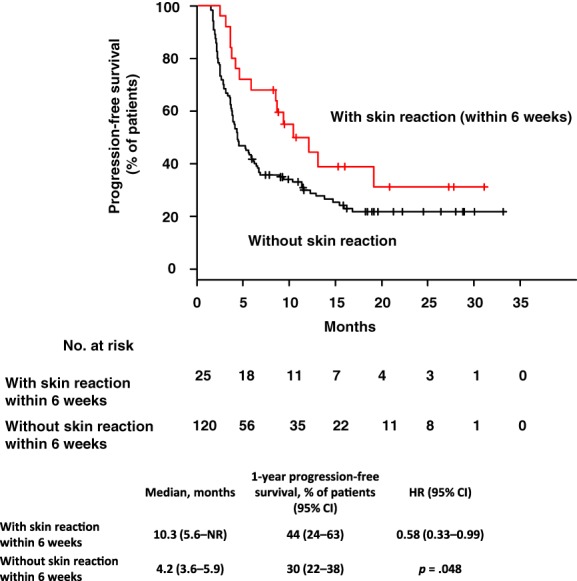
Subjects, materials, and methods: We retrospectively surveyed patients with advanced NSCLC who received nivolumab or pembrolizumab monotherapy at Sendai Kousei Hospital (n = 155) during January 2016 to April 2018. Treatment efficacy was evaluated in patients with and without skin reactions, and associated predictive markers were determined. A 6-week landmark analysis was conducted to assess the clinical benefit of early skin reactions.
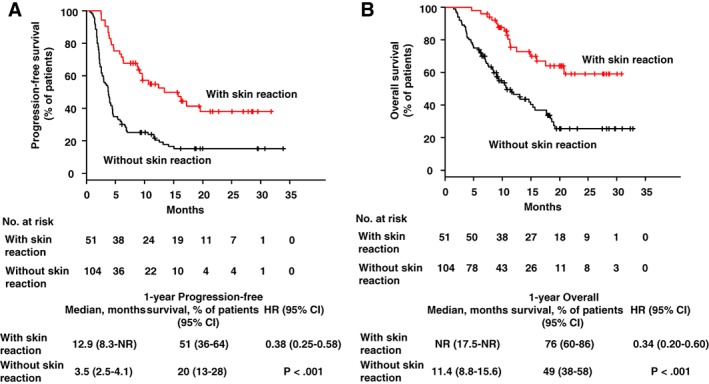
Results: Skin reactions were observed in 51 patients with a median time to onset of 6.4 weeks. The overall response rate (ORR) was significantly higher in patients with skin reactions (57% vs. 19%, p < .001). Median progression-free survival (PFS) durations of 12.9 and 3.5 months and overall survival durations of not reached and 11.4 months were observed in patients with and without skin reactions, respectively. In the 6-week landmark analysis, the ORR was significantly higher in patients with skin reactions, and skin reactions were significantly associated with increased PFS. A multivariate analysis identified pre-existing rheumatoid factor (RF) as an independent predictor of skin reactions.
Conclusion: Skin reactions appeared beneficial in patients treated with nivolumab/pembrolizumab for advanced NSCLC and could be predicted by pre-existing RF. Further large-scale validations studies are warranted.
Implications for practice: This single-institutional medical record review that included 155 patients with advanced non-small cell lung cancer who were treated with nivolumab or pembrolizumab monotherapy revealed that overall response rate and progression-free survival were significantly better in patients with skin reactions. Pre-existing rheumatoid factor was an independent predictor of skin reactions.
Keywords: Immune-related adverse events; Immunotherapy; Lung cancer; Programmed cell death 1; Rheumatoid factor; Skin reaction.
© AlphaMed Press 2019.
Conflict of interest statement
Figures
References
-
- Reck M, Rodríguez‐Abreu D, Robinson AG et al. Pembrolizumab versus chemotherapy for PD‐L1‐positive non‐small‐cell lung cancer. N Engl J Med 2016;375:1823–1833. - PubMed
-
- Brahmer J, Rodríguez‐Abreu D, Robinson A et al. OA 17.06 updated analysis of KEYNOTE‐024: Pembrolizumab vs platinum‐based chemotherapy for advanced NSCLC with PD‐L1 TPS ≥50%. J Thorac Oncol 2017;12(suppl 2):S1793–S1794.
-
- Gandhi L, Rodríguez‐Abreu D, Gadgeel S et al. KEYNOTE‐189 Investigators. Pembrolizumab plus chemotherapy in metastatic non–small‐cell lung cancer. N Engl J Med 2018;378:2078–2092. - PubMed
MeSH terms
Substances
LinkOut - more resources
Full Text Sources
Medical
Miscellaneous
