. 2020 Jun 1;36(11):3379-3384.
doi: 10.1093/bioinformatics/btaa170.

The Glycine Receptor Allosteric Ligands Library (GRALL)

Affiliations

The Glycine Receptor Allosteric Ligands Library (GRALL)

Adrien H Cerdan et al. Bioinformatics. .

Abstract

Motivation: Glycine receptors (GlyRs) mediate fast inhibitory neurotransmission in the brain and have been recognized as key pharmacological targets for pain. A large number of chemically diverse compounds that are able to modulate GlyR function both positively and negatively have been reported, which provides useful information for the development of pharmacological strategies and models for the allosteric modulation of these ion channels.

Results: Based on existing literature, we have collected 218 unique chemical entities with documented modulatory activities at homomeric GlyR-α1 and -α3 and built a database named GRALL. This collection includes agonists, antagonists, positive and negative allosteric modulators and a number of experimentally inactive compounds. Most importantly, for a large fraction of them a structural annotation based on their putative binding site on the receptor is provided. This type of annotation, which is currently missing in other drug banks, along with the availability of cooperativity factors from radioligand displacement experiments are expected to improve the predictivity of in silico methodologies for allosteric drug discovery and boost the development of conformation-based pharmacological approaches.

Availability and implementation: The GRALL library is distributed as a web-accessible database at the following link: https://ifm.chimie.unistra.fr/grall. For each molecular entry, it provides information on the chemical structure, the ligand-binding site, the direction of modulation, the potency, the 3D molecular structure and quantum-mechanical charges as determined by our in-house pipeline.

Contact: mcecchini@unistra.fr.

Supplementary information: Supplementary data are available at Bioinformatics online.


Figures

Fig. 1.
Fig. 1.
Screenshot from the GRALL website (https://ifm.chimie.unistra.fr/grall). GRALL can be downloaded as a combination of CSV (data) and multi-MOL2 (3D structures) files or accessed online. All compounds are displayed as rows in a table. For each compound, the chemical name, the 2D chemical structure, the isomeric SMILES, the chemical family, the binding site (if known and the level of confidence), the type of activity measurement, the potency against GlyR-α1 and/or -α3, the direction of modulation (i.e. PAM, NAM or absence of modulation) on GlyR-α1 and/or -α3, the DOI of the original publication reporting the functional assays and a link to the 3D structure of the compound in MOL2 format is available. A text-based search engine permits to filter the chemical library. Each column of the database can be directly sorted. Not Available (N.A) is used when the information was not found in the literature
Fig. 2.
Fig. 2.
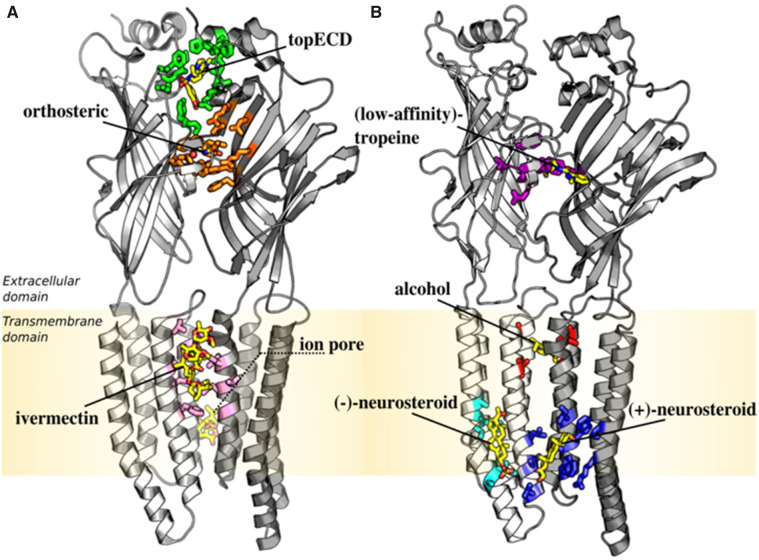
Topographical location of the actual/putative regulatory sites at GlyR by structural biology. (A) Regulatory sites illuminated by high-resolution structures of GlyR. From top to bottom: (i) the allosteric inter-subunit extracellular site (top-ECD) that accommodates the positive allosteric modulator AM-3607 is shown in green; (ii) the orthosteric site that binds the endogenous neurotransmitter glycine is in orange; (iii) the allosteric inter-subunit site in the transmembrane domain that binds the positive allosteric modulator ivermectin (ivermectin site) is in pink; (iv) the allosteric site for negative modulation by picrotoxin (ion pore site) is in the background. Coordinates for glycine, the allosteric modulators AM-3607 and ivermectin were extracted from the X-ray structure of GlyR-α3 (PDB: 5VDH; Huang et al., 2017a). Coordinates for picrotoxin were extracted from the X-ray structure of GABAAR-α1β3γ2 (PDB: 6HUG; Masiulis et al., 2019); they are consistent with the most-recent cryo-EM results in GlyR-α1 (Kumar et al., 2019). (B) Putative regulatory sites illuminated by high-resolution structures of homologous pLGICs with concordant evidence at GlyR. From top to bottom: (i) the extracellular site for the low-affinity tropeine-binding site is shown in purple with granisetron bound; (ii) the inter-subunit transmembrane site for alcohol binding is in red with propofol bound; (iii) the allosteric intra-subunit binding site for inhibition by neurosteroids or (−)-neurosteroid site is shown in cyan with pregnenolone sulfate (PS) bound; (iv) the allosteric inter-subunit binding site for potentiation by neurosteroids or (+)-neurosteroid site is shown in dark blue with tetrahydrodeoxycorticosterone (THDOC) bound. Coordinates for THDOC and PS were extracted from the X-ray structures of GLIC-GABAAR-α1 chimera (PDB: 5OSB) and (PDB: 5OSC) (Laverty et al., 2017), respectively, after structural alignment to GlyR-α3 in PyMOL (Schrödinger, LLC, 2015). Coordinates for granisetron were extracted from the high-resolution structure of 5-HT3A receptor (PDB: 6NP0; Basak et al., 2019). Coordinates for propofol were extracted from the high-resolution structure of GLIC F238A/N239A (PDB: 5MVM; Fourati et al., 2018). In all cases, residues that are known to be involved in binding of allosteric modulators at GlyR are color-coded

References

    1. Ahrens J. et al. (2008) A transmembrane residue influences the interaction of propofol with the strychnine-sensitive glycine alpha1 and alpha1beta receptor. Anesth. Analg., 107, 1875–1883. - PubMed
    1. Alvarez L.D., Pecci A. (2019) Mapping the neurosteroid binding sites on glycine receptors. J. Steroid Biochem. Mol. Biol., 192, 105388. - PubMed
    1. Basak S. et al. (2019) Molecular mechanism of setron-mediated inhibition of full-length 5-HT3A receptor. Nat. Commun., 10. - PMC - PubMed
    1. Bayly C.I. et al. (1993) A well-behaved electrostatic potential based method using charge restraints for deriving atomic charges: the RESP model. J. Phys. Chem., 97, 10269–10280.
    1. Berthold M.R. et al. (2007) KNIME: the Konstanz Information Miner In: Studies in Classification, Data Analysis, and Knowledge Organization (GfKL 2007). Springer.

Publication types