


Vital Signs: Colorectal Cancer Screening Test Use - United States, 2018
- PMID: 32163384
- PMCID: PMC7075255
- DOI: 10.15585/mmwr.mm6910a1
Vital Signs: Colorectal Cancer Screening Test Use - United States, 2018
Abstract
Background: Colorectal cancer (CRC) is the second leading cause of cancer death in the United States of cancers that affect both men and women. Despite strong evidence that screening for CRC reduces incidence and mortality, CRC screening prevalence is below the national target. This report describes current CRC screening prevalence by age, various demographic factors, and state.
Methods: Data from the 2018 Behavioral Risk Factor Surveillance System survey were analyzed to estimate the percentages of adults aged 50-75 years who reported CRC screening consistent with the United States Preventive Services Task Force recommendation.
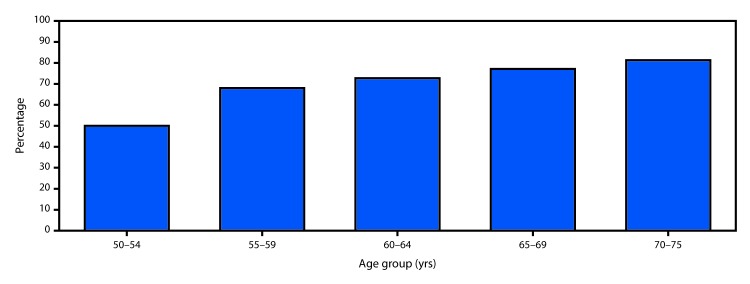
Results: In 2018, 68.8% of adults were up to date with CRC screening. The percentage up to date was 79.2% among respondents aged 65-75 years and 63.3% among those aged 50-64 years. CRC screening prevalence was lowest among persons aged 50-54 years (50.0%) and increased with age. Among respondents aged 50-64 years, CRC screening prevalence was lowest among persons without health insurance (32.6%) and highest among those with reported annual household income of ≥$75,000 (70.8%). Among respondents aged 65-75 years, CRC screening prevalence was lowest among those without a regular health care provider (45.6%), and highest among those with reported annual household income ≥$75,000 (87.1%). Among states, CRC screening prevalence was highest in Massachusetts (76.5%) and lowest in Wyoming (57.8%).
Discussion: CRC screening prevalence is lower among adults aged 50-64 years, although most reported having a health care provider and health insurance. Concerted efforts are needed to inform persons aged <50 years about the benefit of screening so that screening can start at age 50 years.
Conflict of interest statement
All authors have completed and submitted the International Committee of Medical Journal Editors form for disclosure of potential conflicts of interest. No potential conflicts of interest were disclosed.
Figures
References
-
- US Cancer Statistics Working Group. United States cancer statistics: data visualizations. Atlanta, GA: US Department of Health and Human Services, CDC; 2019. https://www.cdc.gov/cancer/dataviz
-
- National Cancer Institute. SEER*Explorer. Bethesda, MD: US Department of Health and Human Services, National Institutes of Health, National Cancer Institute; 2019. https://seer.cancer.gov/explorer/
-
- US Department of Health and Human Services. Healthy people 2020. Washington, DC: US Department of Health and Human Services, Office of Disease Prevention and Health Promotion; 2020. https://www.healthypeople.gov/2020/leading-health-indicators/2020-lhi-to...
MeSH terms
LinkOut - more resources
Full Text Sources
Medical
