Long-term trends in death and dependence after ischaemic strokes: A retrospective cohort study using the South London Stroke Register (SLSR)
- PMID: 32163411
- PMCID: PMC7067375
- DOI: 10.1371/journal.pmed.1003048
Long-term trends in death and dependence after ischaemic strokes: A retrospective cohort study using the South London Stroke Register (SLSR)
Abstract
Background: There have been reductions in stroke mortality over recent decades, but estimates by aetiological subtypes are limited. This study estimates time trends in mortality and functional dependence by ischaemic stroke (IS) aetiological subtype over a 16-year period.
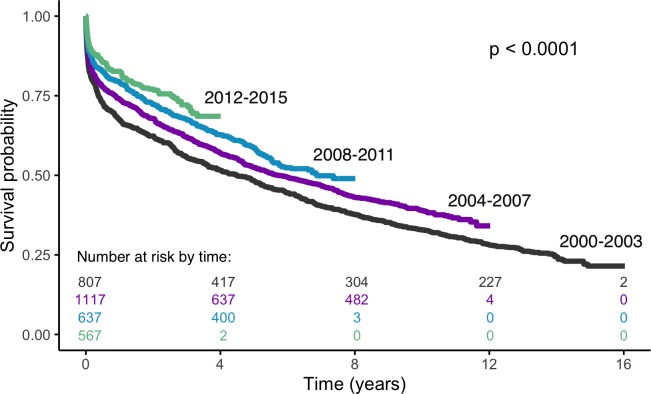
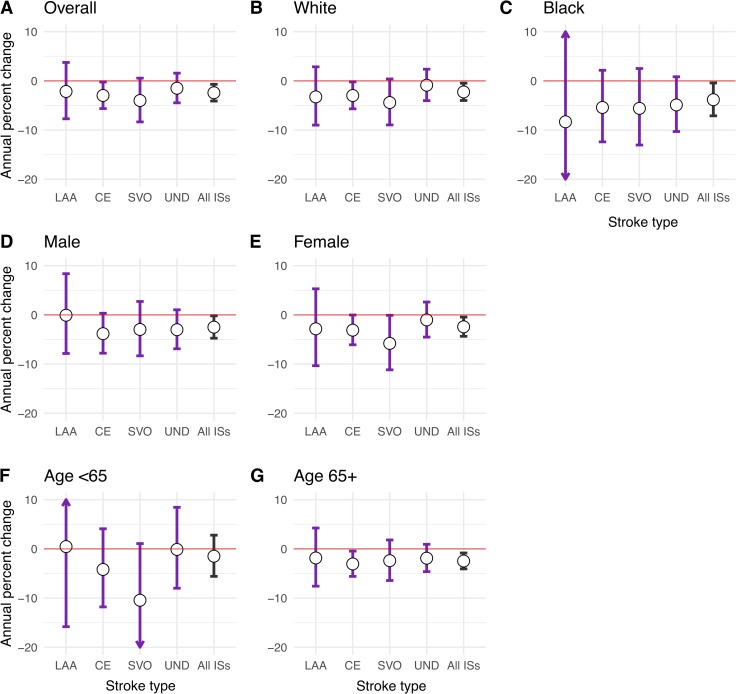
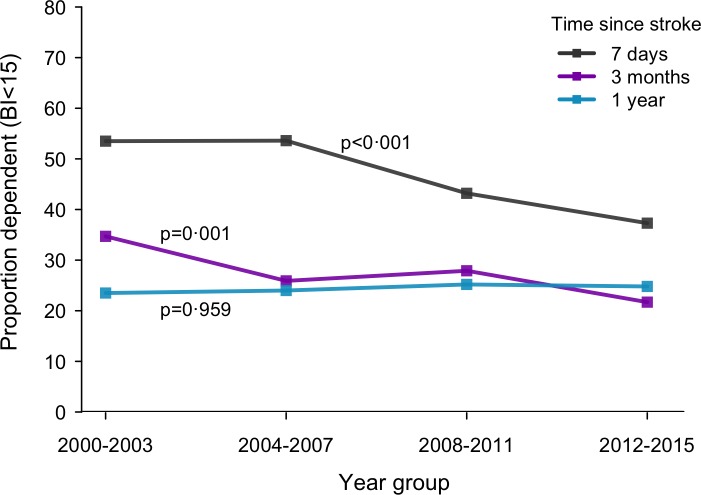
Methods and findings: The study population was 357,308 in 2011; 50.4% were males, 56% were white, and 25% were of black ethnic backgrounds. Population-based case ascertainment of stroke was conducted, and all participants who had their first-ever IS between 2000 and 2015 were identified. Further classification was concluded according to the underlying mechanism into large-artery atherosclerosis (LAA), cardio-embolism (CE), small-vessel occlusion (SVO), other determined aetiologies (OTH), and undetermined aetiologies (UND). Temporal trends in survival rates were examined using proportional-hazards survival modelling, adjusted for demography, prestroke risk factors, case mix variables, and processes of care. We carried out additional regression analyses to explore patterns in case-fatality rates (CFRs) at 30 days and 1 year and to explore whether these trends occurred at the expense of greater functional dependence (Barthel Index [BI] < 15) among survivors. A total of 3,128 patients with first-ever ISs were registered. The median age was 70.7 years; 50.9% were males; and 66.2% were white, 25.5% were black, and 8.3% were of other ethnic groups. Between 2000-2003 and 2012-2015, the adjusted overall mortality decreased by 24% (hazard ratio [HR] per year 0.976; 95% confidence interval [CI] 0.959-0.993). Mortality reductions were equally noted in both sexes and in the white and black populations but were only significant in CE strokes (HR per year 0.972; 95% CI 0.945‒0.998) and in patients aged ≥55 years (HR per year 0.975; 95% CI 0.959‒0.992). CFRs within 30 days and 1 year after an IS declined by 38% (rate ratio [RR] per year 0.962; 95% CI 0.941‒0.984) and 37% (RR per year 0.963; 95% CI 0.949‒0.976), respectively. Recent IS was independently associated with a 23% reduced risk of functional dependence at 3 months after onset (RR per year 0.983; 95% CI 0.968-0.998; p = 0.002 for trend). The study is limited by small number of events in certain subgroups (e.g., LAA), which could have led to insufficient power to detect significant trends.
Conclusions: Both mortality and 3-month functional dependence after IS decreased by an annual average of around 2.4% and 1.7%, respectively, during 2000‒2015. Such reductions were particularly evident in strokes of CE origins and in those aged ≥55 years.
Conflict of interest statement
The authors have declared that no competing interests exist.
Figures
References
-
- Murray CJ, Vos T, Lozano R, Naghavi M, Flaxman AD, Michaud C, et al. Disability-adjusted life years (DALYs) for 291 diseases and injuries in 21 regions, 1990–2010: a systematic analysis for the Global Burden of Disease Study 2010. Lancet. 2012;380(9859):2197–223. 10.1016/S0140-6736(12)61689-4 - DOI - PubMed
-
- Bray BD, Paley L, Hoffman A, James M, Gompertz P, Wolfe CDA, et al. Socioeconomic disparities in first stroke incidence, quality of care, and survival: a nationwide registry-based cohort study of 44 million adults in England. Lancet Public Health. 2018;3(4):e185–e93. 10.1016/S2468-2667(18)30030-6 - DOI - PMC - PubMed
Publication types
MeSH terms
Grants and funding
LinkOut - more resources
Full Text Sources
Medical