Prevalence of chronic chikungunya and associated risks factors in the French West Indies (La Martinique): A prospective cohort study
- PMID: 32163420
- PMCID: PMC7100975
- DOI: 10.1371/journal.pntd.0007327
Prevalence of chronic chikungunya and associated risks factors in the French West Indies (La Martinique): A prospective cohort study
Abstract
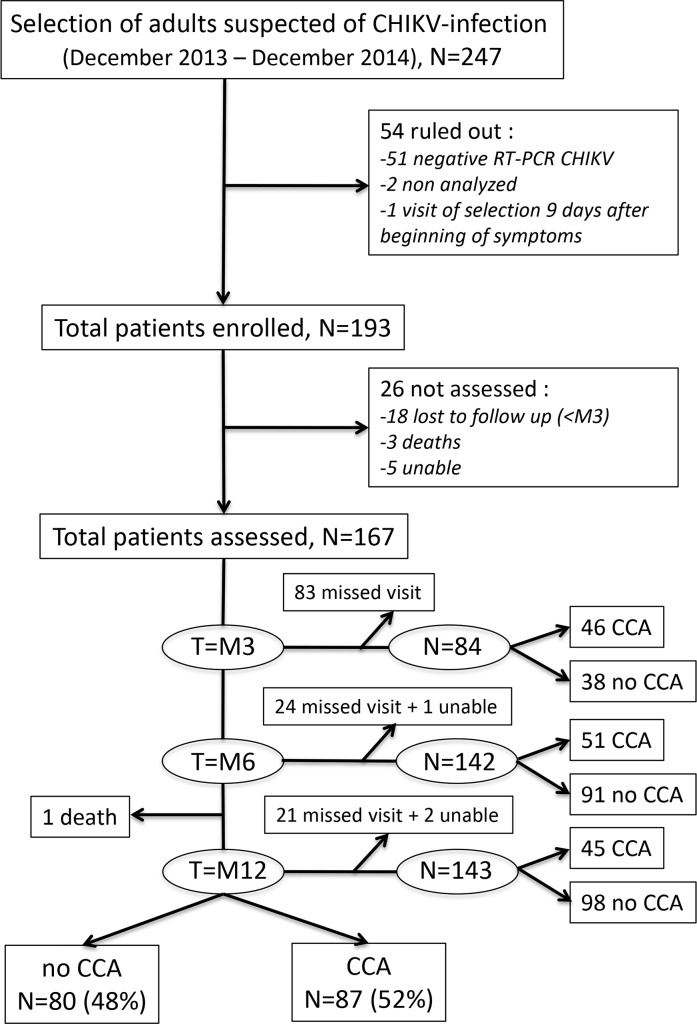
Background: The chikungunya virus (CHIKV) is a re-emerging alphavirus that can cause chronic and potentially incapacitating rheumatic musculoskeletal disorders known as chronic chikungunya arthritis (CCA). We conducted a prospective cohort study of CHIKV-infected subjects during the 2013 chikungunya outbreak in Martinique. The aim of this study was to assess the prevalence of CCA at 12 months and to search for acute phase factors significantly associated with chronicity.
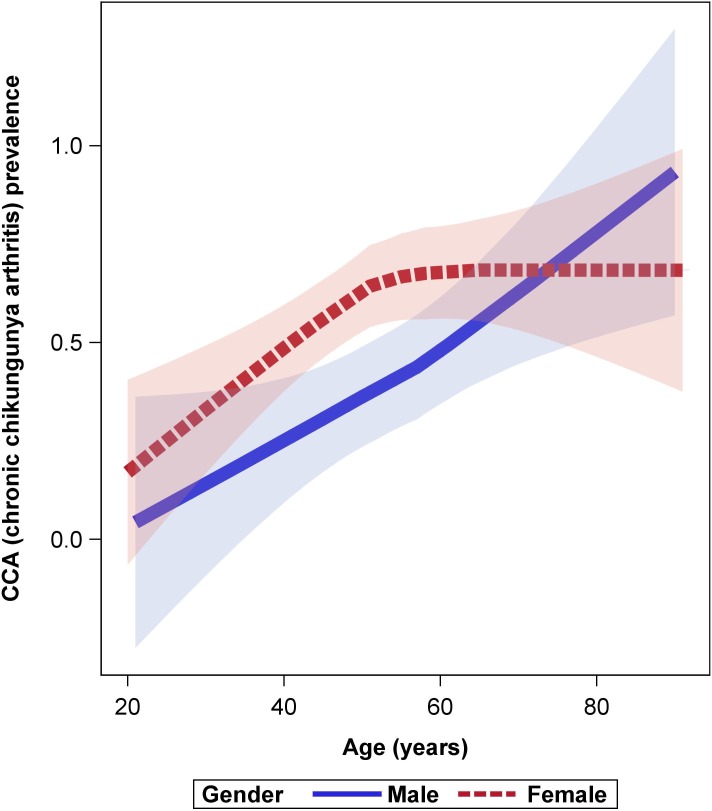
Methodology/principal findings: A total of 193 patients who tested positive for CHIKV RNA via qRT-PCR underwent clinical investigations in the acute phase (<21 days), and then 3, 6, and 12 months after inclusion. The Asian lineage was identified as the circulating genotype. A total of 167 participants were classified as either with or without CCA, and were analyzed using logistic regression models. The overall prevalence of CCA at 12 months was 52.1% (95%CI: 44.5-59.7). In univariate analysis, age (RD 9.62, 95% CI, 4.87;14.38, p<0.0001), female sex (RD 15.5, 95% CI, 1.03;30.0, p = 0.04), headache (RD 15.42, 95% CI, 0.65;30.18 p = 0.04), vertigo (RD 15.33, 95% CI, 1.47;29.19, p = 0.03), vomiting (RD 12.89, 95% CI, 1.54;24.24, p = 0.03), dyspnea (RD 13.53, 95% CI, 0.73;26.33, p = 0.04), intravenous rehydration (RD -16.12, 95% CI, -31.58; -0.66 p = 0.04) and urea (RD 0.66, 95% CI, 0.12;1.20, p = 0.02) were significantly associated with the development of CCA. For the subpopulation with data on joint involvement in the acute phase, the risk factors significantly associated with CCA were at least one 1 enthesitis (RD 16.7, 95%CI, 2.8; 30.7, p = 0.02) and at least one tenosynovitis (RD 16.8, 95% CI, 1.4-32.2, p = 0.04).
Conclusions: This cohort study conducted in Martinique confirms that CCA is a common complication of acute chikungunya disease. Our analysis emphasized the importance of age and female sex for CCA occurrence, and highlighted the aggravating role of dehydration during the acute phase. Early and adequate hydration were found to reduce the risk chronic chikungunya disorders.
Trial registration: clinicaltrials.gov (NCT01099852).
Conflict of interest statement
The authors have declared that no competing interests exist.
Figures
References
-
- Paupy C, Ollomo B, Kamgang B, Moutailler S, Rousset D, Demanou M, et al. Comparative role of Aedes albopictus and Aedes aegypti in the emergence of Dengue and Chikungunya in central Africa. Vector Borne Zoonotic Dis Larchmt N. 2010; 10(3): 259–66. - PubMed
-
- Diagne CT, Faye O, Guerbois M, Knight R, Diallo D, Faye O, et al. Vector Competence of Aedes aegypti and Aedes vittatus (Diptera: Culicidae) from Senegal and Cape Verde Archipelago for West African Lineages of Chikungunya Virus. Am J Trop Med Hyg. 2014; 91(3): 635–41. 10.4269/ajtmh.13-0627 - DOI - PMC - PubMed
-
- Delatte H, Paupy C, Dehecq JS, Thiria J, Failloux AB, Fontenille D. [Aedes albopictus, vector of chikungunya and dengue viruses in Reunion Island: biology and control]. Parasite Paris Fr. 2008; 15(1): 3–13. - PubMed
-
- Vazeille M, Moutailler S, Coudrier D, Rousseaux C, Khun H, Huerre M, et al. Two Chikungunya isolates from the outbreak of La Reunion (Indian Ocean) exhibit different patterns of infection in the mosquito, Aedes albopictus. PloS One. 2007; 2(11): e1168 10.1371/journal.pone.0001168 - DOI - PMC - PubMed
Publication types
MeSH terms
Substances
Associated data
LinkOut - more resources
Full Text Sources
Medical
Miscellaneous