


Prevalence and determinants of caesarean section in South and South-East Asian women
- PMID: 32163440
- PMCID: PMC7067459
- DOI: 10.1371/journal.pone.0229906
Prevalence and determinants of caesarean section in South and South-East Asian women
Abstract
Background: Caesarean section is considered a relatively preferable and safe method of delivery as compared to normal delivery. Since the last decade, its prevalence has increased in both developed and developing countries. In the context of developing countries viz., South Asia (the highest populated region) and South-East Asia (the third-highest populated region), where a significant proportion of home deliveries were reported,however, the preference for, caesarean delivery and its associated factors are not well understood.
Objective: To study the caesarean delivery in the South and South-East Asian countries and to determine the factors associated with the preference for caesarean delivery.
Methodology: Demographic and Health Survey Data on from ever-married women of nine developing countries of South and South-East Asia viz., Vietnam, India, Maldives, Timor-Leste, Nepal, Indonesia, Pakistan, Bangladesh, and Cambodia have been considered. Both bivariate and binary logistic regression models were used to estimate the propensity of a woman undergoing for caesarean delivery and to assess the influence of maternal socioeconomic characteristics towards the preference for caesarean delivery.
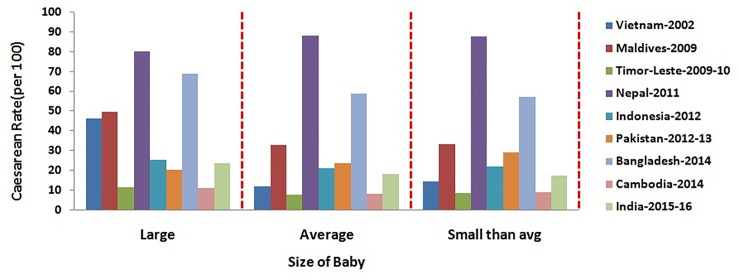
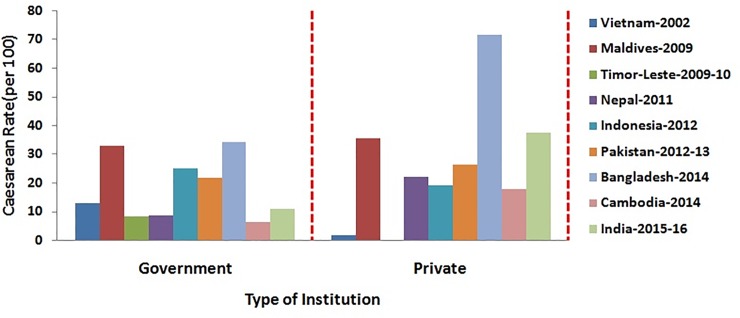
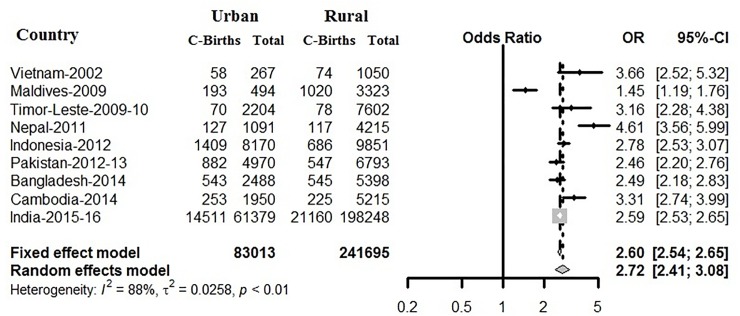
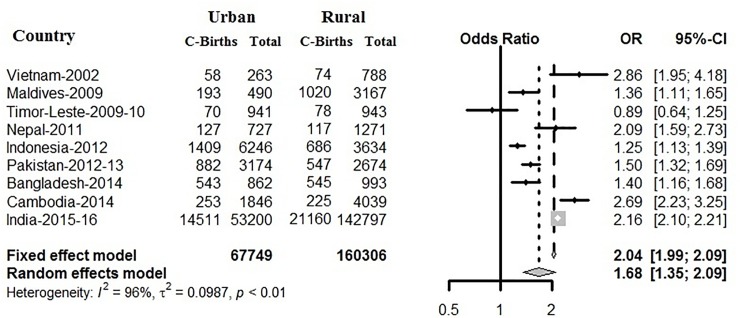
Results: Obtained results have shown an inclination of caesarean delivery among urban than rural women and are quite conspicuous, but is found to be underestimated mostly among rural women. Caesarean delivery in general is mostly predisposed among women whose baby sizes are either very large or smaller than average, have a higher level of education and place of delivery is private medical institutions. The logistic regression also revealed the influence of maternal socioeconomic characteristics towards the preference for caesarean delivery. Based on nine South and South-East Asian countries an overall C-section prevalence of 13%, but based on institutional births its increase to 19%. The forest plot demonstrated that a significant inclination of C-section among urban than rural regions. In Meta-Analysis, very high and significant heterogeneity among countries is observed, but confirms that in terms of prevalence of C-section all of the countries follow independent pattern.
Conclusion: Study of seven urban and four rural regions of nine South and South- East Asian countries showed, a significant inclination towards the caesarean delivery above the more recent outdated WHO recommended an optimal range of 10-15%and are associated maternal socioeconomic characteristics. In order to control unwanted caesarean delivery, the government needs to develop better healthcare infrastructure and along with more antenatal care related schemes to reduce the risks associated with increased caesarean delivery.
Conflict of interest statement
The authors have read the journal's policy and the authors of this study have the following competing interests: RP is a paid employee of Eurofins Limited (https://www.eurofins.com/agroscience-services/about-us/latest-news/eurofins-scientific-to-acquire-advinus-therapeutics/). There are no patents, products in development or marketed products associated with this research to declare. This does not alter our adherence to PLOS ONE policies on sharing data and materials.
Figures


References
-
- Leone Tiziana, Sabu S. Padmadas, and Zoë Matthews. "Community factors affecting rising caesarean section rates in developing countries: an analysis of six countries." Social science & medicine 67, no. 8 (2008): 1236–1246. - PubMed
-
- Chavan Niranjan. "Caesarean Delivery" In Labour Room Emergencies, pp. 297–303. Springer, Singapore, 2020.
-
- Osterman Michelle JK, and Joyce A. Martin. "National Vital Statistics Reports." National Vital Statistics Reports 63, no. 1 (2014).
MeSH terms
LinkOut - more resources
Full Text Sources
Medical
