Review
. 2020 Mar 10;8(3):384.
doi: 10.3390/microorganisms8030384.

Riboregulation in Nitrogen-Fixing Endosymbiotic Bacteria

Affiliations
Review

Riboregulation in Nitrogen-Fixing Endosymbiotic Bacteria

Marta Robledo et al. Microorganisms. .

Abstract

Small non-coding RNAs (sRNAs) are ubiquitous components of bacterial adaptive regulatory networks underlying stress responses and chronic intracellular infection of eukaryotic hosts. Thus, sRNA-mediated regulation of gene expression is expected to play a major role in the establishment of mutualistic root nodule endosymbiosis between nitrogen-fixing rhizobia and legume plants. However, knowledge about this level of genetic regulation in this group of plant-interacting bacteria is still rather scarce. Here, we review insights into the rhizobial non-coding transcriptome and sRNA-mediated post-transcriptional regulation of symbiotic relevant traits such as nutrient uptake, cell cycle, quorum sensing, or nodule development. We provide details about the transcriptional control and protein-assisted activity mechanisms of the functionally characterized sRNAs involved in these processes. Finally, we discuss the forthcoming research on riboregulation in legume symbionts.

Keywords: RNA-binding proteins; RNases; Sinorhizobium (Ensifer) meliloti; dRNA-Seq; legumes; non-coding RNA; rhizobia; sRNA; α-proteobacteria.


Conflict of interest statement

The authors declare no conflict of interest. The funders had no role in the design of the study; in the collection, analyses, or interpretation of data; in the writing of the manuscript, or in the decision to publish the results.

Figures
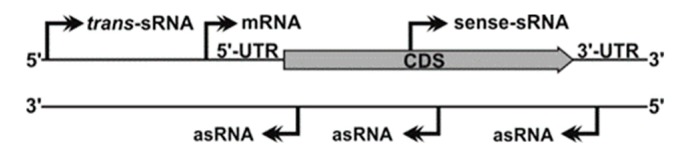
Figure 1
Figure 1
The prokaryotic non-coding transcriptome as revealed by dRNA-Seq. Identified Transcription Start Sites (TSSs; shown by arrows) can be assigned to mRNA and the different sRNA types (trans-sRNAs, asRNAs and mRNA-derived sense-sRNAs). See text for further details.
Figure 2
Figure 2
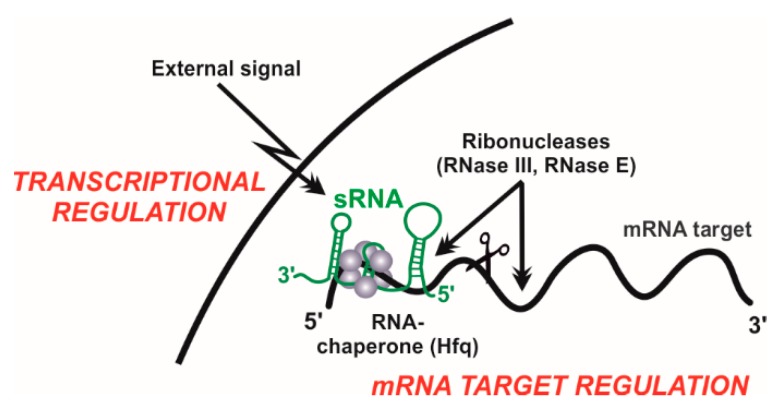
Key features of bacterial trans-sRNA biology. Differential regulation, target recognition and association with RNA chaperones and ribonucleases.
Figure 3
Figure 3
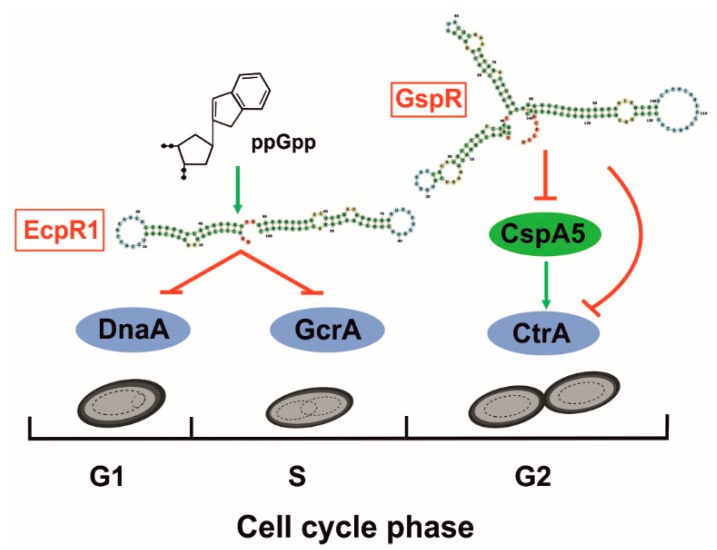
Activity mechanisms of S. meliloti cell-cycle trans-sRNAs. EcpR1 (left) is transcriptionally induced by the alarmone ppGpp and represses the early cell cycle transcriptional regulators DnaA and GcrA, restraining transition to G2 phase. GspR (right) regulates the expression of the gene encoding the essential cell division protein CtrA, preventing cytokinesis, and the cold-shock protein homolog CspA5, which is a CtrA activator.
Figure 4
Figure 4
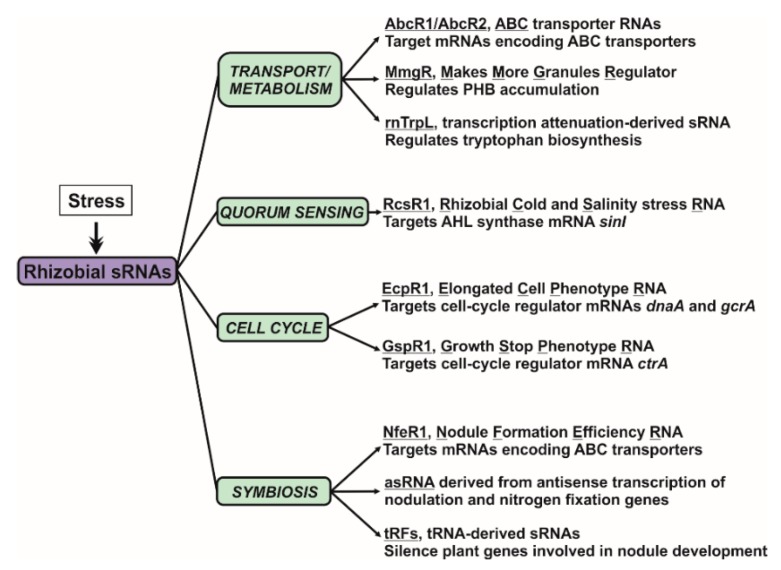
Cell processes that are riboregulated in rhizobia and the sRNAs involved.

References

    1. Poole P., Ramachandran V., Terpolilli J. Rhizobia: From saprophytes to endosymbionts. Nat. Rev. Microbiol. 2018;16:291. doi: 10.1038/nrmicro.2017.171. - DOI - PubMed
    1. Gage D. Infection and invasion of roots by symbiotic, nitrogen-fixing rhizobia during nodulation of temperate legumes. Microbiol. Mol. Biol. Rev. 2004;68:280–300. doi: 10.1128/MMBR.68.2.280-300.2004. - DOI - PMC - PubMed
    1. Gibson K.E., Kobayashi H., Walker G.C. Molecular determinants of a symbiotic chronic infection. Annu. Rev. Genet. 2008;42:413–441. doi: 10.1146/annurev.genet.42.110807.091427. - DOI - PMC - PubMed
    1. Zahran H.H. Rhizobium-legume symbiosis and nitrogen fixation under severe conditions and in an arid climate. Microbiol. Mol. Biol. Rev. 1999;63:968–989. doi: 10.1128/MMBR.63.4.968-989.1999. - DOI - PMC - PubMed
    1. Philippot L., Raaijmakers J.M., Lemanceau P., Van Der Putten W.H. Going back to the roots: The microbial ecology of the rhizosphere. Nat. Rev. Microbiol. 2013;11:789–799. doi: 10.1038/nrmicro3109. - DOI - PubMed

LinkOut - more resources