


Targeted Exome Sequencing Provided Comprehensive Genetic Diagnosis of Congenital Anomalies of the Kidney and Urinary Tract
- PMID: 32164334
- PMCID: PMC7141392
- DOI: 10.3390/jcm9030751
Targeted Exome Sequencing Provided Comprehensive Genetic Diagnosis of Congenital Anomalies of the Kidney and Urinary Tract
Abstract
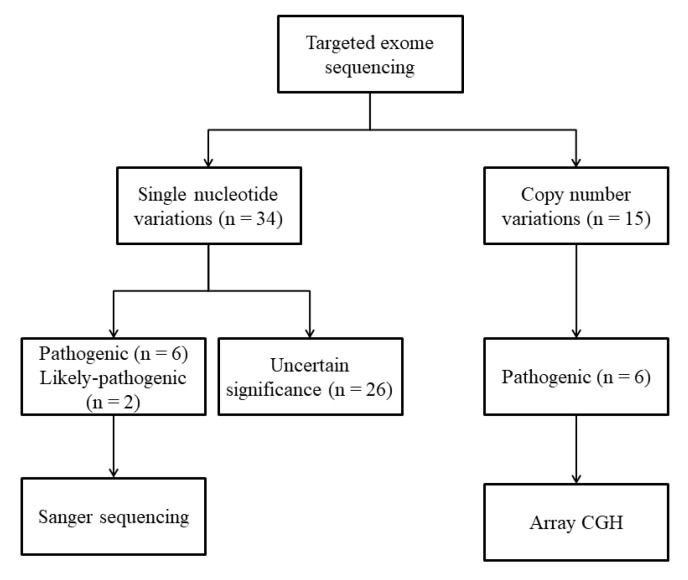
Congenital anomalies of the kidney and urinary tract (CAKUT) are the most common cause of chronic kidney disease in children. The search for genetic causes of CAKUT has led to genetic diagnosis in approximately 5-20 % of CAKUT patients from Western countries. In this study, genetic causes of CAKUT in Korean children were sought using targeted exome sequencing (TES) of 60 genes reported to cause CAKUT in human or murine models. We identified genetic causes in 13.8% of the 94 recruited patients. Pathogenic single nucleotide variants of five known disease-causing genes, HNF1B, PAX2, EYA1, UPK3A, and FRAS1 were found in 7 cases. Pathogenic copy number variations of 6 patients were found in HNF1B, EYA1, and CHD1L. Genetic abnormality types did not significantly differ according to CAKUT phenotypes. Patients with pathogenic variants of targeted genes had syndromic features more frequently than those without (p < 0.001). This is the first genetic analysis study of Korean patients with CAKUT. Only one-seventh of patients were found to have pathogenic mutations in known CAKUT-related genes, indicating that there are more CAKUT-causing genes or environmental factors to discover.
Keywords: congenital anomalies of kidney and urinary tract; copy number variant; genetic analysis; single nucleotide variant.
Conflict of interest statement
The authors declare no conflict of interest. The funders had no role in the design of the study; in the collection, analyses, or interpretation of data; in the writing of the manuscript, or in the decision to publish the results.
Figures
References
-
- Kang N.R., Ahn Y.H., Park E., Choi H.J., Kim S.H., Cho H., Cho M.H., Shin J.I., Lee J.H., Park Y.S., et al. Mental health and psychosocial adjustment in pediatric chronic kidney disease derived from the KNOW-Ped CKD study. Pediatr. Nephrol. 2019;10:1753–1764. doi: 10.1007/s00467-019-04292-w. - DOI - PubMed
Grants and funding
LinkOut - more resources
Full Text Sources
