


Maternal plasma lipid levels across pregnancy and the risks of small-for-gestational age and low birth weight: a cohort study from rural Gambia
- PMID: 32164563
- PMCID: PMC7068879
- DOI: 10.1186/s12884-020-2834-1
Maternal plasma lipid levels across pregnancy and the risks of small-for-gestational age and low birth weight: a cohort study from rural Gambia
Abstract
Background: Sub-optimal maternal lipid levels during pregnancy may be implicated in the pathophysiological mechanisms leading to low birth weight (LBW) and small-for-gestational-age (SGA). We aimed to determine whether maternal lipid levels across pregnancy were associated with birth weight and the risks of LBW and SGA in rural Gambia.
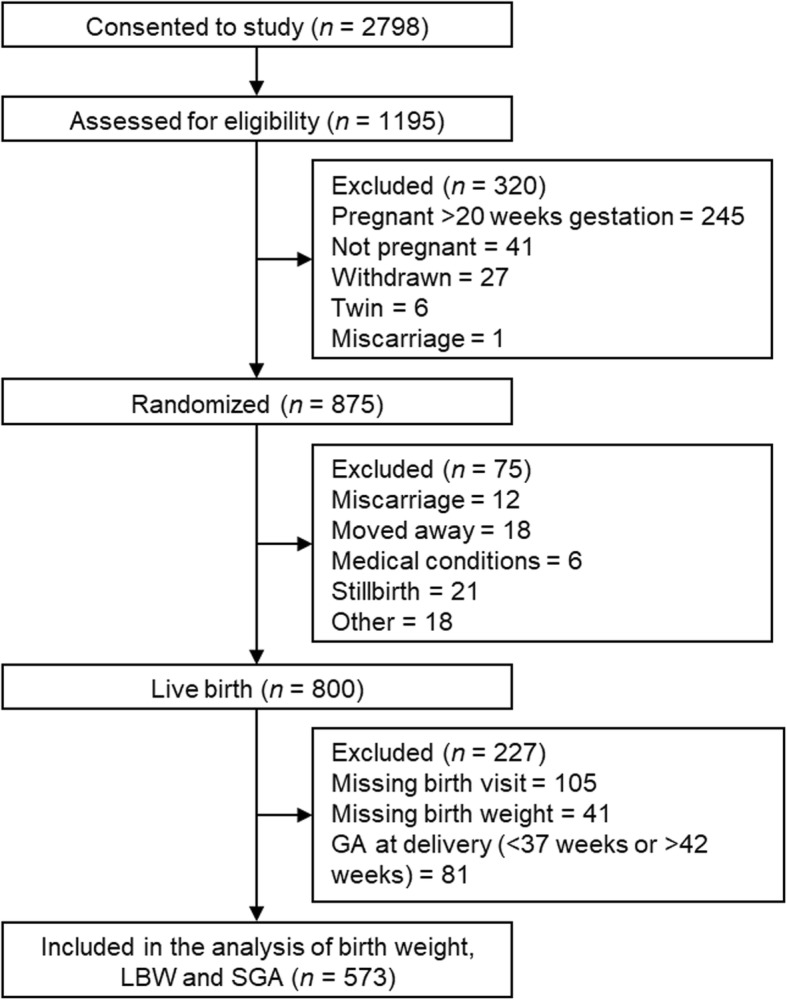
Methods: This secondary analysis of the ENID trial involved 573 pregnant women with term deliveries. Plasma levels of total cholesterol (TC), high-density lipoprotein cholesterol (HDL-c), low-density lipoprotein cholesterol (LDL-c), and triglycerides (TG) were analyzed at enrolment (mean (SD) = 13.9 (3.3) weeks gestation), 20 and 30 weeks gestation as continuous variables and percentile groups. Regression models with adjustment for confounders were used to examine associations between gestational lipid levels and birth weight and the risks of LBW (birth weight < 2500 g) and SGA (<10th percentile INTERGROWTH-21ST for birth weight).
Results: There were 7.9% LBW and 32.5% SGA infants. At enrolment, every unit increase in HDL-c was associated with a 2.7% (P = 0.011) reduction in relative risk of LBW. At 20 weeks gestation, every unit increase in TC levels was associated with a 1.3% reduction in relative risk of LBW (P = 0.002). Low (<10th percentile) HDL-c at enrolment or at 20 weeks gestation was associated with a 2.6 (P = 0.007) and 3.0 (P = 0.003) times greater risk of LBW, respectively, compared with referent (10th─90th) HDL-c. High (>90th percentile) LDL-c at 30 weeks gestation was associated with a 55% lower risk of SGA compared with referent LDL-c (P = 0.017). Increased levels of TC (β = 1.3, P = 0.027) at 20 weeks gestation and of TC (β = 1.2, P = 0.006) and LDL-c (β = 1.5, P = 0.002) at 30 weeks gestation were all associated with higher birth weight.
Conclusions: In rural Gambia, lipid levels during pregnancy were associated with infant birth weight and the risks of LBW and SGA. Associations varied by lipid class and changed across pregnancy, indicating an adaptive process by which maternal lipids may influence fetal growth and birth outcomes.
Trial registration: This trial was registered as ISRCTN49285450 on: 12/11/2009.
Keywords: Birth weight; Cholesterol; Low birth weight; Maternal lipids; Pregnancy; Small-for-gestational-age; The Gambia; Triglycerides.
Conflict of interest statement
The authors declare that they have no competing interests.
Figures

References
-
- UNICEF and WHO. Low Birthweight: country, Regional and Global Estimates. UNICEF; 2004. p. 27. ISBN:92-806-3832-7. https://www.unicef.org/publications/index_24840.html.
Publication types
MeSH terms
Substances
Grants and funding
LinkOut - more resources
Full Text Sources
Medical
Miscellaneous
