


Frailty assessment and risk prediction by GRACE score in older patients with acute myocardial infarction
- PMID: 32164580
- PMCID: PMC7069195
- DOI: 10.1186/s12877-020-1500-9
Frailty assessment and risk prediction by GRACE score in older patients with acute myocardial infarction
Abstract
Background: Risk prediction after myocardial infarction is often complex in older patients. The Global Registry of Acute Coronary Events (GRACE) model includes clinical parameters and age, but not frailty. We hypothesised that frailty would enhance the prognostic properties of GRACE.
Methods: We performed a prospective observational cohort study in two independent cardiology units: the Royal Infirmary of Edinburgh, UK (primary cohort) and the South Yorkshire Cardiothoracic Centre, Sheffield, UK (external validation). The study sample included 198 patients ≥65 years old hospitalised with type 1 myocardial infarction (primary cohort) and 96 patients ≥65 years old undergoing cardiac catheterisation for myocardial infarction (external validation). Frailty was assessed using the Clinical Frailty Scale (CFS). The GRACE 2.0 estimated risk of 12-month mortality, Charlson comorbidity index and Karnofsky disability scale were also determined for each patient.
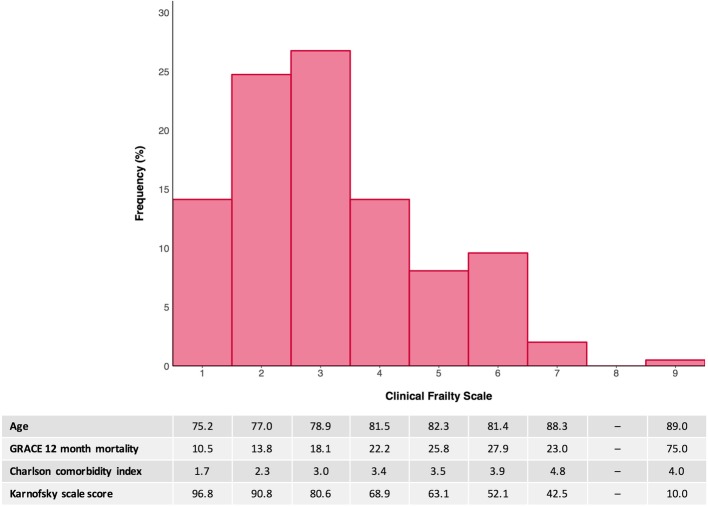
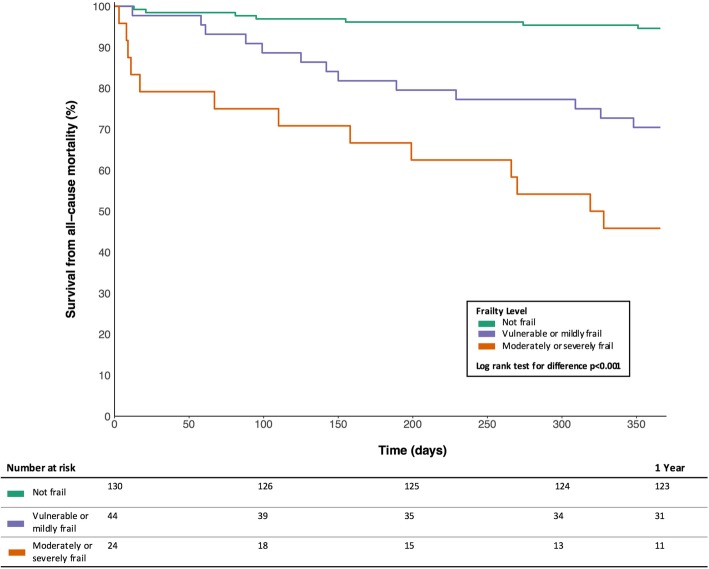
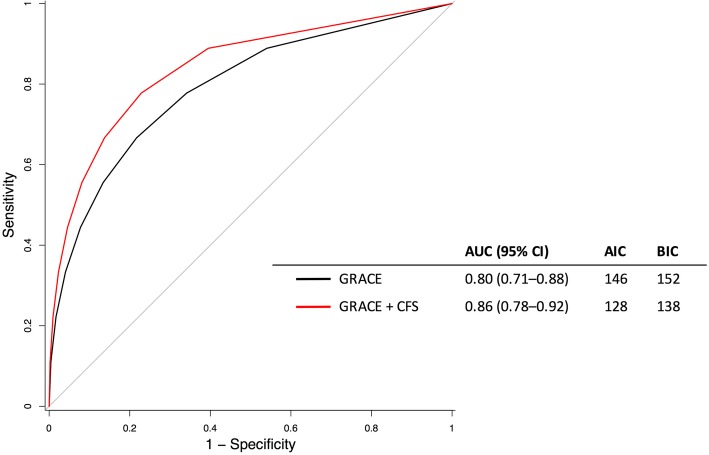
Results: Forty (20%) patients were frail (CFS ≥5). These individuals had greater comorbidity, functional impairment and a higher risk of death at 12 months (49% vs. 9% in non-frail patients, p < 0.001). The hazard of 12-month all-cause mortality nearly doubled per point increase in CFS after adjustment for age, sex and comorbidity (Hazard Ratio [HR] 1.90, 95% CI 1.47-2.44, p < 0.001). The CFS had good discrimination for mortality by Receiver Operating Characteristic (ROC) curve analysis (Area Under the Curve [AUC] 0.81, 95% CI 0.72-0.89) and enhanced the GRACE estimate (AUC 0.86 vs. 0.80 without CFS, p = 0.04). At existing GRACE thresholds, the CFS resulted in a Net Reclassification Improvement (NRI) of 0.44 (95% CI 0.28-0.60, p < 0.001), largely through reductions in risk estimates amongst non-frail patients. Similar findings were observed in the external validation cohort (NRI 0.46, 95% CI 0.23-0.69, p < 0.001).
Conclusions: The GRACE score overestimated mortality risk after myocardial infarction in these cohorts of older patients. The CFS is a simple guided frailty tool that may enhance prediction in this setting. These findings merit evaluation in larger cohorts of unselected patients.
Trial registration: Clinicaltrials.gov; NCT02302014 (November 26th 2014, retrospectively registered).
Keywords: Acute coronary syndrome; Frailty; Myocardial infarction; Risk prediction.
Conflict of interest statement
The authors declare that they have no competing interests.
Figures
References
-
- Fox KAA, Gore JM, Eagle KA, Steg PG, Agnelli G, Avezum A, et al. Rationale and design of the grace (global registry of acute coronary events) project: a multinational registry of patients hospitalized with acute coronary syndromes. Am Heart J. 2001;141(2):190–199. doi: 10.1067/mhj.2001.112404. - DOI - PubMed
Publication types
MeSH terms
Substances
Associated data
Grants and funding
LinkOut - more resources
Full Text Sources
Medical
