


Mutation landscape of germline and somatic BRCA1/2 in patients with high-grade serous ovarian cancer
- PMID: 32164585
- PMCID: PMC7069205
- DOI: 10.1186/s12885-020-6693-y
Mutation landscape of germline and somatic BRCA1/2 in patients with high-grade serous ovarian cancer
Abstract
Background: Poly (ADP-ribose) polymerase inhibitors targeting BRCA1/2 mutations are available for treating patients with high-grade serous ovarian cancer. These treatments may be more appropriately directed to patients who might respond if the tumor tissue is additionally tested by next-generation sequencing with a multi-gene panel and Sanger sequencing of a blood sample. In this study, we compared the results obtained using the next-generation sequencing multi-gene panel to a known germline BRCA1/2 mutational state determined by conventional Sanger sequencing to evaluate the landscape of somatic mutations in high-grade serous ovarian cancer tumors.
Methods: Cancer tissue from 98 patients with high-grade serous ovarian cancer who underwent Sanger sequencing for germline BRCA1/2 analysis were consecutively analyzed for somatic mutations using a next-generation sequencing 170-gene panel.
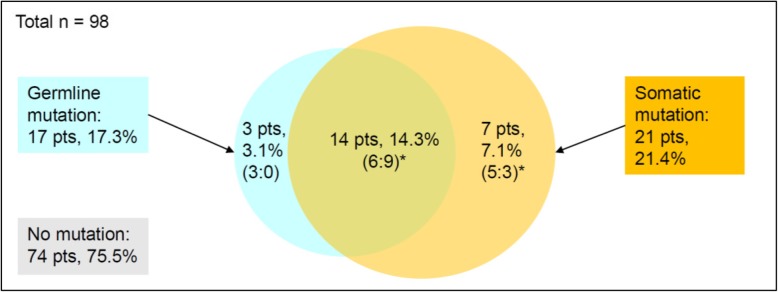
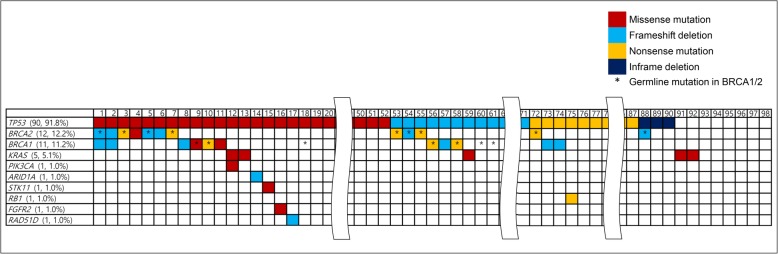
Results: Twenty-four patients (24.5%) showed overall BRCA1/2 mutations. Seven patients (7.1%) contained only somatic BRCA1/2 mutations with wild-type germline BRCA1/2, indicating acquired mutation of BRCA1/2. Three patients (3.1%) showed reversion of germline BRCA1 mutations. Among the 14 patients (14.3%) with both germline and somatic mutations in BRCA1/2, two patients showed different variations of BRCA1/2 mutations. The next-generation sequencing panel test for somatic mutation detected other pathogenic variations including RAD51D and ARID1A, which are possible targets of poly (ADP-ribose) polymerase inhibitors. Compared to conventional Sanger sequencing alone, next-generation sequencing-based tissue analysis increased the number of candidates for poly (ADP-ribose) polymerase inhibitor treatment from 17.3% (17/98) to 26.5% (26/98).
Conclusions: Somatic mutation analysis by next-generation sequencing, in addition to germline BRCA1/2 mutation analysis, should become the standard of care for managing women with high-grade serous ovarian cancer to widen the indication of poly (ADP-ribose) polymerase inhibitors.
Keywords: BRCA1/2 mutation; High-grade serous ovarian cancer; Next-generation sequencing; Poly (ADP-ribose) polymerase.
Conflict of interest statement
The authors declare that they have no competing interests.
Figures
References
-
- Coleman RL, Oza AM, Lorusso D, Aghajanian C, Oaknin A, Dean A, Colombo N, Weberpals JI, Clamp A, Scambia G, et al. Rucaparib maintenance treatment for recurrent ovarian carcinoma after response to platinum therapy (ARIEL3): a randomised, double-blind, placebo-controlled, phase 3 trial. Lancet (London, England) 2017;390(10106):1949–1961. doi: 10.1016/S0140-6736(17)32440-6. - DOI - PMC - PubMed
Publication types
MeSH terms
Substances
LinkOut - more resources
Full Text Sources
Medical
Miscellaneous
