


Two-stage, school and community-based population screening successfully identifies individuals and families at high-risk for type 2 diabetes: the Feel4Diabetes-study
- PMID: 32164646
- PMCID: PMC7066727
- DOI: 10.1186/s12902-019-0478-9
Two-stage, school and community-based population screening successfully identifies individuals and families at high-risk for type 2 diabetes: the Feel4Diabetes-study
Abstract
Background: The implementation of population screening and early prevention strategies targeting individuals at high-risk for type 2 diabetes (T2D) seems to be a public health priority. The current work aimed to describe the screening procedure applied in the Feel4Diabetes-study and examine its effectiveness in identifying individuals and families at high risk, primarily for T2D and secondarily for hypertension, among vulnerable populations in low to middle-income countries (LMICs) and high-income countries (HICs) across Europe.
Methods: A two-stage screening procedure, using primary schools as the entry-point to the community, was applied in low socioeconomic status (SES) regions in LMICs (Bulgaria-Hungary), HICs (Belgium-Finland) and HICs under austerity measures (Greece-Spain). During the first-stage screening via the school-setting, a total of 20,501 parents (mothers and/or fathers) of schoolchildren from 11,396 families completed the Finnish Diabetes Risk Score (FINDRISC) questionnaire, while their children underwent anthropometric measurements in the school setting. Parents from the identified "high-risk families" (n = 4484) were invited to participate in the second-stage screening, including the measurement of fasting plasma glucose (FPG) and blood pressure (BP). In total, 3153 parents participated in the second-stage screening (mean age 41.1 ± 5.6 years, 65.8% females).
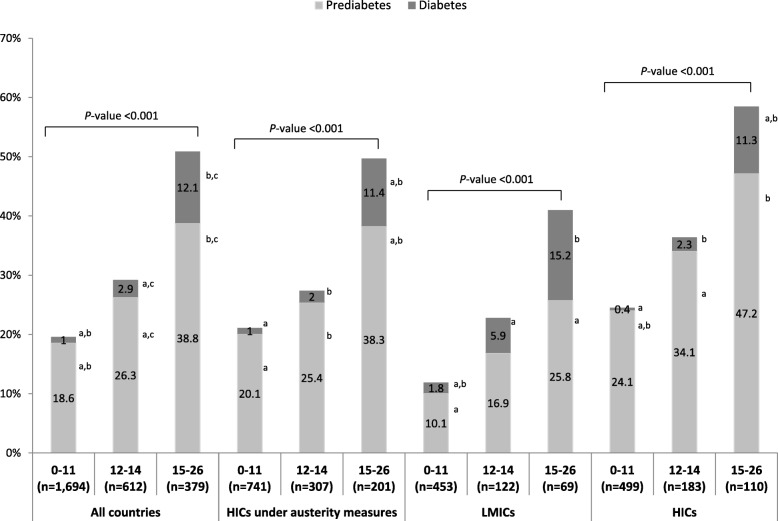
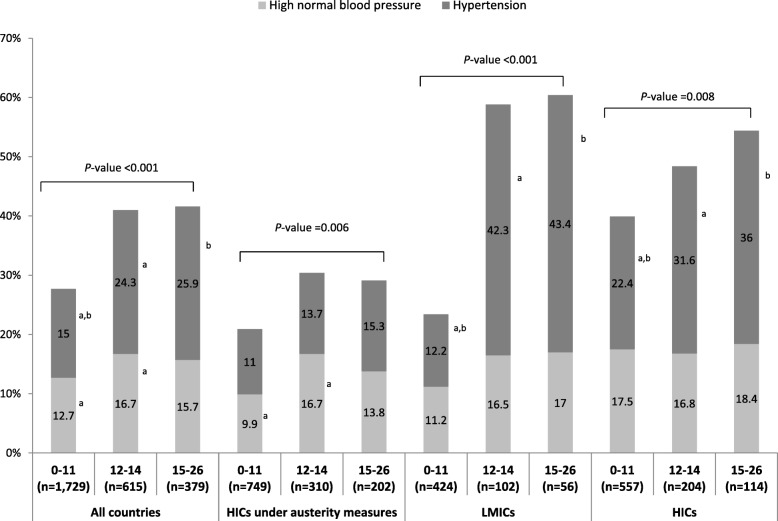
Results: Among parents who attended the second-stage screening, the prevalence of prediabetes (as defined by impaired fasting glucose; FPG 100-125 mg/dl) and T2D (FPG > 126 mg/dl) was 23.2 and 3.0% respectively, and it was found to be higher in the higher FINDRISC categories. The percentage of undiagnosed T2D among the participants identified with T2D was 53.5%. The prevalence of high normal BP (systolic BP 130-139 mmHg and/ or diastolic BP 85-89 mmHg) and hypertension (systolic BP ≥ 140 mmHg and/ or diastolic BP ≥ 90 mmHg) was 14 and 18.6% respectively, which was also higher in the higher FINDRISC categories. The percentage of cases not receiving antihypertensive treatment among the participants identified with hypertension was 80.3%.
Conclusion: The findings of the current study indicate that the two-stage school and community-based screening procedure followed, effectively identified high-risk individuals and families in vulnerable populations across Europe. This approach could be potentially scalable and sustainable and support initiatives for the early prevention of T2D and hypertension.
Trial registration: The Feel4Diabetes-intervention is registered at https://clinicaltrials.gov/ (NCT02393872; date of trial registration: March 20, 2015).
Keywords: Hypertension; School-based; Screening; Type 2 diabetes; Vulnerable groups.
Conflict of interest statement
OA is a member of the Editorial Board of BMC Endocrine Disorders. He also acted as Guest Editor in the current Supplement Issue. None of the rest of the authors has any conflict to declare.
Figures
References
-
- International Diabetes Federation (IDF) Diabetes Atlas 8th Edition (2017). https://www.idf.org/e-library/epidemiology-research/diabetes-atlas.html Accessed 18 Oct 2019.
-
- Global Burden of Metabolic Risk Factors for Chronic Diseases Collaboration Cardiovascular disease, chronic kidney disease, and diabetes mortality burden of cardiometabolic risk factors from 1980 to 2010: a comparative risk assessment. Lancet Diabetes Endocrinol. 2014;2(8):634–647. doi: 10.1016/S2213-8587(14)70102-0. - DOI - PMC - PubMed
-
- Agardh E, Allebeck P, Hallqvist J, Moradi T, Sidorchuk A. Type 2 diabetes incidence and socio-economic position: a systematic review and meta-analysis. Int J Epidemiol. 2011;40(3):804–818. - PubMed
Publication types
MeSH terms
Associated data
Grants and funding
LinkOut - more resources
Full Text Sources
Medical
