


Supporting social prescribing in primary care by linking people to local assets: a realist review
- PMID: 32164681
- PMCID: PMC7068902
- DOI: 10.1186/s12916-020-1510-7
Supporting social prescribing in primary care by linking people to local assets: a realist review
Abstract
Background: Social prescribing is a way of addressing the 'non-medical' needs (e.g. loneliness, debt, housing problems) that can affect people's health and well-being. Connector schemes (e.g. delivered by care navigators or link workers) have become a key component to social prescribing's delivery. Those in this role support patients by either (a) signposting them to relevant local assets (e.g. groups, organisations, charities, activities, events) or (b) taking time to assist them in identifying and prioritising their 'non-medical' needs and connecting them to relevant local assets. To understand how such connector schemes work, for whom, why and in what circumstances, we conducted a realist review.
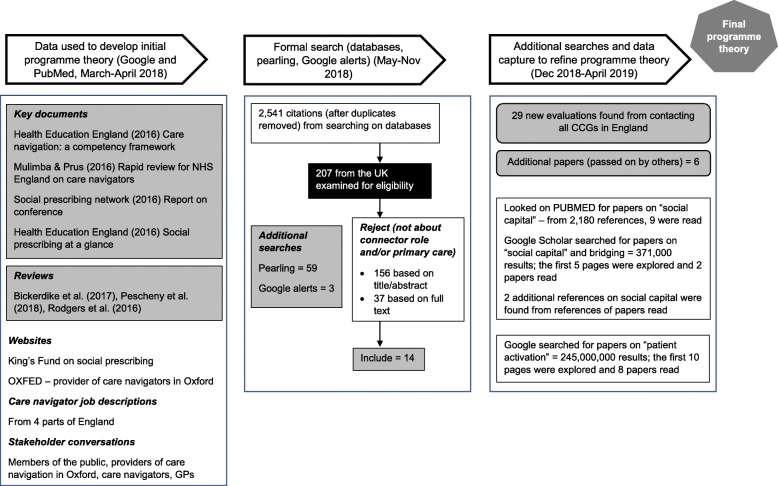
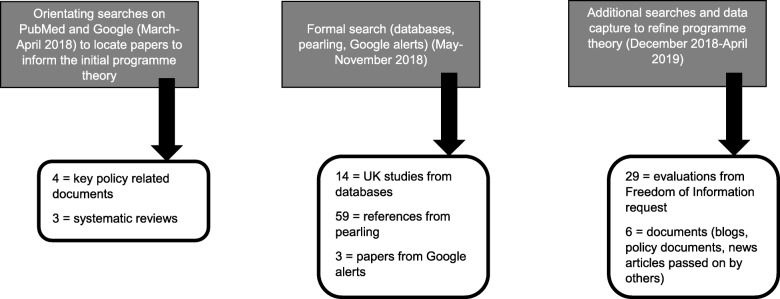
Method: A search of electronic databases was supplemented with Google alerts and reference checking to locate grey literature. In addition, we sent a Freedom of Information request to all Clinical Commissioning Groups in England to identify any further evaluations of social prescribing connector schemes. Included studies were from the UK and focused on connector schemes for adult patients (18+ years) related to primary care.
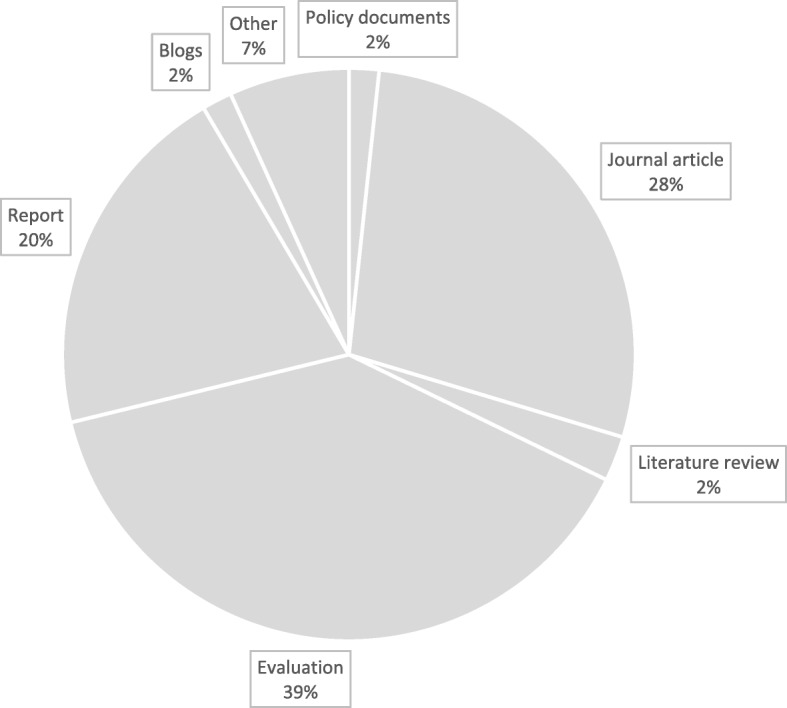
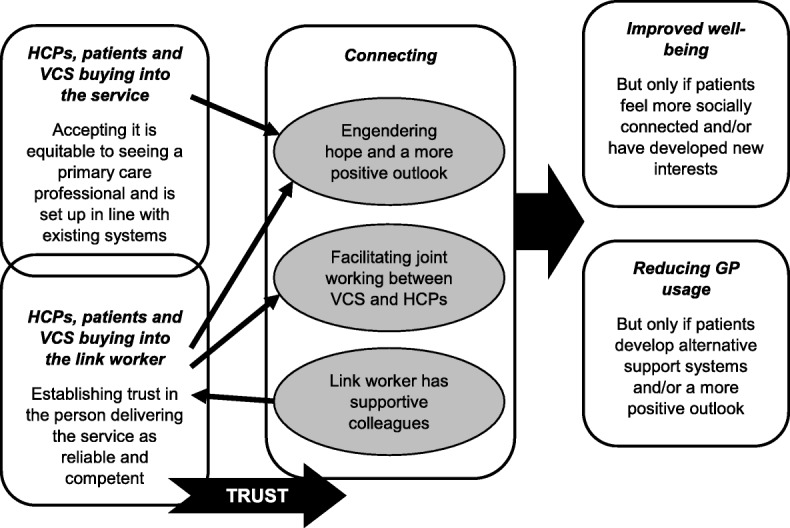
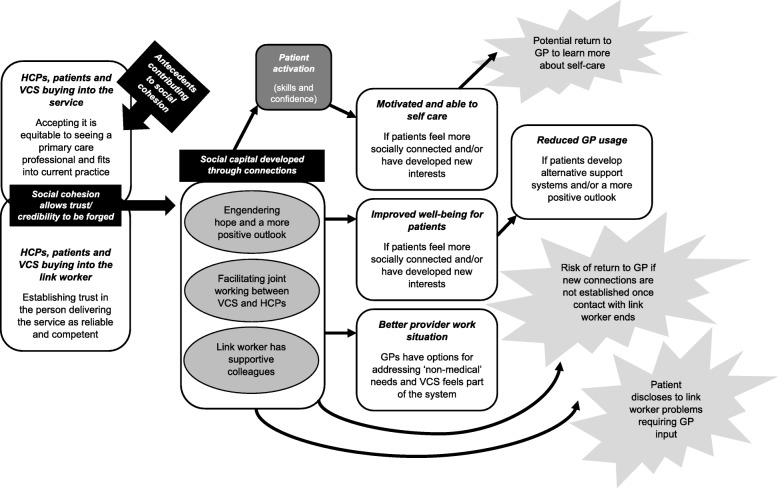
Results: Our searches resulted in 118 included documents, from which data were extracted to produce context-mechanism-outcome configurations (CMOCs). These CMOCs underpinned our emerging programme theory that centred on the essential role of 'buy-in' and connections. This was refined further by turning to existing theories on (a) social capital and (b) patient activation.
Conclusion: Our realist review highlights how connector roles, especially link workers, represent a vehicle for accruing social capital (e.g. trust, sense of belonging, practical support). We propose that this then gives patients the confidence, motivation, connections, knowledge and skills to manage their own well-being, thereby reducing their reliance on GPs. We also emphasise within the programme theory situations that could result in unintended consequences (e.g. increased demand on GPs).
Keywords: Care navigators; Evidence synthesis; Link workers; Realist review; Social capital; Social prescribing.
Conflict of interest statement
The authors declare that they have no competing interests.
Figures
References
-
- Baird B, Charles A, Honeyman A, Maguire D, Das P. Understanding pressures in general practice. London: The King’s Fund; 2016.
-
- Citizens Advice Bureau . A very general practice: how much time do GPs spend on issues other than health? London: Citizens Advice Bureau; 2015.
-
- NHS England . Universal personalised care: implementing the comprehensive model. London: NHS England; 2019.
-
- British Medical Association . Social prescribing: making it work for GPs and patients. London: British Medical Association; 2019.
-
- Palmer D, Wheeler J, Hendrix E, Sango PN, Hatzidimitriadou E. “When I am out with her (befriender) I feel so good mentally and all my physical pains go unnoticed.” Social prescribing in Bexley: pilot evaluation report. London: Mind; 2017.
Publication types
MeSH terms
Grants and funding
LinkOut - more resources
Full Text Sources
