


Smoke, alcohol and drug addiction and female fertility
- PMID: 32164734
- PMCID: PMC7069005
- DOI: 10.1186/s12958-020-0567-7
Smoke, alcohol and drug addiction and female fertility
Abstract
Background: Considerable interest has been gathered on the relevant impact of preventable factors, including incorrect lifestyle and unhealthy habits, on female fertility. Smoking, alcohol and addictive drugs consumption represent a major concern, given the broad range of diseases which might be favored or exacerbated by these dependable attitudes. Despite the well-characterized effects of prenatal exposure on pregnancy outcomes and fetus health, a substantial proportion of women of reproductive age is still concerned with these habits. At present, the impact of smoke, alcohol and addictive drugs on women fertility, and, particularly, the specific targets and underlying mechanisms, are still poorly understood or debated, mainly due to the scarcity of well-designed studies, and to numerous biases.
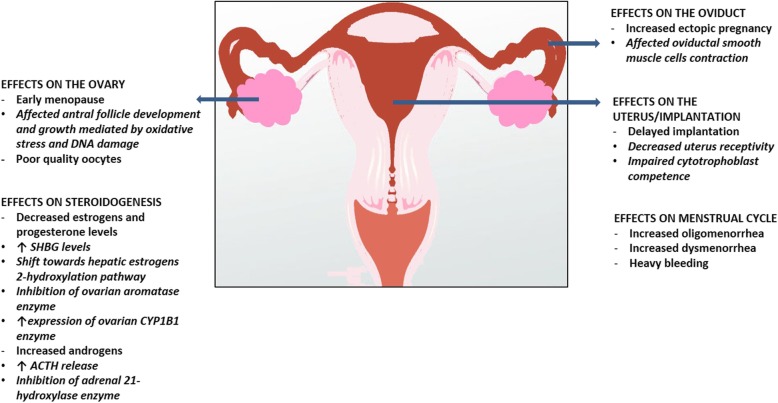
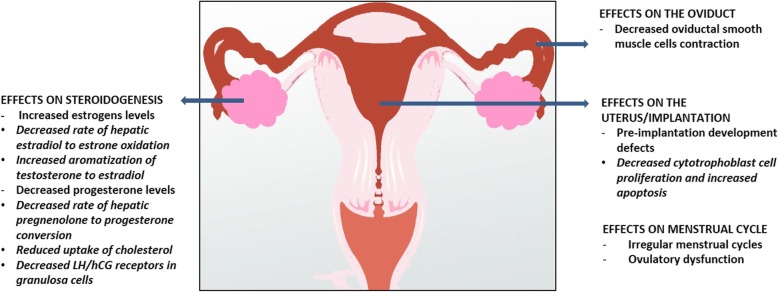
Objective: The current review will provide a comprehensive overview of clinical and experimental studies in humans and animals addressing the impact of smoke, alcohol and addictive drugs on female fertility, by also embracing effects on ovary, oviduct, and uterus, with particular reference to primary endpoints such as ovarian reserve, steroidogenesis, ovulation and menstrual cycle, oviduct function and uterus receptivity and implantation. A brief focus on polycystic ovary syndrome and endometriosis will be also included.
Methods: A Pubmed literature search was performed with selected keywords; articles were individually retrieved by each author. No limitation was set for publication date. Articles in languages other than English were excluded. Additional articles were retrieved from references list of selected manuscripts.
Results and conclusions: Currently, the most consistent evidences of a detrimental effect of smoke, alcohol and addictive drugs on specific domains of the female reproductive function are provided by experimental studies in animals. Overall, clinical studies suggest that smoking is associated to decreased fertility, although causal inference should be further demonstrated. Studies addressing the effect of alcohol consumption on female fertility provide conflicting results, although the majority reported lack of a correlation. Extremely scarce studies investigated the effects of addictive drugs on female fertility, and the specific actions of selected drugs have been difficult to address, due to multidrug consumption.
Keywords: Alcohol; Drug; Endometriosis; Female Fertility; Ovary; Oviduct; PCOS; Reproduction; Smoke; Uterus.
Conflict of interest statement
The authors declare that they have no competing interests.
Since Prof. Pivonello and Prof. Colao served as Guest Editor of the thematic series "The Influence of Environment and Lifestyle on Human Fertility", peer review of the present manuscript was handled by another member of the Reproductive Biology and Endocrinology editorial board.
Figures
References
-
- Health NCCfWsaCs . Fertility: Assessment and Treatment for People with Fertility Problems. In Fertility: Assessment and Treatment for People with Fertility Problems. London: National Institute for Health and Clinical Excellence: Guidance; 2013.
-
- Centers for Disease C, Prevention State-specific smoking-attributable mortality and years of potential life lost--United States, 2000-2004. MMWR Morb Mortal Wkly Rep. 2009;58:29–33. - PubMed
-
- Alcohol Use and Your Health [https://www.cdc.gov/alcohol/fact-sheets/alcohol-use.htm].
Publication types
MeSH terms
LinkOut - more resources
Full Text Sources
Medical
