


Why do patients take part in research? An overview of systematic reviews of psychosocial barriers and facilitators
- PMID: 32164790
- PMCID: PMC7069042
- DOI: 10.1186/s13063-020-4197-3
Why do patients take part in research? An overview of systematic reviews of psychosocial barriers and facilitators
Erratum in
-
Correction to: Why do patients take part in research? An overview of systematic reviews of psychosocial barriers and facilitators.Trials. 2020 Oct 8;21(1):840. doi: 10.1186/s13063-020-04793-2. Trials. 2020. PMID: 33032640 Free PMC article.
Abstract
Background: Understanding why people take part in health research is critical to improve research efficiency and generalisability. The aim of this overview of systematic reviews was to identify psychosocial determinants of research participation and map them to psychological theory and empirical recruitment research, to identify effective strategies to increase research participation.
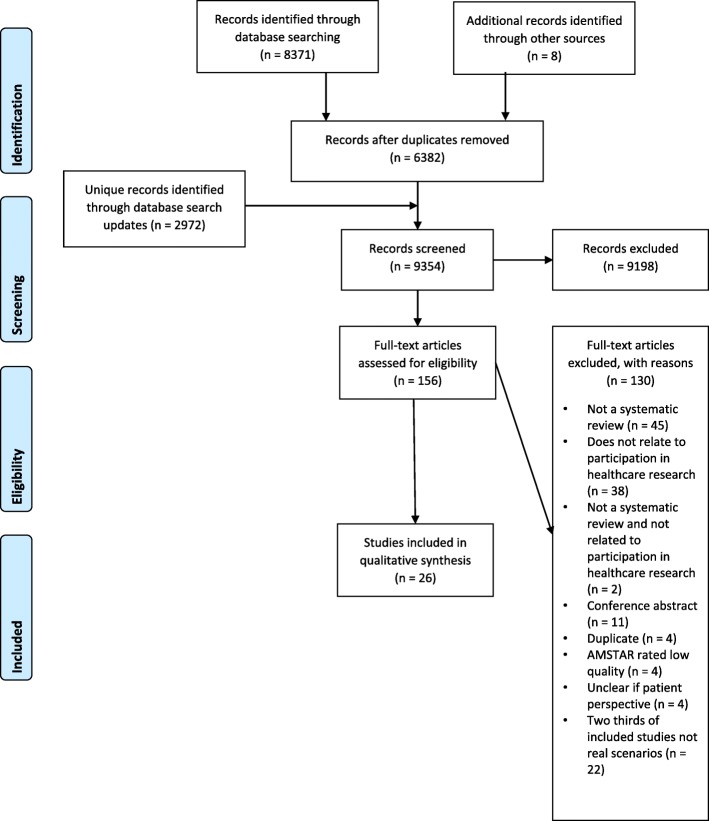
Methods: Qualitative and quantitative systematic reviews were systematically identified. No date or language limits were applied. Two reviewers independently selected reviews. Methodological quality was rated using AMSTAR, and poor-quality reviews (scoring 0-3) were excluded. Barriers and facilitators were coded to psychological theory (Theoretical Domains Framework) and empirical recruitment research (recruitment interventions that had been subjected to randomised controlled trial evaluation).
Results: We included 26 systematic reviews (429 unique primary studies), covering a wide range of patient populations and health settings. We identified five groups of facilitators, of which three were dominant (potential for personal benefit, altruism, trust) and appear to be relevant across research setting and design. We identified nine groups of barriers, which were more dependent on the particular study (context, population, design). Two determinants (participant information, social influences) were found to be both barriers and facilitators. Barriers and facilitators could be coded to the Motivation and Opportunity components of the Theoretical Domains Framework; only one was coded to a Capability component. There was some overlap between psychosocial determinants and empirical recruitment research, but some barriers and facilitators had not been tested at all.
Conclusions: Identifying effective recruitment strategies could increase the efficiency and generalisability of primary research. We identified a number of barriers and facilitators that could be addressed by researchers. There is a need for more research to identify effective recruitment strategies that draw on the psychosocial facilitators and barriers identified in this overview.
Keywords: Consent; Overview; Psychosocial; Recruitment; Research participation; Systematic review.
Conflict of interest statement
Adwoa Parker and Peter Bower are authors on one of the included systematic reviews. The other authors declare that they have no competing interests.
References
-
- Walters SJ, Bonacho dos Anjos Henriques-Cadby I, Bortolami O, Flight L, Hind D, Jacques RM, et al. Recruitment and retention of participants in randomised controlled trials: a review of trials funded and published by the United Kingdom Health Technology Assessment Programme. BMJ Open. 2017;7(3):e015276. doi: 10.1136/bmjopen-2016-015276. - DOI - PMC - PubMed
-
- Treweek S, Mitchell E, Pitkethly M, Cook J, Kjeldstrøm M, Taskila T, Johansen M, Sullivan F, Wilson S, Jackson C, Jones R. Strategies to improve recruitment to randomised controlled trials. Cochrane Database Syst Rev. 2010;(1):MR000013. 10.1002/14651858.MR000013.pub4. - PubMed
Publication types
MeSH terms
LinkOut - more resources
Full Text Sources
