Review
. 2020 Jun;46(6):1296-1325.
doi: 10.1016/j.ultrasmedbio.2020.01.002. Epub 2020 Mar 10.

Ultrasound-Responsive Cavitation Nuclei for Therapy and Drug Delivery

Affiliations
Review

Ultrasound-Responsive Cavitation Nuclei for Therapy and Drug Delivery

Klazina Kooiman et al. Ultrasound Med Biol. 2020 Jun.

Abstract

Therapeutic ultrasound strategies that harness the mechanical activity of cavitation nuclei for beneficial tissue bio-effects are actively under development. The mechanical oscillations of circulating microbubbles, the most widely investigated cavitation nuclei, which may also encapsulate or shield a therapeutic agent in the bloodstream, trigger and promote localized uptake. Oscillating microbubbles can create stresses either on nearby tissue or in surrounding fluid to enhance drug penetration and efficacy in the brain, spinal cord, vasculature, immune system, biofilm or tumors. This review summarizes recent investigations that have elucidated interactions of ultrasound and cavitation nuclei with cells, the treatment of tumors, immunotherapy, the blood-brain and blood-spinal cord barriers, sonothrombolysis, cardiovascular drug delivery and sonobactericide. In particular, an overview of salient ultrasound features, drug delivery vehicles, therapeutic transport routes and pre-clinical and clinical studies is provided. Successful implementation of ultrasound and cavitation nuclei-mediated drug delivery has the potential to change the way drugs are administered systemically, resulting in more effective therapeutics and less-invasive treatments.

Keywords: Blood–brain barrier opening; Bubble–cell interaction; Cavitation nuclei; Drug delivery; Sonobactericide; Sonoporation; Sonothrombolysis; Therapy; Tumor; Ultrasound.


Conflict of interest statement

Conflict of interest disclosure The authors declare no conflict of interest.

Figures
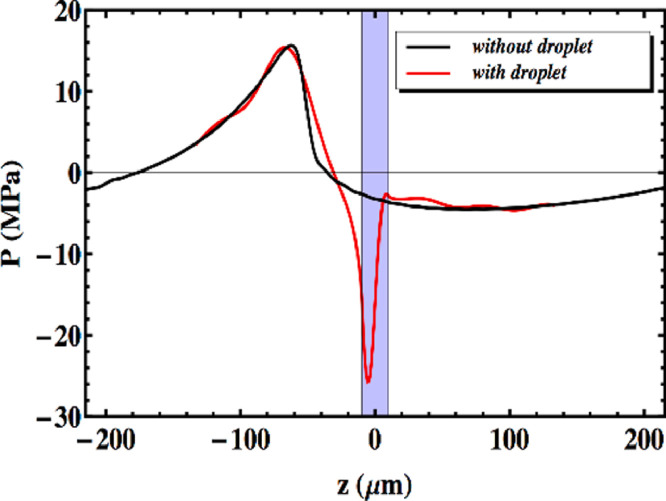
Fig 1
Fig. 1
Combined effect of non-linear propagation and focusing of the harmonics in a perfluoropentane micrometer-sized droplet. The emitted ultrasound wave has a frequency of 3.5 MHz and a focus at 3.81 cm, and the radius of the droplet is 10 µm for ease of observation. The pressures are given on the axis of the droplet along the propagating direction of the ultrasound wave, and the shaded area indicates the location of the droplet. Reprinted with permission from Sphak et al. (2014).
Fig 2
Fig. 2
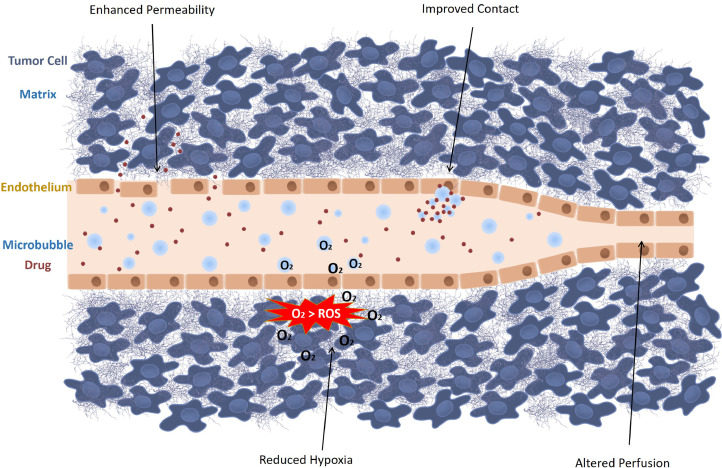
Ultrasound-activated microbubbles can locally alter the tumor microenvironment through four mechanisms: enhanced permeability, improved contact, reduced hypoxia and altered perfusion. ROS = reactive oxygen species.
Fig 3
Fig. 3
Schematic overview of how microbubbles (MB) and ultrasound (US) have been found to contribute to cancer immunotherapy. From left to right: Microbubbles can be used as antigen carriers to stimulate antigen uptake by dendritic cells. Microbubbles and ultrasound can alter the permeability of tumors, thereby increasing the intra-tumoral penetration of adoptively transferred immune cells or checkpoint inhibitors. Finally, exposing tissues to cavitating microbubbles can induce sterile inflammation by the local release of damage-associated molecular patterns (DAMPS).
Fig 4
Fig. 4
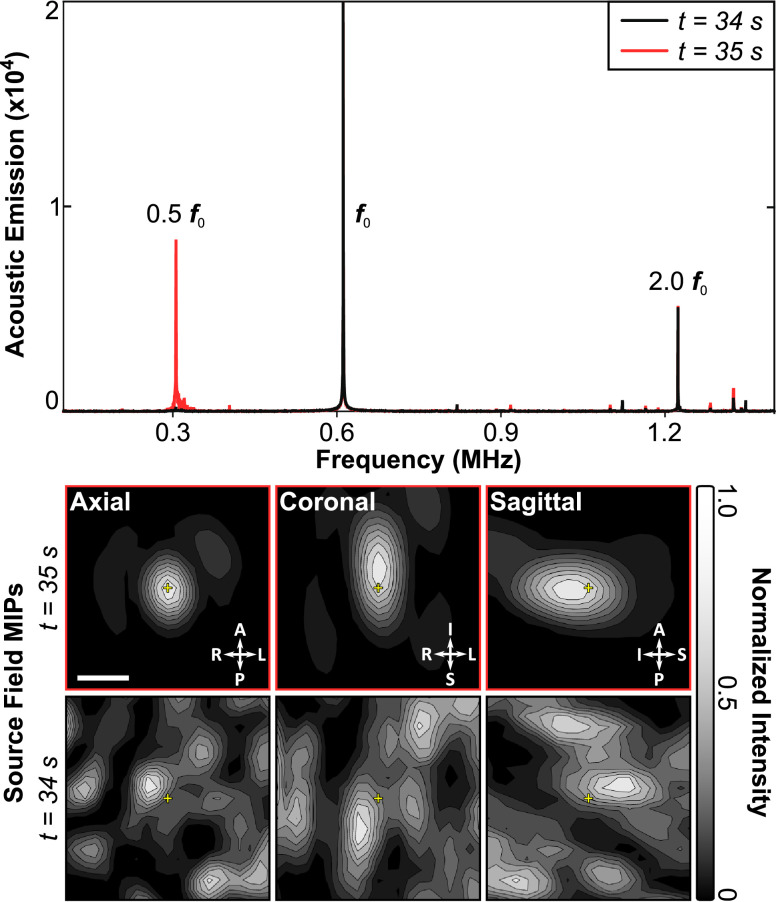
Three-dimensional transcranial subharmonic microbubble imaging and treatment control in vivo in rabbit brain during blood–brain barrier opening. Spectral information (top) indicates the appearance of subharmonic activity at t = 35 s into the treatment. Passive mapping of the subharmonic band localizes this activity to the target region. Bar = 2.5 mm. Reprinted (adapted), with permission, from Jones et al. (2018).
Fig 5
Fig. 5
T1-Weighted sagittal magnetic resonance images revealing leptomeningeal tumors in rat spinal cord (gray arrowhead) before ultrasound and microbubble treatment (left column), and the enhancement of the cord indicating blood–spinal cord barrier opening (white arrows) after ultrasound and microbubble treatment (right column). Reprinted (adapted) with permission from O'Reilly et al. (2018).
Fig 6
Fig. 6
Simulated acoustic pressure and temperature in a representative subject exposed to pulsed 220 kHz ultrasound with a 33.3% duty cycle. The absolute peak-to-peak pressure maximum for the simulations is displayed in gray scale. Temperature is displayed using a heat map with a minimum color priority write threshold of 1°C. Computed tomography features such as bone (cyan), skin and internal epithelium (beige) and clot (green) are plotted using contour lines. The transducer is outlined in magenta. Constructive interference is prominent in the soft tissue between the temporal bone and the transducer. Some constructive interference is also present in the brain tissue close to the contralateral temporal bone; however, the pressure in this region did not exceed the pressure in the M1 section of the middle cerebral artery. Temperature rise was prominent in the ipsilateral bone along the transducer axis. The computational model is described in Kleven et al. (2019).
Fig 7
Fig. 7
Histologic sections of a coronary artery of a pig 28 d after angioplasty. Pigs were treated with sirolimus-loaded microbubbles only (a) or sirolimus-loaded microbubbles and ultrasound (b) using a mechanically rotating intravascular ultrasound catheter (5 MHz, 500 cycles, 50% duty cycle, 0.6 MPa peak negative pressure). Treatment with ultrasound and sirolimus-loaded microbubbles reduced neointimal formation by 50%. In both sections, the intima (I) and media (M) are outlined. Bar = 500 µm. Reprinted with permission from Springer Nature: Springer, Annals of Biomedical Engineering, Reducing Neointima Formation in a Swine Model with IVUS and Sirolimus Microbubbles, Kilroy JP, Dhanaliwala AH, Klibanov AL, Bowles DK, Wamhoff BR, Hossack JA, COPYRIGHT, from Kilroy JP et al. (2015).
Fig 8
Fig. 8
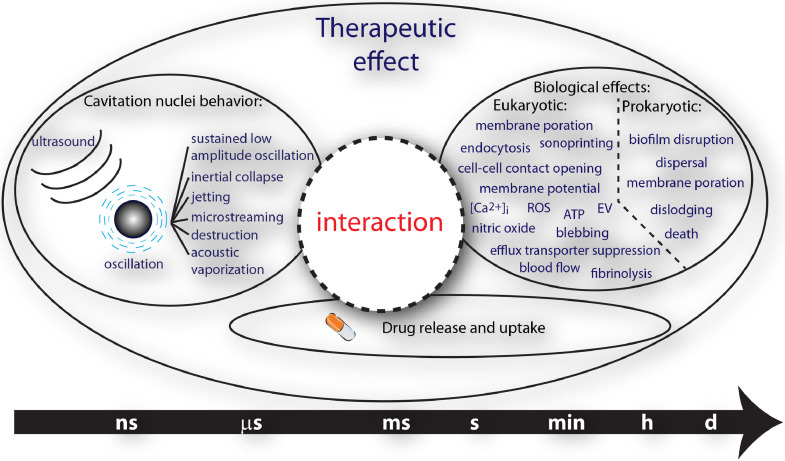
Different time scales of the therapeutic effects of ultrasound and cavitation nuclei treatment. [Ca2+]i = intracellular calcium; ROS = reactive oxygen species; ATP = adenosine triphosphate; EV = extracellular vesicles. Reprinted (adapted) with permission from Lattwein et al. (2020).

References

    1. Abrahao A., Meng Y., Llinas M., Huang Y., Hamani C., Mainprize T., Aubert I., Heyn C., Black S.E., Hynynen K., Lipsman N., Zinman L. Motor cortex blood-brain barrier opening in amyotrophic lateral sclerosis using MR-guided focused ultrasound: A first-in-human trial. Nat Commun. 2019;10:4373. - PMC - PubMed
    1. Acconcia C.N., Leung B.Y., Goertz D.E. The microscale evolution of the erosion front of blood clots exposed to ultrasound stimulated microbubbles. J Acoust Soc Am. 2016;139:EL135. - PubMed
    1. Acconcia C.N., Jones R.M., Goertz D.E., O'Reilly M.A., Hynynen K. Megahertz rate, volumetric imaging of bubble clouds in sonothrombolysis using a sparse hemispherical receiver array. Phys Med Biol. 2017;62:L31–L40. - PubMed
    1. Agarwal A., Jern Ng W., Liu Y. Removal of biofilms by intermittent low-intensity ultrasonication triggered bursting of microbubbles. Biofouling. 2014;30:359–365. - PubMed
    1. Alexandrov A.V., Demchuk A.M., Burgin W.S., Robinson D.J., Grotta J.C., Investigators C. Ultrasound-enhanced thrombolysis for acute ischemic stroke: Phase I. Findings of the CLOTBUST trial. J Neuroimaging. 2004;14:113–117. - PubMed

Publication types

Substances