


Soil resilience and recovery: rapid community responses to management changes
- PMID: 32165771
- PMCID: PMC7045894
- DOI: 10.1007/s11104-016-3068-x
Soil resilience and recovery: rapid community responses to management changes
Abstract
Background and aims: Soil degradation is a major global problem; to investigate the potential for recovery of soil biota and associated key functions, soils were monitored during the early years of conversion between permanent grassland, arable cropping and bare fallow (maintained by regular tilling). Distinct differences in soil properties had become apparent 50 years after a previous conversion.
Methods: Subplots on previously permanent grassland, arable and bare fallow soil were converted to the two alternatives, generating 9 treatments. Soil properties (soil organic carbon, mesofauna, microbial community structure and activity) were measured.
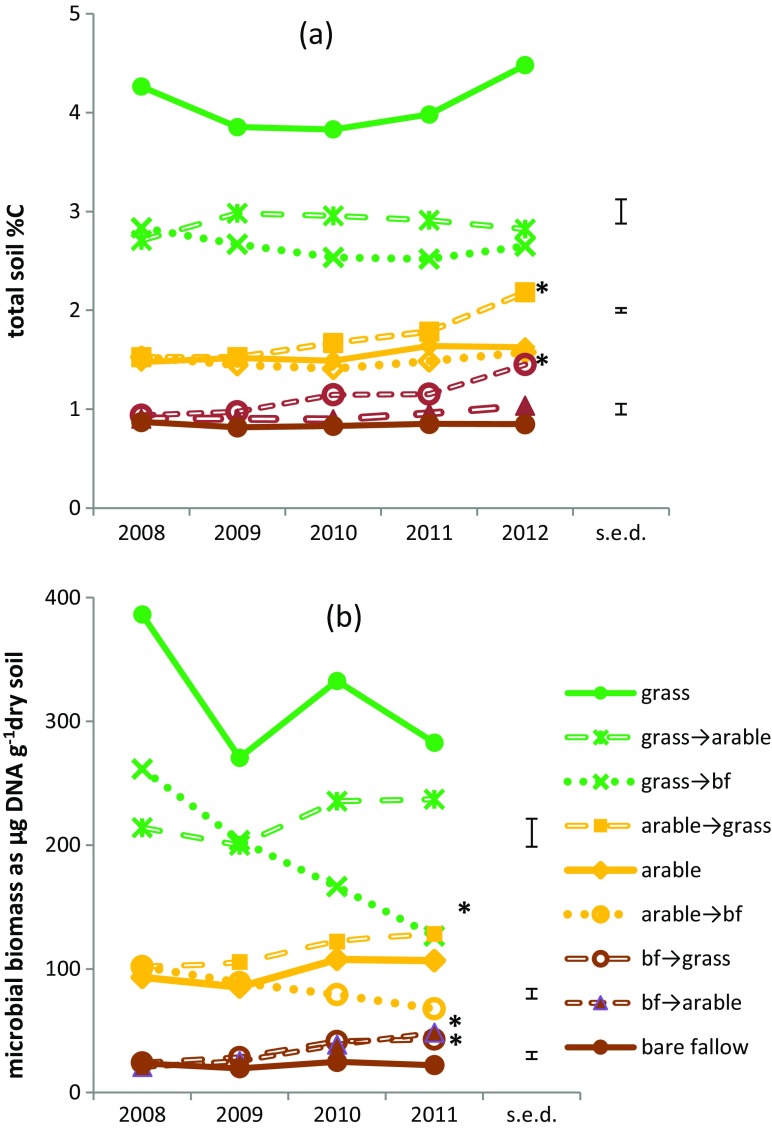
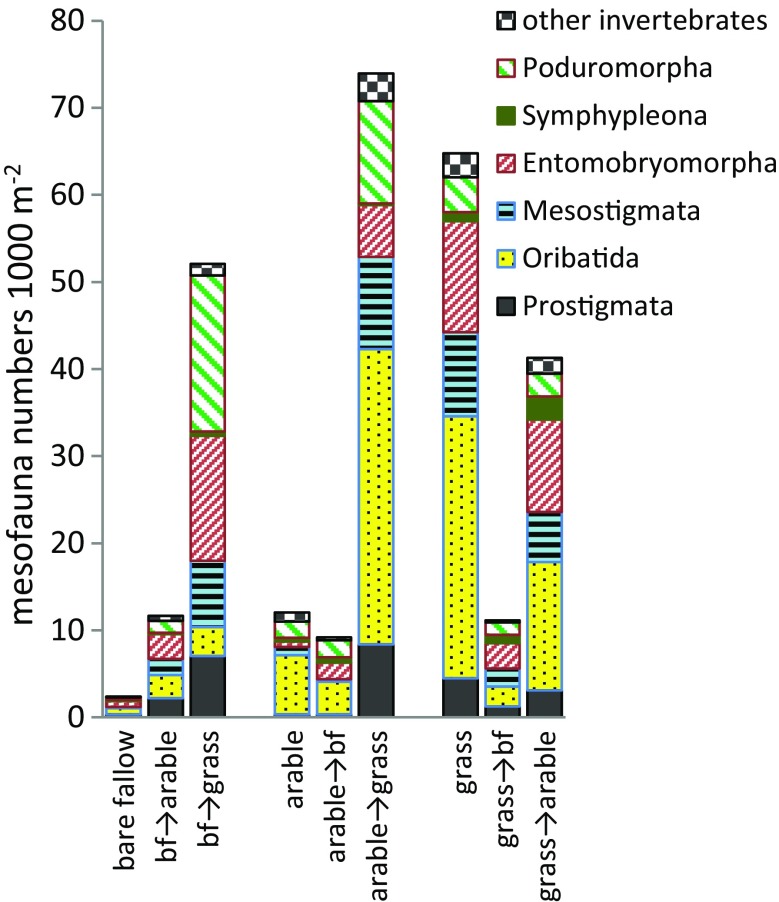
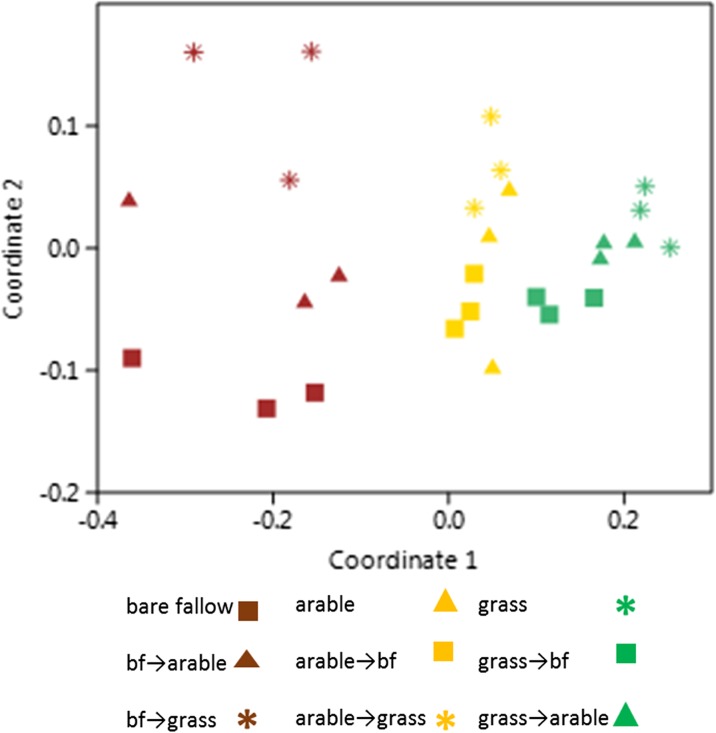
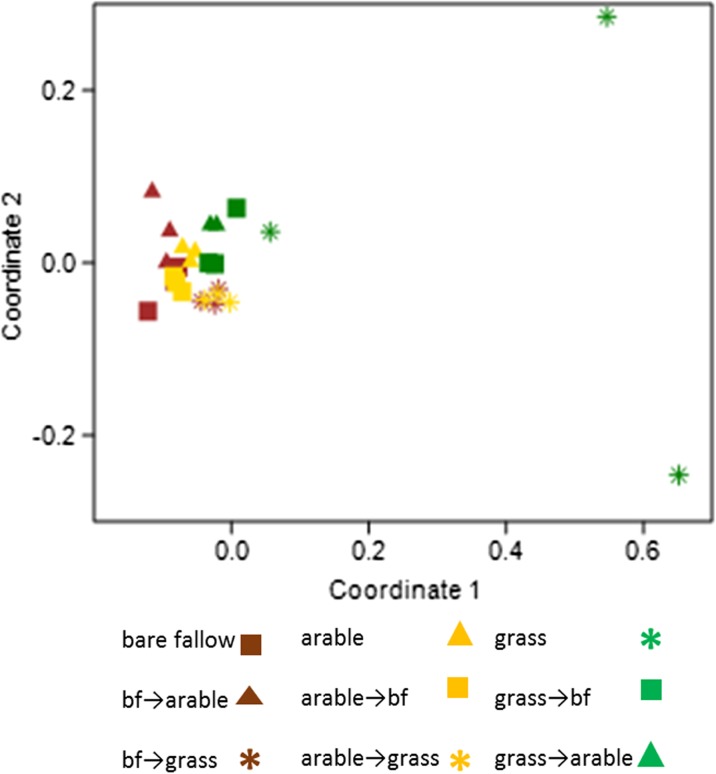
Results: After 2 years, mesofauna and microbial abundance increased where plants were grown on previously bare fallow soils and declined where grassland was converted to bare fallow treatment. Overall prokaryote community composition remained more similar to the previous treatments of the converted plots than to the new treatments but there were significant changes in the relative abundance of some groups and functional genes. Four years after conversion, SOC in arable and bare fallow soils converted to grassland had increased significantly.
Conclusions: Conversion to permanent grassland effectively replenished C in previously degraded soil; the soil microbiome showed significant conversion-related changes; plant-driven recovery was quicker than C loss in the absence of plants.
Keywords: Bare fallow soil; Grass; Nitrogen-cycling genes; Soil bacteria; Soil fungi; Soil mesofauna; Soil microbiome; Soil organic carbon; Wheat.
© The Author(s) 2016.
Figures
References
-
- Abarenkov K, Nilsson RH, Larsson K-H, Alexander IJ, Eberhardt U, Erland S, Hoiland K, Kjoller R, Larsson E, Pennanen T, Sen R, Taylor AFS, Tedersoo L, Ursing BM, Vralstad T, Liimatainen K, Peintner U, Koljalg U. The UNITE database for molecular identification of fungi - recent updates and future perspectives. New Phytol. 2010;186:281–285. doi: 10.1111/j.1469-8137.2009.03160.x. - DOI - PubMed
-
- Andres P, Mateos E. Soil mesofaunal responses to post-mining restoration treatments. Appl Soil Ecol. 2006;33:67–78. doi: 10.1016/j.apsoil.2005.08.007. - DOI
-
- Beck S, Powell JR, Drigo B, Cairney JWG, Anderson IC. The role of stochasticity differs in the assembly of soil- and root-associated fungal communities. Soil Biol Biochem. 2015;80:18–25. doi: 10.1016/j.soilbio.2014.09.010. - DOI
-
- Caporaso JG, Kuczynski J, Stombaugh J, Bittinger K, Bushman FD, Costello EK, Fierer N, Pena AG, Goodrich JK, Gordon JI, Huttley GA, Kelley ST, Knights D, Koenig JE, Ley RE, Lozupone CA, McDonald D, Muegge BD, Pirrung M, Reeder J, Sevinsky JR, Tumbaugh PJ, Walters WA, Widmann J, Yatsunenko T, Zaneveld J, Knight R. QIIME allows analysis of high-throughput community sequencing data. Nat Methods. 2010;7:335–336. doi: 10.1038/nmeth.f.303. - DOI - PMC - PubMed
Grants and funding
LinkOut - more resources
Full Text Sources