Review
. 2018 Nov 12:2:2398212818812011.
doi: 10.1177/2398212818812011. eCollection 2018 Jan-Dec.

Epigenetics, chromatin and brain development and function

Affiliations
Review

Epigenetics, chromatin and brain development and function

Anthony R Isles. Brain Neurosci Adv. .

Abstract

Research investigating epigenetics and chromatin function in brain and behaviour has mushroomed over the last two decades. And yet epigenetics as a biological concept predates the discovery in the 1950s of DNA as the principle mode of inheritance by over a decade. This review explores the past, present and future research into epigenetics as it relates to understanding brain development and function.

Keywords: DNA methylation; epigenome editing; genomic imprinting; histones; memory; single cell.


Conflict of interest statement

Declaration of conflicting interests: The author declared no potential conflicts of interest with respect to the research, authorship and/or publication of this article.

Figures
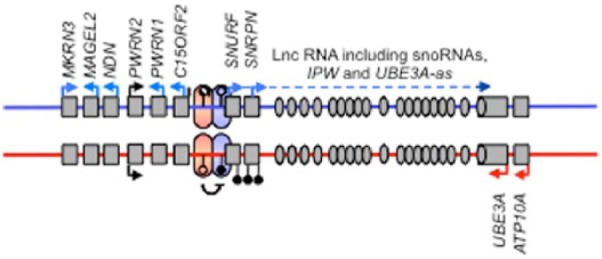
Figure 1.
Figure 1.
Schematic showing a representative imprinted gene cluster, in this case, the Angelman and Prader–Willi Syndrome (AS/PWS) imprinted cluster on human chromosome 15. As is common for imprinted genes, within this cluster are both maternally (red arrows) and paternally (blue arrows) expressed genes, including a long non-coding RNA (Lnc-RNA). Also marked with black ‘lollipops’ is the differentially methylated region (DMR), which in the case of the AS/PWS locus is methylated on the maternally derived chromosome and un-methylated on the paternal chromosome. The parental-specific marking of the DMR distinguishes the maternal and paternal chromosomes at this interval and guides parental-specific gene expression control via chromatin changes and non-coding RNA (e.g. UBE3A antisense, UBE3A-as).
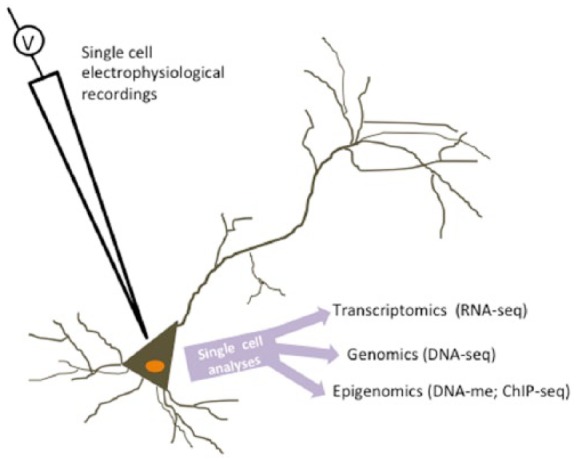
Figure 2.
Figure 2.
Schematic illustrating the possible future applications of single-cell epigenomics to neuroscience. The example here links single-cell electrophysiological recordings with single-cell transcriptomics, genomics and epigenomics. For instance, this would enable a true readout of the gene expression and associated DNA-me and/or chromatin changes that underpin synaptic plasticity.

References

    1. Barton SC, Surani MA, Norris ML. (1984) Role of paternal and maternal genomes in mouse development. Nature 311(5984): 374–376. - PubMed
    1. Clark SJ, Lee HJ, Smallwood SA, et al. (2016) Single-cell epigenomics: Powerful new methods for understanding gene regulation and cell identity. Genome Biology 17(1): 72. - PMC - PubMed
    1. Crick F. (1984) Memory and molecular turnover. Nature 312(5990): 101. - PubMed
    1. Ferron SR, Charalambous M, Radford E, et al. (2011) Postnatal loss of Dlk1 imprinting in stem cells and niche astrocytes regulates neurogenesis. Nature 475(7356): 381–385. - PMC - PubMed
    1. Griffith JS, Mahler HR. (1969) DNA ticketing theory of memory. Nature 223(5206): 580–582. - PubMed

LinkOut - more resources