


Psychopharmacology: From serendipitous discoveries to rationale design, but what next?
- PMID: 32166162
- PMCID: PMC7058199
- DOI: 10.1177/2398212818812629
Psychopharmacology: From serendipitous discoveries to rationale design, but what next?
Abstract
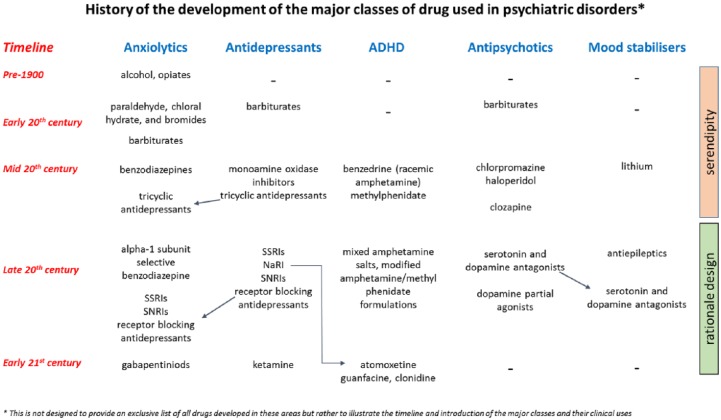
Psychopharmacology really developed as a discipline from the mid-20th century with the discovery of a number of new classes of psychoactive drugs which could modify behaviour. These drugs were discovered as a consequence of clinical observations of patients, often being treated for other conditions. These serendipitous discoveries were the start of an era of drug development which has led to the antidepressants, antipsychotics, anxiolytics and mood stabilisers used today. Subsequent research focused on understanding why these drugs were effective, and used this information to develop a second generation of drugs that were more selective for their therapeutic targets, and therefore had reduced side effects and improved safety and tolerability. After a period of decline in new discoveries and withdrawal of the majority of the major pharmaceutical companies from active development programmes in psychiatry, new avenues are emerging fuelling renewed interest in this area.
Keywords: Psychiatry; animal models; antidepressants; antipsychotics; behaviour.
© The Author(s) 2018.
Conflict of interest statement
Declaration of conflicting interests: The author currently holds research grant funding from the MRC, BBSRC and Wellcome Trust. She has also received research funding from Boehringer Ingelheim, Eli Lilly, MSD, Pfizer and SmallPharma although these companies have not had any influence on the content of this article.
Figures
References
-
- Andrews PW, Bharwani A, Lee KR, et al. (2015) Is serotonin an upper or a downer? The evolution of the serotonergic system and its role in depression and the antidepressant response. Neuroscience & Biobehavioral Reviews 51: 164–188. - PubMed
-
- Artigas F, Romero L, de Montigny C, et al. (1996) Acceleration of the effect of selected antidepressant drugs in major depression by 5-HT1A antagonists. Trends in Neurosciences 19(9): 378–383. - PubMed
-
- Axelrod J. (1972) Biogenic amines and their impact in psychiatry. Seminars in Psychiatry 4(3): 199–210. - PubMed
-
- Baldwin DS, Anderson IM, Nutt DJ, et al. (2014) Evidence-based pharmacological treatment of anxiety disorders, post-traumatic stress disorder and obsessive-compulsive disorder: A revision of the 2005 guidelines from the British Association for Psychopharmacology. Journal of Psychopharmacology 28(5): 403–439. - PubMed
Publication types
LinkOut - more resources
Full Text Sources
