


Clinically Significant Pleural Effusion in Intensive Care: A Prospective Multicenter Cohort Study
- PMID: 32166290
- PMCID: PMC7063904
- DOI: 10.1097/CCE.0000000000000070
Clinically Significant Pleural Effusion in Intensive Care: A Prospective Multicenter Cohort Study
Abstract
Objectives: The prevalence and optimal management of clinically significant pleural effusion, confirmed by thoracic ultrasound, in the critically ill is unknown. This study aimed to determine: 1) the prevalence, characteristics, and outcomes of patients treated in intensive care with clinically significant effusion and 2) the comparative efficacy and safety of pleural drainage or expectant medical management.
Design: A prospective multicenter cohort study.
Setting: ICUs in four teaching hospitals in Western Australia.
Patients: Consecutive patients with clinically significant pleural effusions (depth ≥ 2 cm on thoracic ultrasound with clinician-determined adverse effects on patient progress).
Interventions: None.
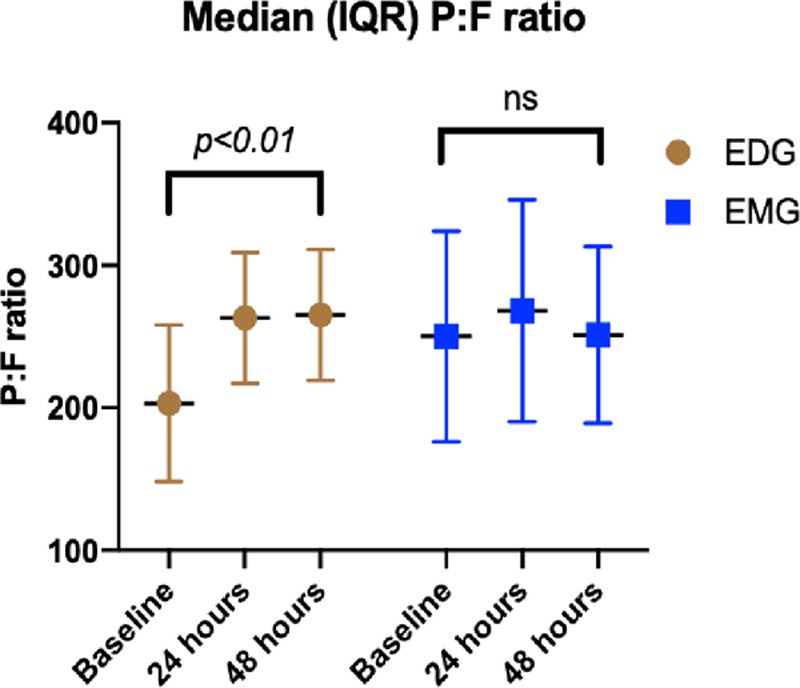
Measurements and main results: Primary outcome was the change in Pao2:Fio2 (mm Hg) ratio from baseline to 24 hours. Changes in diagnosis and treatment based on pleural fluid analysis and pleural effusion related serious adverse events between those who underwent either drainage within 24 hours or expectant management were compared. Of the 7,342 patients screened, 226 patients (3.1%) with 300 pleural effusions were enrolled. Early drainage of pleural effusion occurred in 76 patients (34%) and significantly improved oxygenation (Pao2:Fio2 ratio 203 at baseline vs 263 at 24 hr, +29.6% increment; p < 0.01). This was not observed in the other 150 patients who had expectant management (Pao2:Fio2 ratio 250 at baseline vs 268 at 24 hr, +7.2% increment; p = 0.44). The improvement in oxygenation after early drainage remained unchanged after adjustment for a propensity score on the decision to initiate early drainage. Pleural effusion related serious adverse events were not different between the two groups (early drainage 10.5% vs no early drainage 16.0%; p = 0.32). Improvements in diagnosis were noted in 91 initial (nonrepetitive) drainages (76.5% out of 119); treatment strategy was optimized after 80 drainage episodes (59.7% out of 134).
Conclusions: Early drainage of clinically significant pleural effusion was associated with improved oxygenation and diagnostic accuracy without increased complications.
Keywords: PaO2:FIO2 ratio; intensive care; pleural drainage; pleural effusion; thoracic ultrasound.
Copyright © 2020 The Authors. Published by Wolters Kluwer Health, Inc. on behalf of the Society of Critical Care Medicine.
Conflict of interest statement
Dr. Fysh received postdoctoral fellowship funding from the Raine Foundation, Western Australian Department of Health, and the National Health and Medical Research Council. Dr. Lee is a National Health and Medical Research Council (NHMRC)/Medical Future Research Fund Practitioner Fellow and receives project grant funding from the NHMRC, New South Wales Dust Disease Board, Sir Charles Gairdner Research Advisory Committee, and the Cancer Council of Western Australia. Dr. Lee is on the advisory boards of CareFusion and Sequana Medical and was a co-investigator of Australasian Malignant Pleural Effusion (AMPLE)-1 and AMPLE-2 trials in which drainage kits were provided without charge by Rocket Ltd. The remaining authors have disclosed that they do not have any potential conflicts of interest.
Figures

References
-
- Azoulay E. Pleural effusions in the intensive care unit. Curr Opin Pulm Med. 2003; 9:291–297 - PubMed
-
- Mattison LE, Coppage L, Alderman DF, et al. Pleural effusions in the medical ICU: Prevalence, causes, and clinical implications. Chest. 1997; 111:1018–1023 - PubMed
-
- Azoulay E, Fartoukh M, Similowski T, et al. Routine exploratory thoracentesis in ICU patients with pleural effusions: Results of a French questionnaire study. J Crit Care. 2001; 16:98–101 - PubMed
-
- Maslove DM, Chen BT, Wang H, et al. The diagnosis and management of pleural effusions in the ICU. J Intensive Care Med. 2013; 28:24–36 - PubMed
LinkOut - more resources
Full Text Sources
