Canada's National Collaborating Centres: Facilitating evidence-informed decision-making in public health
- PMID: 32167080
- PMCID: PMC7041659
- DOI: 10.14745/ccdr.v46i23a02
Canada's National Collaborating Centres: Facilitating evidence-informed decision-making in public health
Abstract
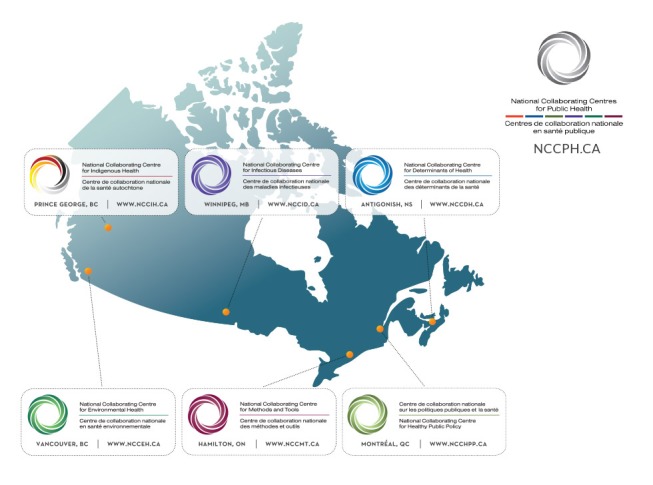
Although evidence-informed decision-making is fundamental to public health, it is challenging in practice as there is a continual burgeoning of both evidence and emerging issues, which public health professionals need to address at local, regional and national levels. One way that Canada has addressed this perennial challenge is through its six National Collaborating Centres (NCCs). The NCCs for Public Health were created to promote and support the use of scientific research and other knowledge to strengthen public health practice, programs and policies in Canada. The NCCs identify knowledge gaps, foster networks across sectors and jurisdictions and provide the public health system with an array of evidence-informed resources and knowledge translation services. Each centre is hosted in academic or government organizations across Canada and focuses on a specific public health priority: Determinants of Health; Environmental Health; Healthy Public Policy; Indigenous Health; Infectious Diseases; and Knowledge Translation Methods and Tools. Since their launch in 2005, the NCCs have undergone two federal evaluations, the results of which clearly demonstrate their significant contribution to evidence-informed decision-making in public health in Canada, while identifying some opportunities for future growth. The NCCs successfully help to bridge the gaps between evidence, policy and practice and facilitate the implementation of evidence in multiple, often complex, settings.
Keywords: Public health; determinants of health; evidence-informed decision-making; evidence-informed practice; health equity; knowledge synthesis; knowledge translation; networks.
Conflict of interest statement
Conflict of interest: None.
Figures
References
-
- Peters DH, Tran NT, Adam T. Implementation Research in Health: A Practical Guide. Alliance for Health Policy and Systems Research, World Health Organization. Geneva (CH): WHO; 2013. http://www.who.int/iris/bitstream/10665/91758/1/9789241506212_eng.pdf?ua=1
-
- National Collaborating Centres for Public Health. About Us (Accessed 2020-01-02). https://nccph.ca/about-us/