Effect of helical kink in antimicrobial peptides on membrane pore formation
- PMID: 32167466
- PMCID: PMC7069690
- DOI: 10.7554/eLife.47946
Effect of helical kink in antimicrobial peptides on membrane pore formation
Abstract
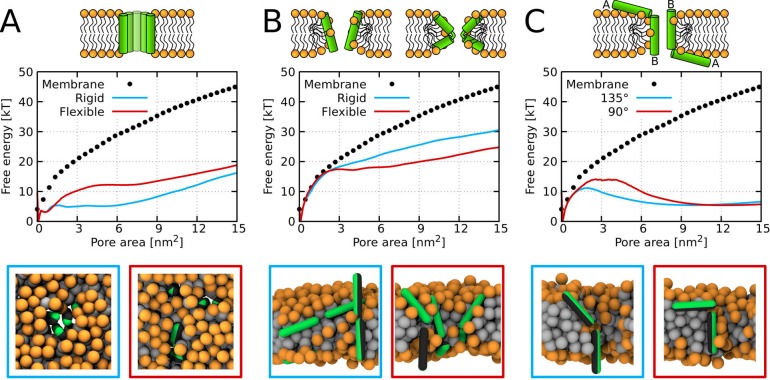
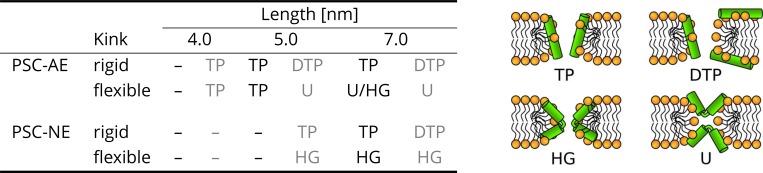
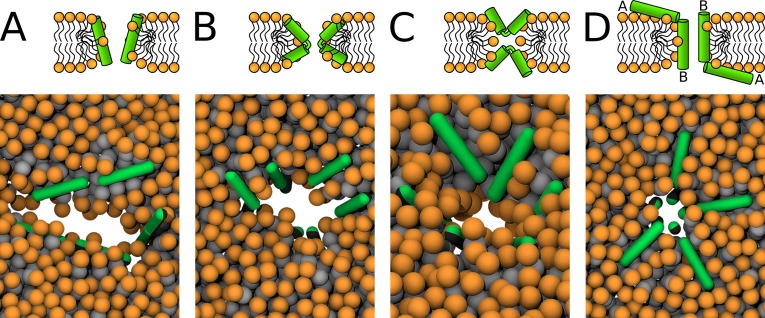
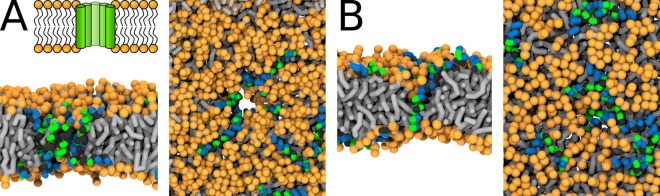
Every cell is protected by a semipermeable membrane. Peptides with the right properties, for example Antimicrobial peptides (AMPs), can disrupt this protective barrier by formation of leaky pores. Unfortunately, matching peptide properties with their ability to selectively form pores in bacterial membranes remains elusive. In particular, the proline/glycine kink in helical peptides was reported to both increase and decrease antimicrobial activity. We used computer simulations and fluorescence experiments to show that a kink in helices affects the formation of membrane pores by stabilizing toroidal pores but disrupting barrel-stave pores. The position of the proline/glycine kink in the sequence further controls the specific structure of toroidal pore. Moreover, we demonstrate that two helical peptides can form a kink-like connection with similar behavior as one long helical peptide with a kink. The provided molecular-level insight can be utilized for design and modification of pore-forming antibacterial peptides or toxins.
Keywords: antibiotics; fluorescent probes; membrane structure; membrane transport; molecular biophysics; none; structural biology.
© 2020, Tuerkova et al.
Conflict of interest statement
AT, IK, TK, LS, ŠP, MH, RV No competing interests declared
Figures
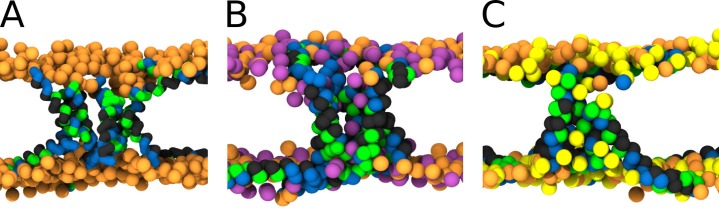
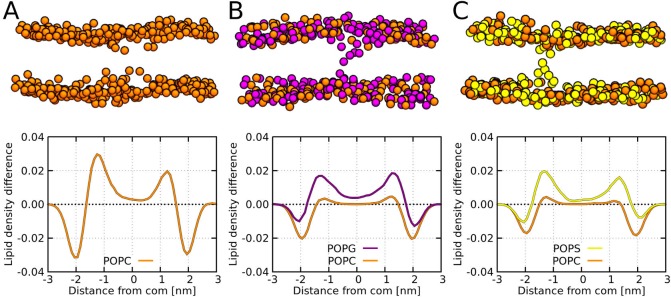
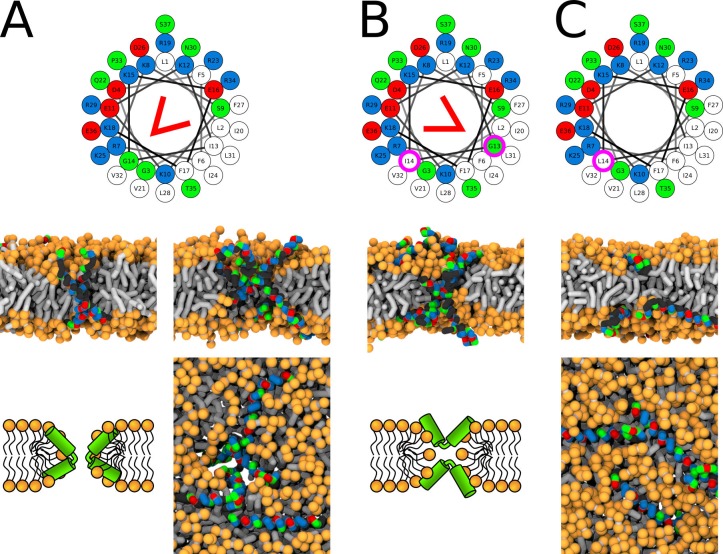
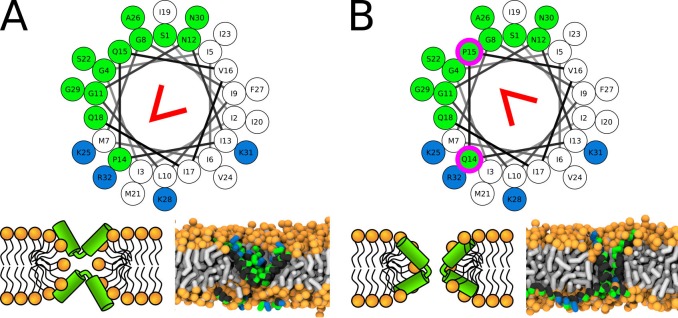

References
-
- Abraham MJ, Murtola T, Schulz R, Páll S, Smith JC, Hess B, Lindahl E. GROMACS: high performance molecular simulations through multi-level parallelism from laptops to supercomputers. SoftwareX. 2015;1-2:19–25. doi: 10.1016/j.softx.2015.06.001. - DOI
-
- Alouf JE, Dufourcq J, Siffert O, Thiaudiere E, Geoffroy C. Interaction of staphylococcal delta-toxin and synthetic analogues with erythrocytes and phospholipid vesicles. biological and physical properties of the amphipathic peptides. European Journal of Biochemistry. 1989;183:381–390. doi: 10.1111/j.1432-1033.1989.tb14939.x. - DOI - PubMed
-
- Amos ST, Vermeer LS, Ferguson PM, Kozlowska J, Davy M, Bui TT, Drake AF, Lorenz CD, Mason AJ. Antimicrobial peptide potency is facilitated by greater conformational flexibility when binding to Gram-negative bacterial inner membranes. Scientific Reports. 2016;6:37639. doi: 10.1038/srep37639. - DOI - PMC - PubMed
Publication types
MeSH terms
Substances
Grants and funding
LinkOut - more resources
Full Text Sources
Other Literature Sources