


Regional and Racial-Ethnic Differences in Perinatal Interventions Among Periviable Births
- PMID: 32168210
- PMCID: PMC7103505
- DOI: 10.1097/AOG.0000000000003747
Regional and Racial-Ethnic Differences in Perinatal Interventions Among Periviable Births
Abstract
Objective: To examine whether there are: 1) regional differences in three perinatal interventions that reflect active treatment among periviable gestations and 2) racial-ethnic differences in the receipt of these perinatal interventions after accounting for hospital region.
Methods: We conducted a retrospective study on neonates born at 776 U.S. centers that participated in the Vermont Oxford Network (2006-2017) with a gestational age of 22-25 weeks. The primary outcome was postnatal life support. Secondary outcomes included maternal administration of antenatal corticosteroids and cesarean delivery. We examined rates and 99% CI of the three outcomes by region. We also calculated the adjusted relative risks (aRRs) and 99% CIs for the three outcomes by race and ethnicity within each region using modified Poisson regression models with robust variance estimation.
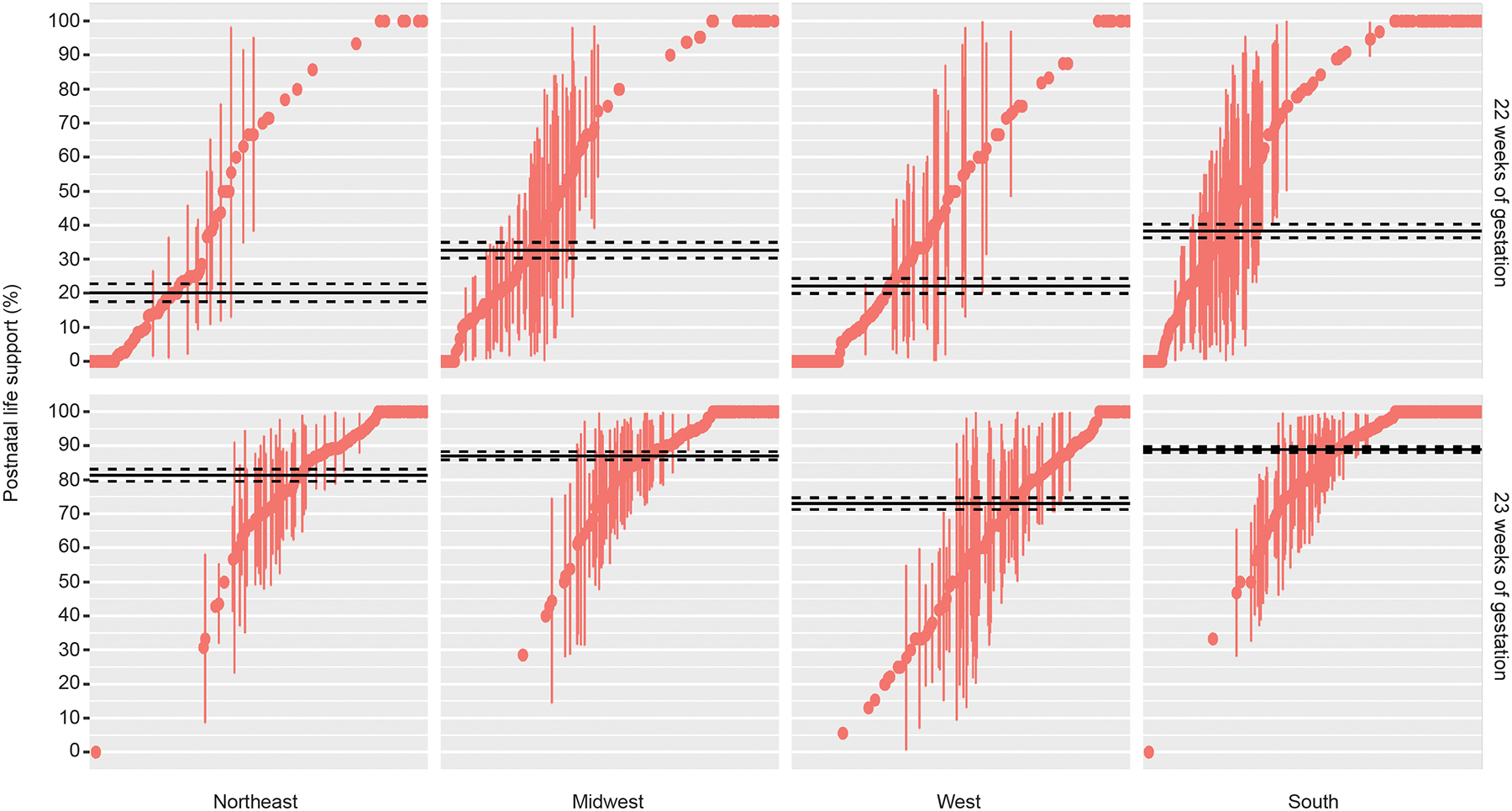
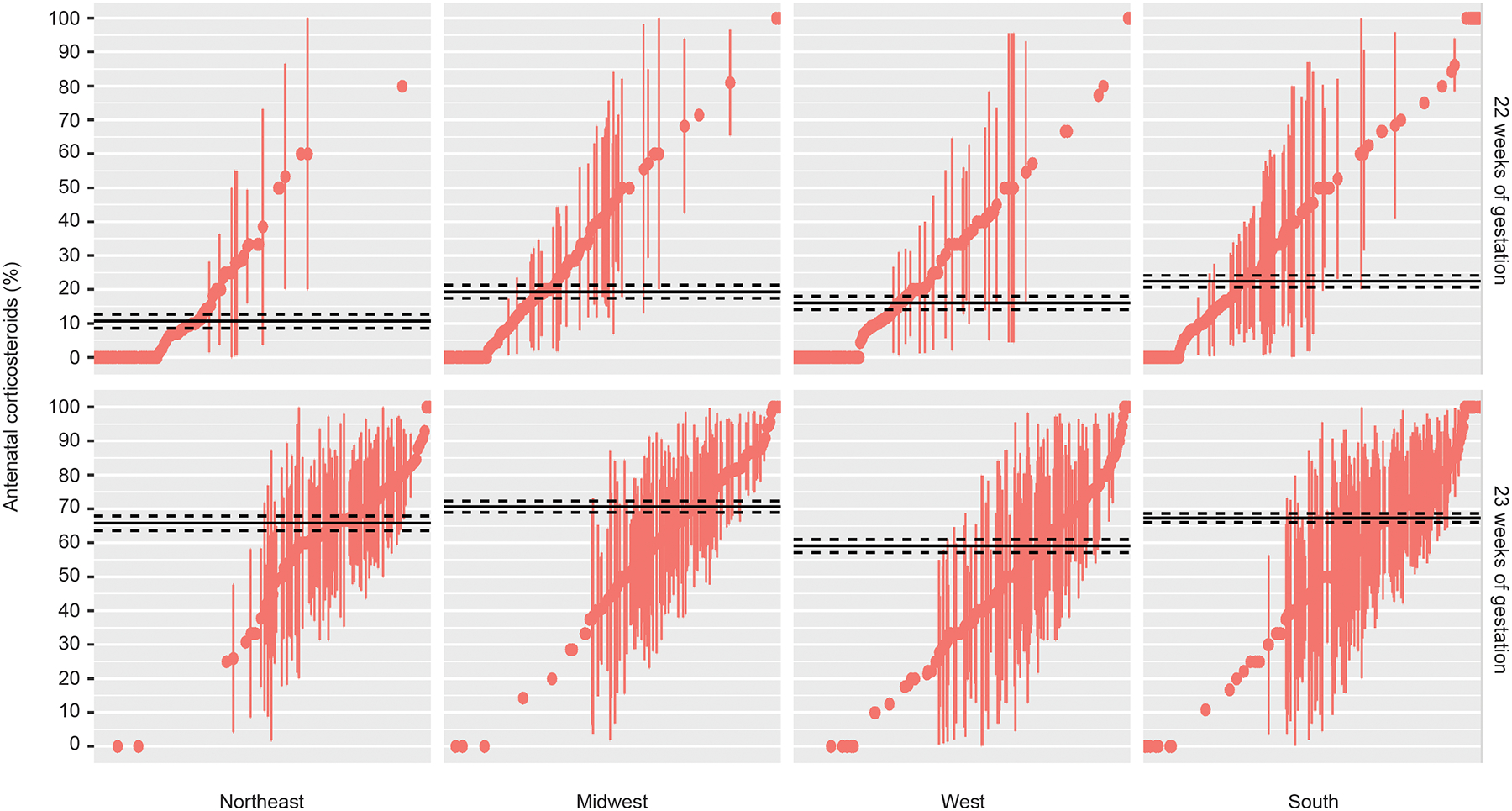
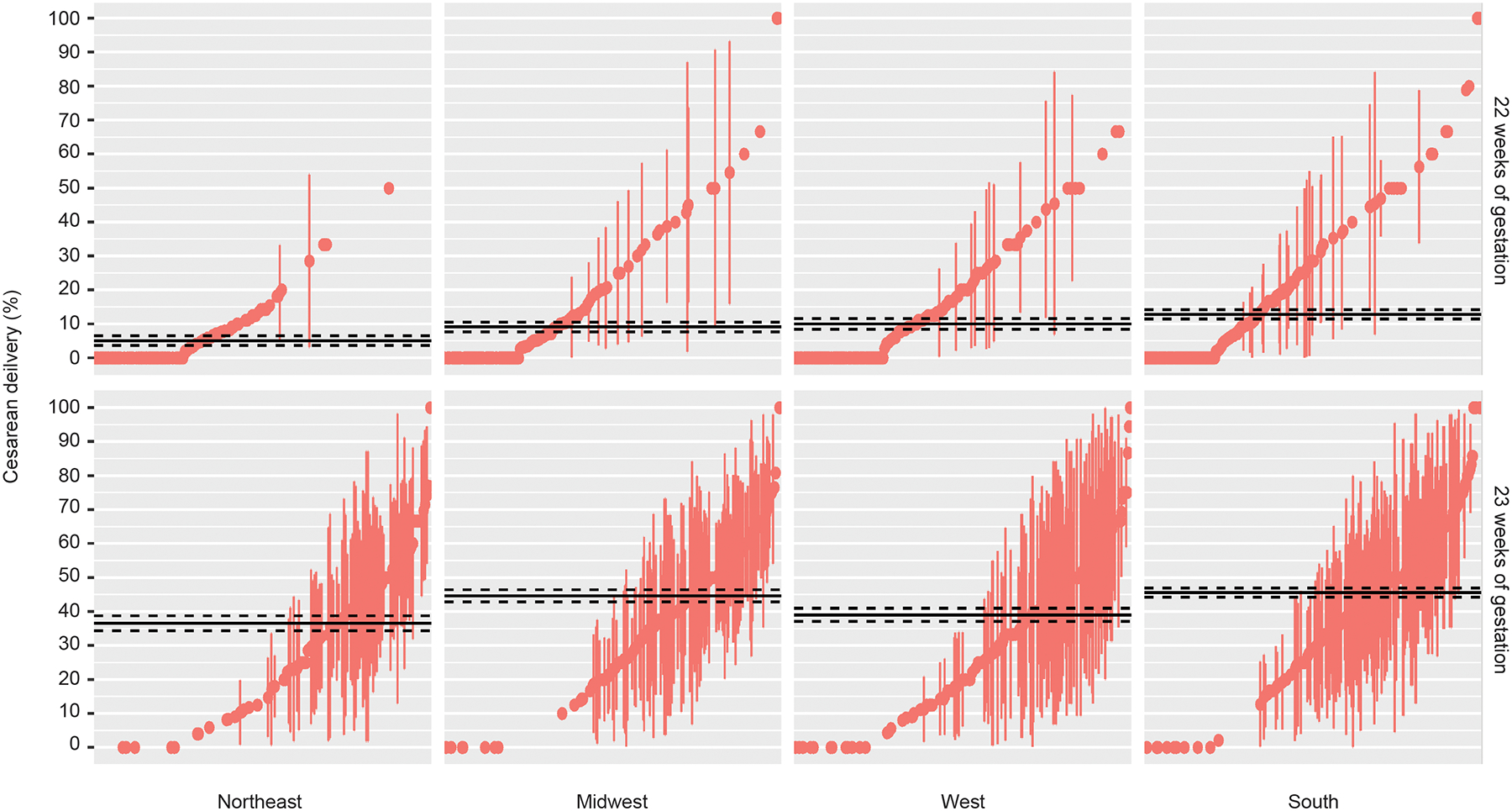
Results: Major regional variation exists in the use of the three interventions at 22 and 23 weeks of gestation but not at 24 and 25 weeks. For example, at 22 weeks of gestation, rates of life support in the South (38.3%; 99% CI 36.3-40.2) and the Midwest (32.7%; 99% CI 30.4-35.0) were higher than in the Northeast (20.2%; 99% CI 17.6-22.8) and the West (22.2%; 99% CI 20.0-24.4). Particularly in the Northeast, black and Hispanic neonates born at 22 or 23 weeks of gestation had a higher provision of postnatal life support than white neonates (at 22 weeks: black: aRR 1.84 [99% CI 1.33-2.56], Hispanic: aRR 1.80 [1.23-2.64]; at 23 weeks: black: aRR 1.14 [99% CI 1.08-1.20], Hispanic: aRR 1.12 [1.05-1.19]). In the West, black and Hispanic neonates born at 23 weeks of gestation also had a higher provision of life support (black: aRR 1.11 [99% CI 1.03-1.19]; Hispanic: aRR 1.10 [1.04-1.16]).
Conclusion: Major regional variation exists in perinatal interventions when managing 22- and 23-week neonates. In the Northeast and the West regions, minority neonates born at 22 and 23 weeks of gestation had higher provision of postnatal life support.
Figures
References
-
- Mercurio MR. The ethics of newborn resuscitation. Semin Perinatol. 2009;33:354–363. - PubMed
-
- Dupont-Thibodeau A, Barrington KJ, Farlow B, Janvier A. End-of-life decisions for extremely low-gestational-age infants: why simple rules for complicated decisions should be avoided. Semin Perinatol. 2014;38:31–37. - PubMed
-
- Brunkhorst J, Weiner J, Lantos J. Infants of borderline viability: the ethics of delivery room care. Semin Fetal Neonatal Med. 2014;19:290–295. - PubMed
-
- Raju TN, Mercer BM, Burchfield DJ, Joseph GF Jr. Periviable birth: executive summary of a joint workshop by the Eunice Kennedy Shriver National Institute of Child Health and Human Development, Society for Maternal-Fetal Medicine, American Academy of Pediatrics, and American College of Obstetricians and Gynecologists. Am J Obstet Gynecol. 2014;210:406–417. - PubMed
-
- Ecker JL, Kaimal A, Mercer BM, Blackwell SC, deRegnier RA, Farrell RM, et al. Periviable birth: Interim update. Am J Obstet Gynecol. 2016;215:B2–B12. - PubMed
Publication types
MeSH terms
Grants and funding
LinkOut - more resources
Full Text Sources
Medical
