


Biobased Materials from Microbial Biomass and Its Derivatives
- PMID: 32168751
- PMCID: PMC7143539
- DOI: 10.3390/ma13061263
Biobased Materials from Microbial Biomass and Its Derivatives
Abstract
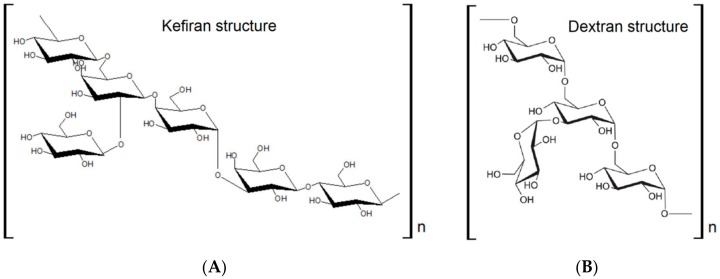
There is a strong public concern about plastic waste, which promotes the development of new biobased materials. The benefit of using microbial biomass for new developments is that it is a completely renewable source of polymers, which is not limited to climate conditions or may cause deforestation, as biopolymers come from vegetal biomass. The present review is focused on the use of microbial biomass and its derivatives as sources of biopolymers to form new materials. Yeast and fungal biomass are low-cost and abundant sources of biopolymers with high promising properties for the development of biodegradable materials, while milk and water kefir grains, composed by kefiran and dextran, respectively, produce films with very good optical and mechanical properties. The reasons for considering microbial cellulose as an attractive biobased material are the conformational structure and enhanced properties compared to plant cellulose. Kombucha tea, a probiotic fermented sparkling beverage, produces a floating membrane that has been identified as bacterial cellulose as a side stream during this fermentation. The results shown in this review demonstrated the good performance of microbial biomass to form new materials, with enhanced functional properties for different applications.
Keywords: bacterial cellulose; biobased materials; biopolymer resources; fungal biomass; kombucha; microbial biomass; milk kefir grains; water kefir grains; yeast biomass.
Conflict of interest statement
The authors declare no conflict of interest.
Figures
References
-
- Nakajima H., Dijkstra P., Loos K. The recent developments in biobased polymers toward general and engineering applications: Polymers that are upgraded from biodegradable polymers, analogous to petroleum-derived polymers, and newly developed. Polymers. 2017;9:523. doi: 10.3390/polym9100523. - DOI - PMC - PubMed
-
- Domb A.J., Kost J., Wiseman D.M. Handbook of Biodegradable Polymers. Harwood Academic Publishers; London, UK: 1997.
-
- Mohsenzadeh A., Zamani A., Taherzadeh M.J. Bioethylene Production from Ethanol: A review and Techno-economical Evaluation. Chem. Bio Eng. Rev. 2017;4:75–91. doi: 10.1002/cben.201600025. - DOI
-
- Atabani A.E., Silitonga A.S., Badruddin I.A., Mahlia T.M.I., Masjuki H.H., Mekhilef S. A comprehensive review on biodiesel as an alternative energy resource and its characteristics. Renew. Sust. Energy Rev. 2012;16:2070–2093. doi: 10.1016/j.rser.2012.01.003. - DOI
-
- Kobayashi S., Müllen K. Encyclopedia of Polymeric Nanomaterials. Springer-Verlag; Berlin/Heidelberg, Germany: 2015. p. 2658.
Publication types
Grants and funding
- R&D program PUNQ 990/19/Universidad Nacional de Quilmes (UNQ, Argentina)
- PICT-2015-3150/Agencia Nacional de Promoción Científica y Tecnológica (Argentina)
- Resol-2018-621-GDEBA-CICMCTI Ref. RI-2157-888-18 (Scholarship)/Scientific Research Commission (CIC), Buenos Aires, Argentina
- RESOL-2018-2703-APN-DIR#CONICET and Res. 4845/2014/National Scientific and Technical Research Council (CONICET)
LinkOut - more resources
Full Text Sources
