Review
. 2020 Mar 11;9(3):761.
doi: 10.3390/jcm9030761.

Primary Open Angle Glaucoma and Vascular Risk Factors: A Review of Population Based Studies from 1990 to 2019

Affiliations
Review

Primary Open Angle Glaucoma and Vascular Risk Factors: A Review of Population Based Studies from 1990 to 2019

Andrzej Grzybowski et al. J Clin Med. .

Abstract

Glaucoma is one of the leading causes of blindness worldwide, and as the proportion of those over age 40 increases, so will the prevalence of glaucoma. The pathogenesis of primary open angle glaucoma (POAG) is unclear and multiple ocular risk factors have been proposed, including intraocular pressure, ocular perfusion pressure, ocular blood flow, myopia, central corneal thickness, and optic disc hemorrhages. The purpose of this review was to analyze the association between systemic vascular risk factors (including hypertension, diabetes, age, and migraine) and POAG, based on major epidemiological studies. Reports presenting the association between POAG and systemic vascular risk factors included a total of over 50,000 patients. Several epidemiological studies confirmed the importance of vascular risk factors, particularly hypertension and blood pressure dipping, in the pathogenesis and progression of glaucomatous optic neuropathy. We found that diabetes mellitus is associated with elevated intraocular pressure, but has no clear association with POAG. No significant correlation between migraine and POAG was found, however, the definition of migraine varied between studies.

Keywords: diabetes; hypertension; migraine; population based study; primary open angle glaucoma.


Conflict of interest statement

The authors report no commercial or proprietary interest in any product or concept discussed in this article. Grzybowski reports grants, personal fees, and non-financial support from Bayer; grants, non-financial support from Novartis; non-financial support from Alcon; personal fees and non-financial support from Valeant; grants and non-financial support from Allergan; grants and non-financial support from Pfizer; grants and financial support from Santen. Och has nothing to disclose. Kanclerz reports non-financial support from Visim. No conflicting relationship exists for any author. Leffler and De Moraes has nothing to disclose.

Figures
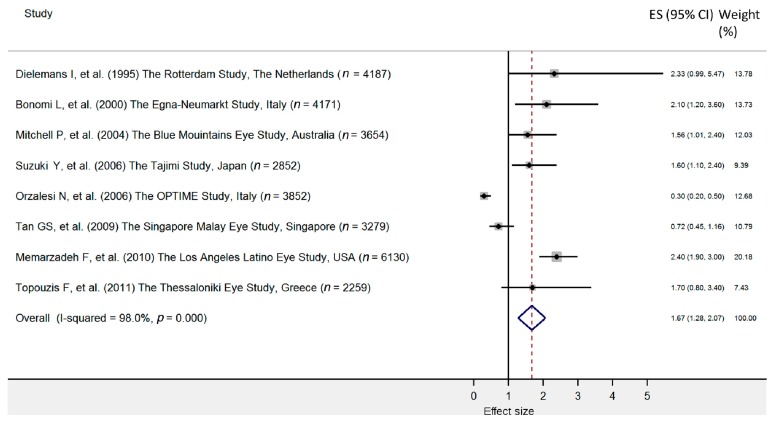
Figure 1
Figure 1
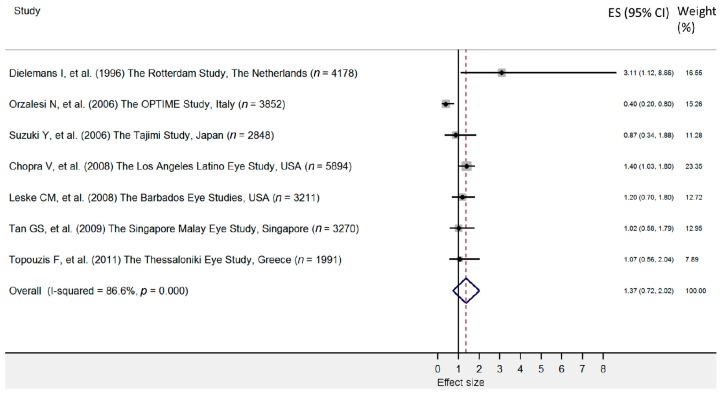
Forest plot of cohort studies that evaluated arterial hypertension as a risk factor for primary open angle glaucoma. The effect size (square, with size proportional to the weights used) and 95% confidence intervals (horizontal lines) is presented for each study. The overall measure revealed by pooled analysis is marked with the center of the diamond, while the associated confidence intervals are indicated by the lateral tips of the diamond [31,33,35,40,42,46,49,50].
Figure 2
Figure 2
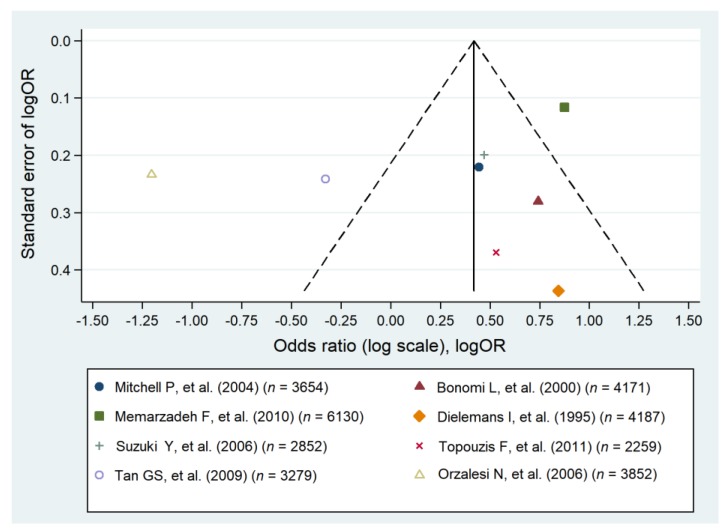
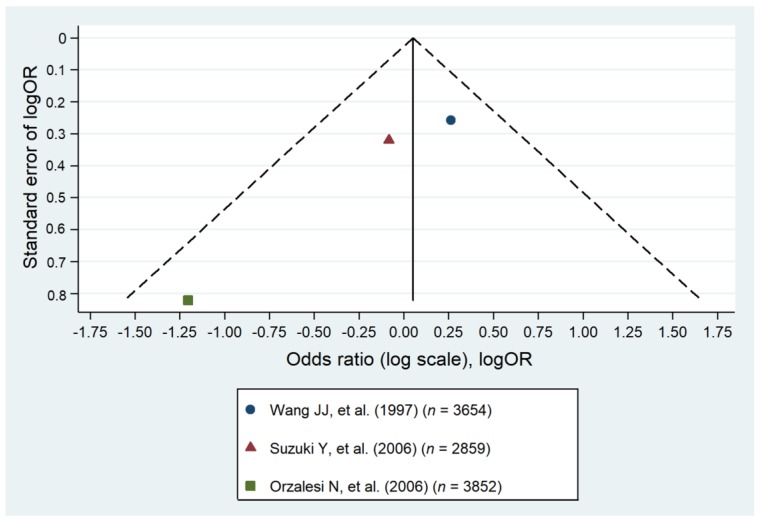
Funnel plot of cohort studies that evaluated arterial hypertension as a risk factor for primary open angle glaucoma [31,33,35,40,42,46,49,50].
Figure 3
Figure 3
Forest plot of cohort studies that evaluated diabetes as a risk factor for primary open angle glaucoma. The effect size (square, with size proportional to weights used) and 95% confidence intervals (horizontal lines) is presented for each study. The overall measure revealed by pooled analysis is marked with the center of the diamond, while the associated confidence intervals are marked by lateral tips of diamond [31,32,34,42,46,49,51].
Figure 4
Figure 4
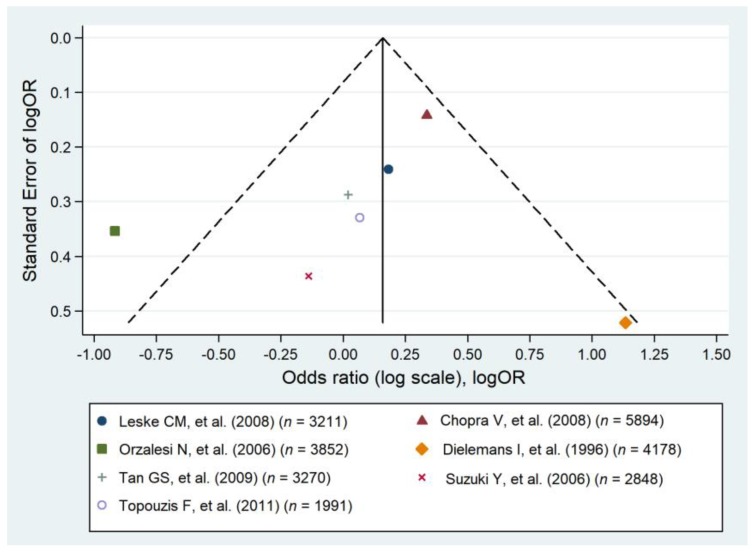
Funnel plot of cohort studies that evaluated diabetes as a risk factor for primary open angle glaucoma [31,32,34,42,46,49,51].
Figure 5
Figure 5
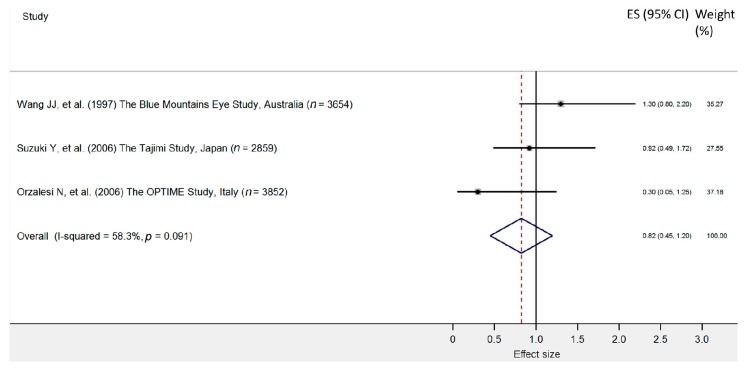
Forest plot of cohort studies that evaluated migraine as a risk factor for primary open angle glaucoma. The effect size (square, with size proportional to weights used) and 95% confidence intervals (horizontal lines) is presented for each study. The overall measure revealed by pooled analysis is marked with the center of the diamond, while the associated confidence intervals are marked by the lateral tips of the diamond [11,31,49].
Figure 6
Figure 6
Forest plot of the cohort studies that evaluated migraine as a risk factor for the primary open angle glaucoma [11,31,49].
Figure 7
Figure 7
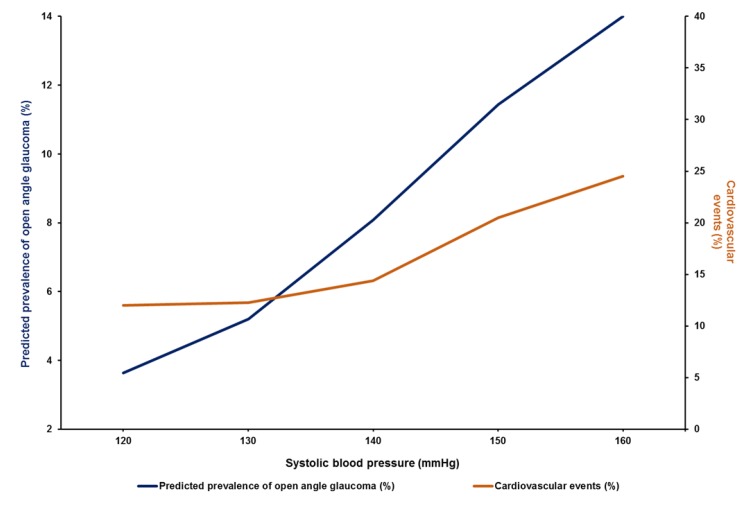
The relationship between SBP and the predicted prevalence of primary open angle glaucoma (POAG) in participants in the Los Angeles Latino Eye Study and cardiovascular events in the Ontarget study [50,73].
Figure 8
Figure 8
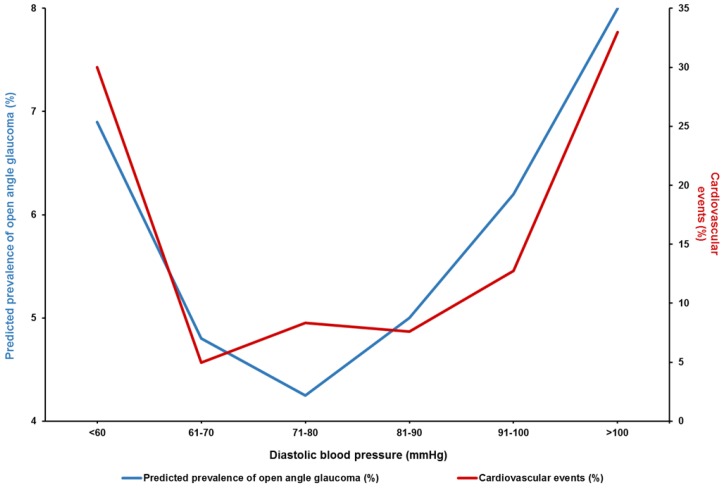
The relationship between diastolic BP (DBP) and the predicted prevalence of POAG in participants of the Los Angeles Latino Eye Study and cardiovascular events in the TNT study [50,74].

References

    1. Quigley H.A. Number of people with glaucoma worldwide. Am. J. Ophthalmol. 1996;122:460. doi: 10.1016/S0002-9394(14)72088-4. - DOI - PMC - PubMed
    1. Quigley H.A., Broman A.T. The number of people with glaucoma worldwide in 2010 and 2020. Br. J. Ophthalmol. 2006;90:262–267. doi: 10.1136/bjo.2005.081224. - DOI - PMC - PubMed
    1. Weinreb R.N., Khaw P.T. Primary open-angle glaucoma. Lancet. 2004;363:1711–1720. doi: 10.1016/S0140-6736(04)16257-0. - DOI - PubMed
    1. Tatham A.J., Weinreb R.N., Zangwill L.M., Liebmann J.M., Girkin C.A., Medeiros F.A. The relationship between cup-to-disc ratio and estimated number of retinal ganglion cells. Investig. Ophthalmol. Vis. Sci. 2013;54:3205–3214. doi: 10.1167/iovs.12-11467. - DOI - PMC - PubMed
    1. EGS Foundation European Glaucoma Society Terminology and Guidelines for Glaucoma, 4th Edition—Part 1. Supported by the EGS Foundation. Br. J. Ophthalmol. 2017;101:1–72. doi: 10.1136/bjophthalmol-2016-EGSguideline.001. - DOI - PMC - PubMed

LinkOut - more resources