


Gastrointestinal mixed adenoneuroendocrine carcinoma: a population level analysis of epidemiological trends
- PMID: 32169074
- PMCID: PMC7071749
- DOI: 10.1186/s12967-020-02293-0
Gastrointestinal mixed adenoneuroendocrine carcinoma: a population level analysis of epidemiological trends
Abstract
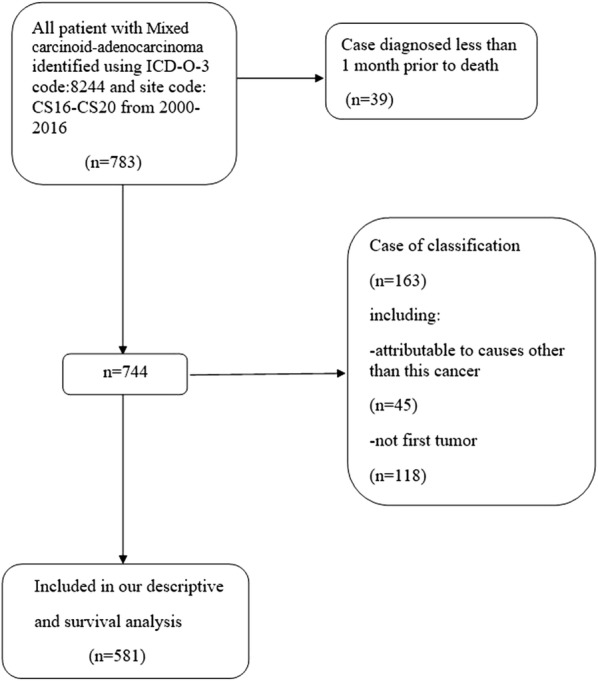
Background: The rise in incidence and mortality of gastrointestinal mixed adenoneuroendocrine carcinoma (MANEC) has not been well focused. The aim of our study was to examine epidemiological trends in incidence and incidence-based (IB) mortality of gastrointestinal MANEC at a population level.
Methods: The incidence and IB mortality of gastrointestinal MANEC as well as data on affected patients from 2000 to 2016 were obtained from the Surveillance, Epidemiology, and End Results database. Trends in incidence and IB mortality were assessed using Joinpoint regression. The Kaplan-Meier method and log-rank test were used for survival analysis. Cox proportional hazards regression was used to identify independent predictors of mortality.
Results: 581 patients diagnosed with gastrointestinal MANEC were enrolled. Gastrointestinal MANEC incidence was 0.23 cases per 1,000,000 individuals in 2000 and 1.16 cases per 1,000,000 individuals in 2016, with an annual percent change (APC) of 8.0% (95% CI 5.7-10.3%, P < 0.05). IB mortality also showed a sustained increase (APC 12.9%, 95% CI 9.0-16.8%, P < 0.05). In Cox regression analysis, age at diagnosis, tumor grade and stage, lymph node metastasis, surgery, and tumor size were independently associated with mortality. Median survival was 75 months (95% CI 60-128 months). Median survival of appendiceal MANEC was significantly longer than that of cecal MANEC (115 vs. 31 months; P < 0.001).
Conclusions: We found a sustained and rapid increase both in incidence and IB mortality of gastrointestinal MANEC, manifesting that there has been no significant improvement in patient outcomes, nor progress in prevention and treatment. Additional resources should be devoted to gastrointestinal MANEC research.
Keywords: Annual percent change (APC); Epidemiology; Gastrointestinal mixed adenoneuroendocrine carcinoma (MANEC); Prognosis; Trend.
Conflict of interest statement
The authors declare that they have no competing interests.
Figures


References
-
- Rindi G, Arnold R, Bosman F. Nomenclature and classification of neuroendocrine neoplasms of the digestive system. WHO classification of tumours of the digestive system; 2010, p. 13–14.
-
- Cordier R. Les cellules argentaffines dans les tumeurs intestinales. Arch Int Med Exp. 1924;1:59–63.
Publication types
MeSH terms
LinkOut - more resources
Full Text Sources
