


Quality of life in patients with severe mental illness: a cross-sectional survey in an integrated outpatient health care model
- PMID: 32170584
- PMCID: PMC7363717
- DOI: 10.1007/s11136-020-02470-0
Quality of life in patients with severe mental illness: a cross-sectional survey in an integrated outpatient health care model
Abstract
Purpose: This study (a) assessed quality of life (QoL) in a patient sample with severe mental illness in an integrated psychiatric care (IC) programme in selected regions in Germany, (b) compared QoL among diagnostic groups and (c) identified socio-demographic, psychiatric anamnestic and clinical characteristics associated with QoL.
Methods: This cross-sectional study included severely mentally ill outpatients with substantial impairments in social functioning. Separate dimensions of QoL were assessed with the World Health Organisation's generic 26-item quality of life (WHOQOL-BREF) instrument. Descriptive analyses and analyses of variance (ANOVAs) were conducted for the overall sample as well as for diagnostic group.
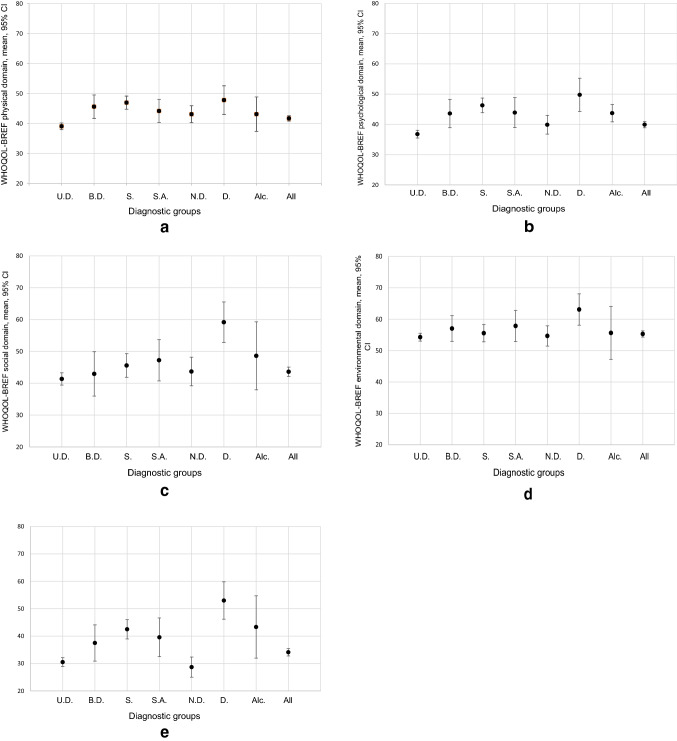
Results: A total of 953 patients fully completed the WHOQOL-BREF questionnaire. QoL in this sample was lower than in the general population (mean 34.1; 95% confidence interval (CI) 32.8 to 35.5), with the lowest QoL in unipolar depression patients (mean 30.5; 95% CI 28.9 to 32.2) and the highest in dementia patients (mean 53.0; 95% CI 47.5 to 58.5). Main psychiatric diagnosis, living situation (alone, partner/relatives, assisted), number of disease episodes, source of income, age and clinical global impression (CGI) scores were identified as potential predictors of QoL, but explained only a small part of the variation.
Conclusion: Aspects of health care that increase QoL despite the presence of a mental disorder are essential for severely mentally ill patients, as complete freedom from the disorder cannot be expected. QoL as a patient-centred outcome should be used as only one component among the recovery measures evaluating treatment outcomes in mental health care.
Keywords: Clinical global impression scale; Determinants; Integrated care; Quality of life; Severe mental disorder; WHOQOL-BREF questionnaire.
Figures
References
-
- Morton E, Michalak EE, Murray G. What does quality of life refer to in bipolar disorders research? A systematic review of the construct’s definition, usage and measurement. Journal of Affective Disorders. 2017;212:128–137. - PubMed
-
- Saarni SI, Viertio S, Perala J, Koskinen S, Lonnqvist J, Suvisaari J. Quality of life of people with schizophrenia, bipolar disorder and other psychotic disorders. British Journal ofPsychiatry. 2010;197(5):386–394. - PubMed
-
- Priebe S, Reininghaus U, McCabe R, Burns T, Eklund M, Hansson L, et al. Factors influencing subjective quality of life in patients with schizophrenia and other mental disorders: A pooled analysis. Schizophrenia Research. 2010;121(1–3):251–258. - PubMed
-
- Berlim MT, McGirr A, Fleck MP. Can sociodemographic and clinical variables predict the quality of life of outpatients with major depression? Psychiatry Research. 2008;160(3):364–371. - PubMed
-
- Trompenaars FJ, Masthoff ED, Van Heck GL, De Vries J, Hodiamont PP. Relationships between social functioning and quality of life in a population of Dutch adult psychiatric outpatients. International Journal of Social Psychiatry. 2007;53(1):36–47. - PubMed
MeSH terms
LinkOut - more resources
Full Text Sources
