. 2020 Mar 14;21(1):227.
doi: 10.1186/s12864-020-6510-7.

Brown marmorated stink bug, Halyomorpha halys (Stål), genome: putative underpinnings of polyphagy, insecticide resistance potential and biology of a top worldwide pest

Affiliations

Brown marmorated stink bug, Halyomorpha halys (Stål), genome: putative underpinnings of polyphagy, insecticide resistance potential and biology of a top worldwide pest

Michael E Sparks et al. BMC Genomics. .

Abstract

Background: Halyomorpha halys (Stål), the brown marmorated stink bug, is a highly invasive insect species due in part to its exceptionally high levels of polyphagy. This species is also a nuisance due to overwintering in human-made structures. It has caused significant agricultural losses in recent years along the Atlantic seaboard of North America and in continental Europe. Genomic resources will assist with determining the molecular basis for this species' feeding and habitat traits, defining potential targets for pest management strategies.

Results: Analysis of the 1.15-Gb draft genome assembly has identified a wide variety of genetic elements underpinning the biological characteristics of this formidable pest species, encompassing the roles of sensory functions, digestion, immunity, detoxification and development, all of which likely support H. halys' capacity for invasiveness. Many of the genes identified herein have potential for biomolecular pesticide applications.

Conclusions: Availability of the H. halys genome sequence will be useful for the development of environmentally friendly biomolecular pesticides to be applied in concert with more traditional, synthetic chemical-based controls.

Keywords: Brown marmorated stink bug genome; Pentatomid genomics; cathepsins; chemoreceptors; invasive species; odorant binding proteins; opsins; polyphagy; xenobiotic detoxification.


Conflict of interest statement

The authors declare that they have no competing interests. Mention of trade names or commercial products in this publication is solely for the purpose of providing specific information and does not imply recommendation or endorsement by the U.S. Department of Agriculture. The USDA is an equal opportunity provider and employer.

Figures
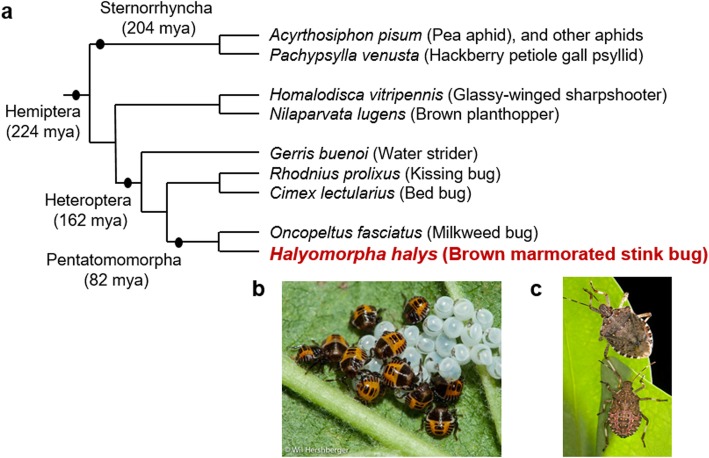
Fig. 1
Fig. 1
Genomic resources in the Hemiptera. a Phylogenetic relatedness of selected hemipterans with available full genomes (modified from [14], originally based on [15]). b H. halys nymphs, first instar, cluster around a mass of newly-hatched eggs on the underside of a leaf (photo from http://www.stopbmsb.org/ by W. Hershberger; used with permission). c Adult (top) and fifth-instar nymph (bottom).
Fig. 2
Fig. 2
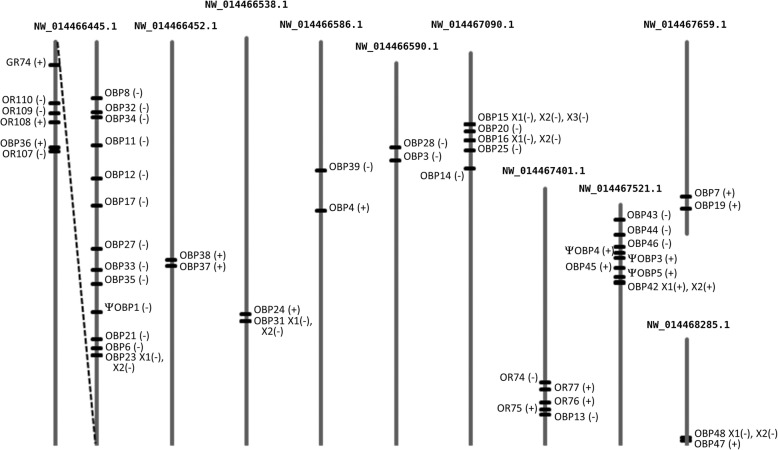
Locations of the OBP gene and pseudogene (Ψ) clusters in H. halys genome scaffolds. The location of each OBP gene is indicated by a horizontal line. Transcriptional directions are indicated by (+) for same direction as the scaffold or (-) for the opposite direction. NW_014466445.1 (2,775,865 bp) is the two terminal 750 k bp pieces, interconnected by a dashed line, which in one end has a cluster of OR genes with the gene obp36 entirely placed inside an OR gene intron. NW_014467401.1 (475,337 bp) illustrates the close proximity of obp13 to some OR genes. The 750 k bp terminal ends of scaffolds NW_014466452.1 (2,701,634 bp) and NW_014466586.1 (2,077,303 bp) are shown. The lengths of the other scaffolds are: NW_014466538.1 = 757,214 bp; NW_014466590.1 = 710,159 bp; NW_014467090.1 = 728,809 bp; NW_014467659.1 = 357,280 bp; and NW_014468285.1 = 196,245 bp. All scaffold representations are drawn to scale.
Fig. 3
Fig. 3
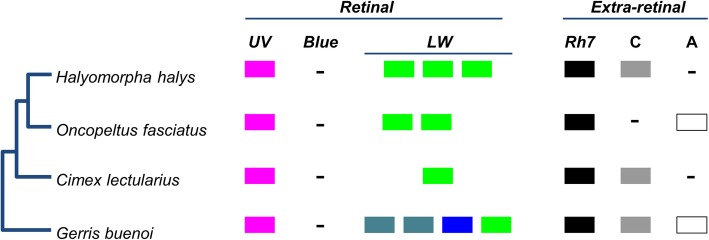
Opsin gene repertoire. Opsin gene family members detected in each of four heteropteran hemipterans surveyed is indicated [62]. C ~ ciliary opsins; A ~ arthropsins; as well as the four rhabdomeric opsins: UV ~ UV-sensitive, Blue ~ Blue-sensitive, LW ~ long wavelength-sensitive, and Rh7 ~ the Rh7 gene. Diverse LW opsin paralog colors indicate hypothesized wavelength-shifts based on [12].
Fig. 4
Fig. 4
Heteropteran long wave-sensitive opsin gene tree. Scale bar corresponds to 0.1 substitutions per amino acid site. Species abbreviations: Ahae ~ Acanthosoma haemorrhoidale, Ahil ~ Acrosternum hilare, Alin ~ Adelphocoris lineolatus, Acur ~ Anoplocnemis curvipes, Asut ~ Adelphocoris suturalis, Apil ~ Alydus pilosulus, Atri ~ Anasa tristis, Aaes ~ Aphelocheirus aestivalis, Afra ~ Aphelonotus fraterculus, Amel ~ Apis mellifera, Abet ~ Aradus betulae, Btri ~ Boisea trivittata, Clec ~ Cimex lectularius, Ccil ~ Corythucha ciliata, Gbue ~ Gerris buenoi, Hhal ~ Halyomorpha halys, Ifal ~ Ischnodemus falicus, Lcal ~ Largus californicus, Ltur ~ Lygaeus turcicus, Lhes ~ Lygus hesperus, Mcri ~ Megacopta cribraria, Mruf ~ Metatropis rufescens, Mgra ~ Mezira granulata, Mvic ~ Megoura viciae, Nsub ~ Nabicula subcoleoptrata, Ncin ~ Nephotettix cincticeps, Nvir ~ Nezara viridula, Nelo ~ Notostira elongata, Ofas ~ Oncopeltus fasciatus, Pcel ~ Pachypsylla celtidismamma, Pmac ~ Podisus maculiventris, Rped ~ Riptortus pedestris, Rorn ~ Reuteroscopus ornatus, Ssal ~ Saldula saltatoria, Tnot ~ Tupiocoris notatus, Tcas ~ Tribolium castaneum.
Fig. 5
Fig. 5
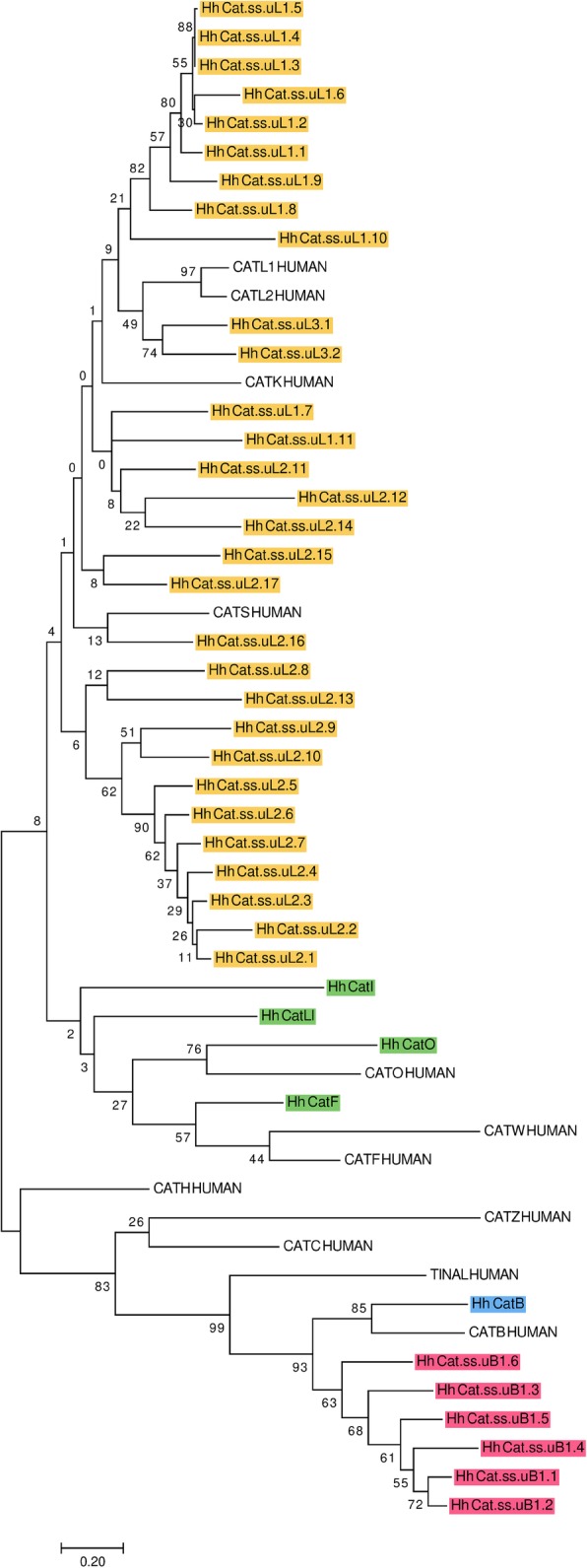
Phylogenetic tree of cysteine cathepsins. An analysis of predicted proteins from cysteine cathepsin genes annotated in the draft genome of H. halys was performed using MEGA7. The tree with the highest log likelihood is shown (-9596.54). The percentage of trees in which the associated taxa clustered together is indicated beside the branches. The tree is drawn to scale, with branch lengths measured in the number of substitutions per site. Cysteine cathepsins annotated in H. halys include those that are conserved in the cathepsin L-like subfamily (Hh CatF, Hh CatO, Hh CatI, Hh CatLl) in green and species-specific (Hh Cat ss.uLX.x) in yellow; cathepsin B ortholog (Hh CatB) in blue and species-specific cathepsin B-like (Hh Cat ss.uLX.x) in pink; and human cathepsins, which are marked according to UniProt IDs: L (CATL1_HUMAN, P07711), V (CATL2_HUMAN, O60911), F (CATF_HUMAN, Q9UBX1), O (CATO_HUMAN, P43234), H (CATH_HUMAN, P09668), K (CATK_HUMAN, P43235), S (CATS_HUMAN, P25774), W (CATW_HUMAN, P56202), Z (CATZ_HUMAN, Q9UBR2), B (CATB_HUMAN, P07858), C (CATC_HUMAN, P53634) and TINAL-like protein (TINAL_HUMAN, Q9GZM7). Correspondences between leaf node identifiers and NCBI protein sequences are indicated in Additional file 1: Table S14.
Fig. 6
Fig. 6
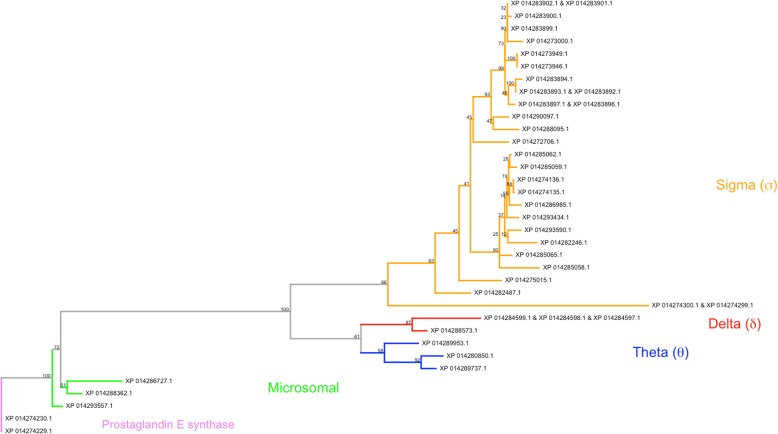
Phylogenetic tree of H. halys glutathione S-transferase (GST)-associated proteins. Contains, microsomal (green), theta (blue), delta (red) and sigma (orange) clades. Two prostaglandin E isoforms (purple) are used as outgroups to all GSTs. Uncolored leaves could not be assigned to family based on annotation. Bootstrap support (100 replicates) is indicated on nodes.
Fig. 7
Fig. 7
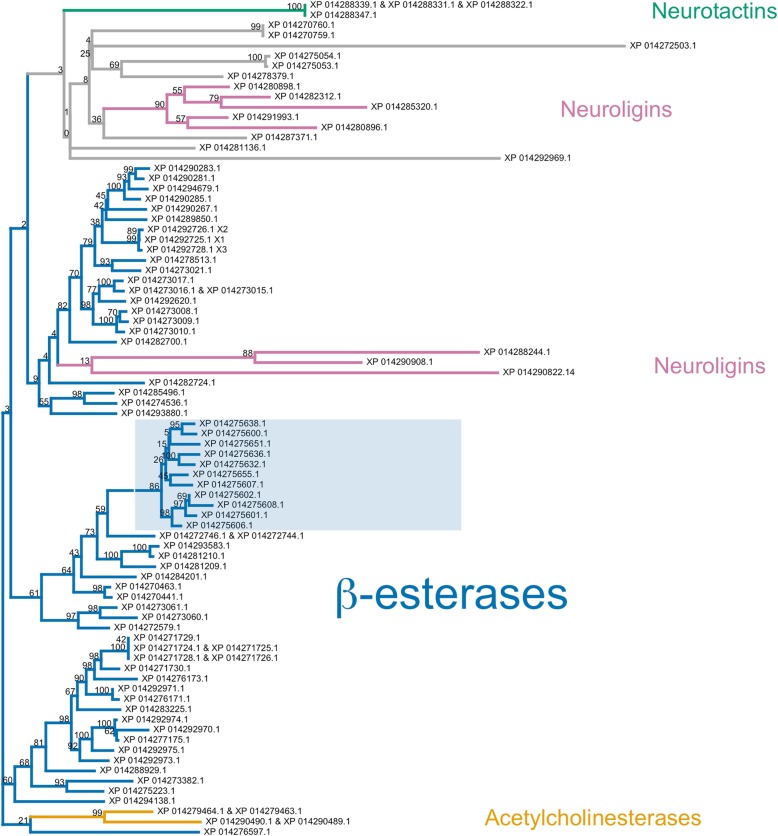
Phylogenetic tree of H. halys carboxylesterase-associated proteins. Contains β-esterases (blue), neuroligins (purple), acetylcholinesterases (orange) and neurotactins (green) groups. Uncolored leaves could not be assigned to family based on annotation. Shaded box represents the monophyletic grouping of the eleven indicated loci on Scaffold NW_014466677.1. Bootstrap support (100 replicates) is indicated on nodes.
Fig. 8
Fig. 8
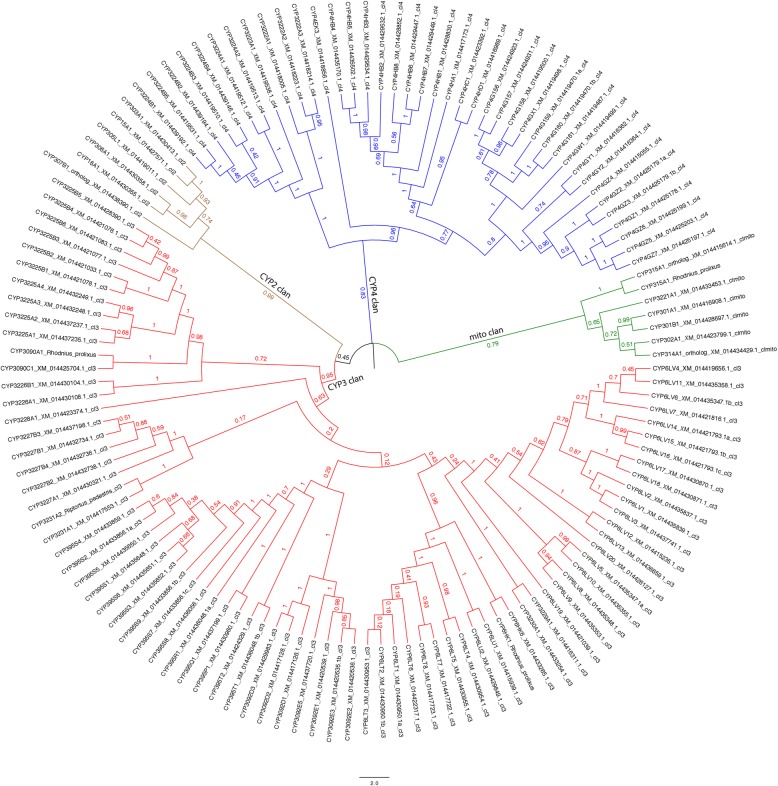
Phylogenetic tree of cytochrome P450s. MEGA X was used to phylogenetically analyze relatedness among cytochrome P450s in H. halys. The maximum likelihood tree (log likelihood = -87136.93) is shown. Branch lengths in this cladogram correspond to substitutions per site. The four cytochrome P450 clans are depicted as follows: brown ~ CYP2, red ~ CYP3, blue ~ CYP4 and green ~ mito

References

    1. Faúndez EI, Rider DA. The brown marmorated stink bug Halyomorpha halys (Stål, 1855) (Heteroptera: Pentatomidae) in Chile. Arquivos Entomolóxicos. 2017;17:305–307.
    1. Brown marmorated stink bug. Available from: https://www.outbreak.gov.au/current-responses-to-outbreaks/brown-marmora....
    1. Sakai AK, Allendorf FW, Holt JS, Lodge DM, Molofsky J, With KA, et al. The population biology of invasive species. Annu Rev Ecol Syst. 2001;32:305–332. doi: 10.1146/annurev.ecolsys.32.081501.114037. - DOI
    1. Leskey TC, Nielsen AL. Impact of the invasive brown marmorated stink bug in North America and Europe: history, biology, ecology, and management. Annu Rev Entomol. 2018;63:599–618. doi: 10.1146/annurev-ento-020117-043226. - DOI - PubMed
    1. Koch RL, Pezzini DT, Michel AP, Hunt TE. Identification, biology, impacts, and management of stink bugs (Hemiptera: Heteroptera: Pentatomidae) of soybean and corn in the Midwestern United States. J Integr Pest Manag. 2017;8:1. doi: 10.1093/jipm/pmx004. - DOI

Substances