


Effect Modification of Sex and Age for the Hospital Volume-Outcome Relationship in Abdominal Aortic Aneurysm Treatment: Secondary Data Analysis of the Nationwide German Diagnosis Related Groups Statistics From 2005 to 2014
- PMID: 32172655
- PMCID: PMC7335519
- DOI: 10.1161/JAHA.119.014534
Effect Modification of Sex and Age for the Hospital Volume-Outcome Relationship in Abdominal Aortic Aneurysm Treatment: Secondary Data Analysis of the Nationwide German Diagnosis Related Groups Statistics From 2005 to 2014
Abstract
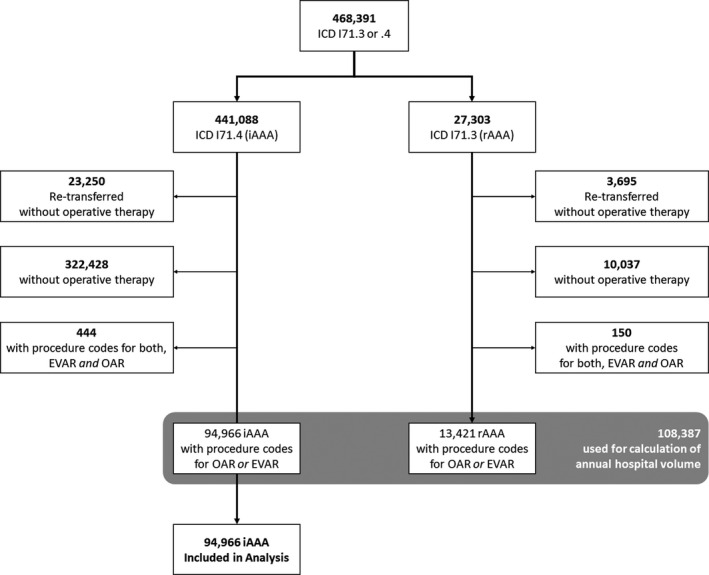
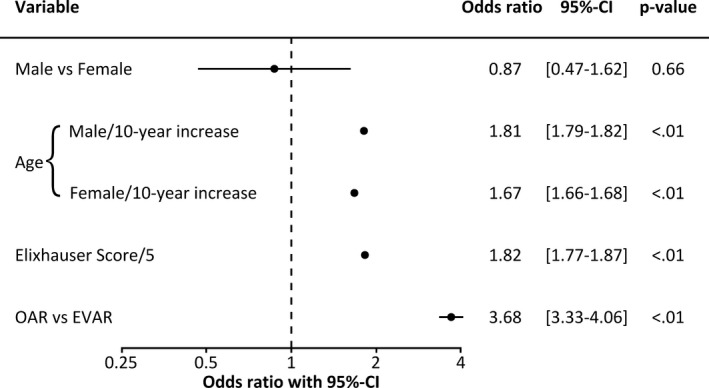
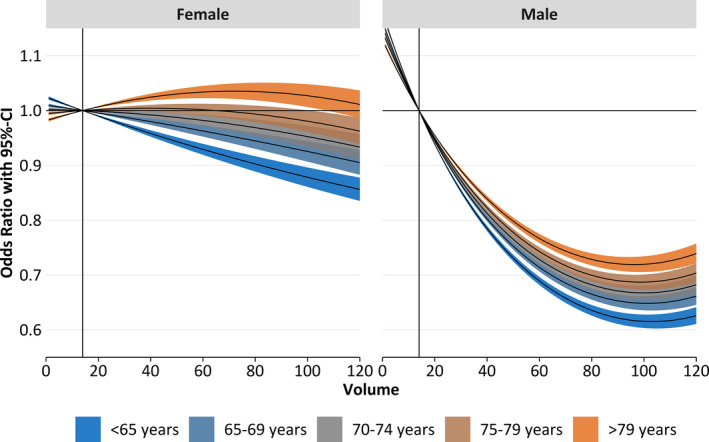
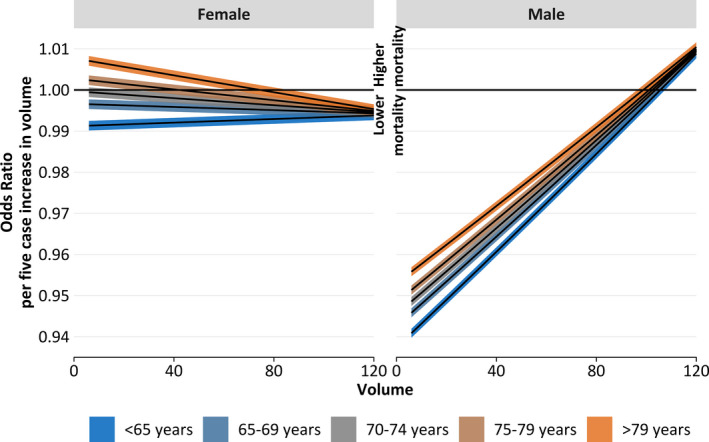
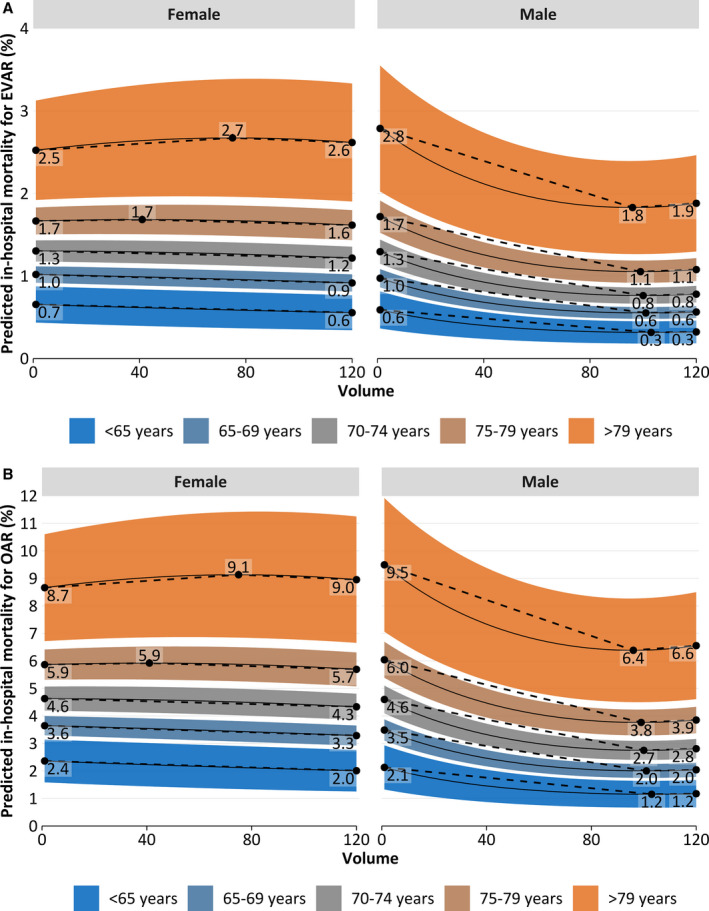
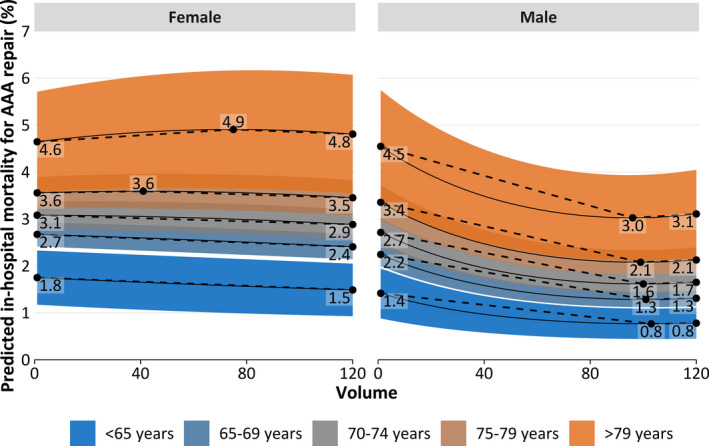
Background Trials and registries associated female sex and high age with unfavorable outcomes in abdominal aortic aneurysm treatment. Many studies showed an inverse correlation between annual hospital volume and in-hospital mortality. The volume-outcome relationship has not been investigated separately for women and men or across the age range. The aim was to analyze whether sex and age are effect modifiers or confounders of the volume-outcome association. Methods and Results In a nationwide setting, all in-hospital cases from 2005 to 2014 with a diagnosis of intact abdominal aortic aneurysm and procedure codes for endovascular or open aortic repair were included. Primary outcome was in-hospital mortality. Using a multilevel multivariable regression model, hospital volume was modeled as a continuous variable. Separate analyses were performed for women and men and for predefined age groups. A total of 94 966 cases were included (12% women; median age, 72 years). Mortality was 4.9% in women and 3.0% in men (3.2% overall). Mortality increased with age. Although there was no significant volume-outcome association in women (P=0.57), there was in men (P=0.02). The strongest volume-outcome association was found in younger men. The younger female subpopulation was found to show a trend for an inverse volume-outcome relationship, whereas an opposite association was found for the women aged >79 years. Conclusions Women have a higher mortality risk after elective abdominal aortic aneurysm treatment. Sex and age are modifiers of the volume-outcome relationship. Unlike in male patients, in women there is no consistent effect of hospital volume on outcome.
Keywords: endovascular aortic repair; hospital performance; hospital volume; in‐hospital mortality; secondary data analysis; sex differences; sex specific.
Figures
References
-
- Stoberock K, Kolbel T, Atlihan G, Debus ES, Tsilimparis N, Larena‐Avellaneda A, Behrendt CA, Wipper S. Gender differences in abdominal aortic aneurysm therapy—a systematic review. Vasa. 2018;47:267–271. - PubMed
-
- Hafez H. National Vascular Database analysis: the relationship between AAA repair volume and outcome. Br J Surg. 2012;99:4.
-
- Holt PJ, Karthikesalingam A, Hofman D, Poloniecki JD, Hinchliffe RJ, Loftus IM, Thompson MM. Provider volume and long‐term outcome after elective abdominal aortic aneurysm repair. Br J Surg. 2012;99:666–672. - PubMed
-
- Holt PJ, Poloniecki JD, Khalid U, Hinchliffe RJ, Loftus IM, Thompson MM. Effect of endovascular aneurysm repair on the volume‐outcome relationship in aneurysm repair. Circ Cardiovasc Qual Outcomes. 2009;2:624–632. - PubMed
-
- Holt PJ, Poloniecki JD, Loftus IM, Michaels JA, Thompson MM. Epidemiological study of the relationship between volume and outcome after abdominal aortic aneurysm surgery in the UK from 2000 to 2005. Br J Surg. 2007;94:441–448. - PubMed
Publication types
MeSH terms
LinkOut - more resources
Full Text Sources
